
Selling pressure continues across the cryptocurrency market following the Binance attack. Bitcoin has slipped toward $77,400, while approximately $1.59 billion in leveraged positions have been liquidated over the past 24 hours. BNB’s daily decline exceeded 5%; reports of institutional investors moving assets off centralized exchanges suggest security concerns have spread across the sector.
Following the overnight attack, attention shifted to how Binance would cover the losses and when withdrawals would resume. The exchange estimated the impact at approximately $6.3 billion, saying it had worked with partners to freeze roughly $3 billion of the affected assets.
Why is Bitcoin falling, and where do altcoins stand?
The security breach at Binance prompted investors to reassess the safety of assets held on exchanges. Suspended withdrawals and uncertainty over the scope of the attack weakened risk appetite.
Market data reviewed at the time of writing showed Bitcoin trading at $77,414.99, down 3.30% over the past 24 hours. Ethereum fell 3.58% to $2,235.55, while BNB dropped 5.32% to $700.59.
| Cryptocurrency | Price | 24-hour change |
Bitcoin (BTC) | $77,414.99 | −3.30% |
Ethereum (ETH) | $2,235.55 | −3.58% |
BNB | $700.59 | −5.32% |
XRP | $1.2481 | −3.06% |
Solana (SOL) | $96.59 | −3.39% |
Dogecoin (DOGE) | $0.07543 | −3.19% |
Solana remained below $100, while BNB suffered a sharper decline than several other major cryptocurrencies. Selling pressure, however, varied across assets.
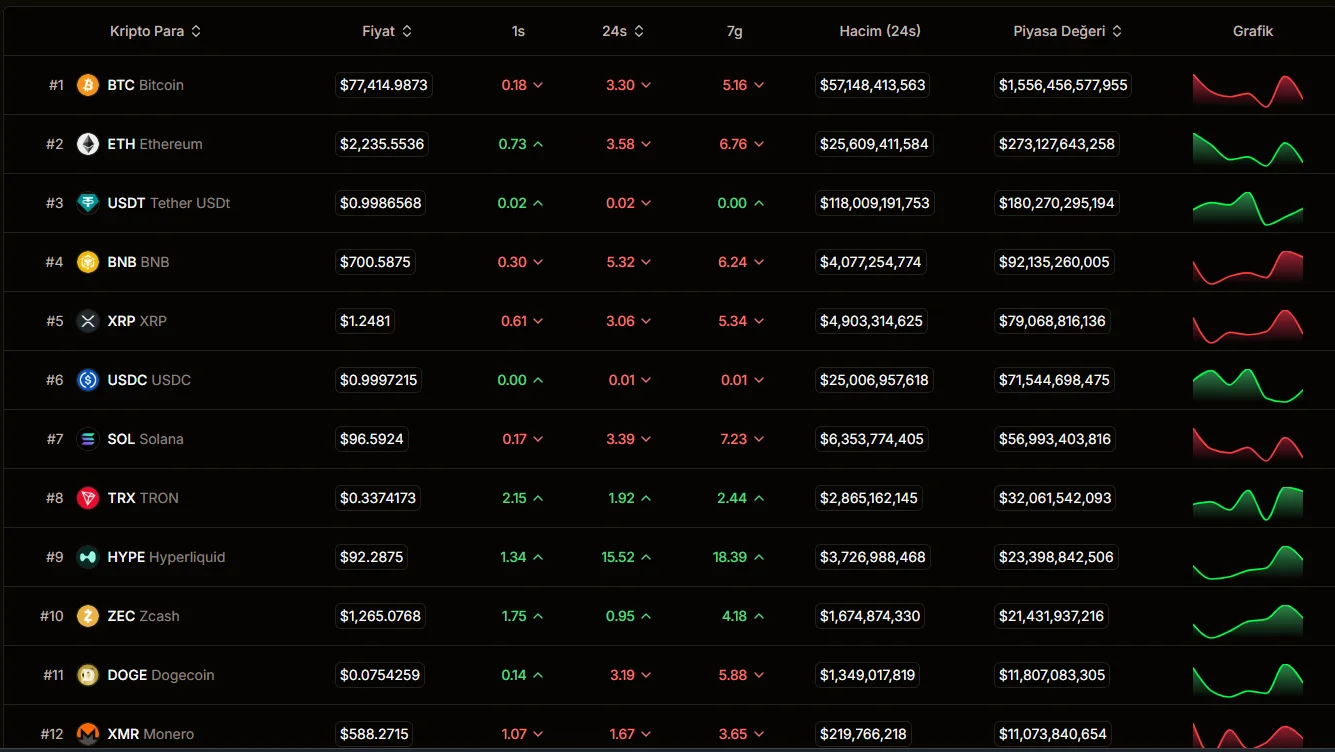
Hyperliquid’s HYPE token rose 15.52% to $92.29. TRON gained 1.92%, while Zcash advanced 0.95%. HYPE’s divergence from the broader market came as investors assessed the partnership announced by NYSE owner ICE and Trade.xyz to develop markets using Hyperliquid infrastructure. Project-specific developments continued to support some assets despite widespread security concerns.
Crypto liquidations reach $1.59 billion
The latest liquidation dashboard showed that positions worth $1,587,332,864 were forcibly closed over the past 24 hours. Long positions, which profit from rising prices, accounted for approximately $1.33 billion, while short positions accounted for $255.83 million.
Longs represented 83.88% of total liquidations. The breakdown shows that the sell-off hit traders using leverage to bet on higher prices particularly hard.
| Period | Total liquidations |
Last 24 hours | $1.587 billion |
Last 12 hours | $723.98 million |
Last 4 hours | $66.66 million |
Last 1 hour | $27.16 million |
In leveraged trading, platforms automatically close positions when adverse price moves leave traders with insufficient collateral. Liquidating long positions can generate additional selling pressure, allowing falling prices to trigger further liquidations.

Long positions also accounted for approximately $22.79 million of the $27.16 million liquidated in the latest hour. The most recent data therefore showed continued pressure on bullish trades.
The $1.59 billion figure represents the value of forcibly closed positions. Adding it to the $6.3 billion in assets affected by the attack would not provide an accurate measure of total losses.
Binance accounted for a substantial share of liquidations
The exchange-level table covers the latest 12 hours. During that period, Binance recorded approximately $344.87 million in liquidations, compared with $128.04 million on Hyperliquid and $89.13 million on Bybit.
Long positions accounted for 90.16% of liquidations on Binance. That share reached 93.80% on Bybit and 76.48% on Hyperliquid.
The figures show that price movements following the attack affected leveraged traders across multiple platforms. The 12-hour exchange figures should not be directly compared with the market-wide 24-hour total.
Did the attack leave a gap in Binance’s reserves?
Binance pledged to cover the losses using its SAFU security fund and company resources. Its commitment to honor customer balances and the condition of the reserves affected by the attack remain separate issues.
“Binance 14,” one of the affected wallets, appeared among the addresses backing customer assets in the exchange’s October 1 proof-of-reserves report. This indicates that the attacker accessed reserves supporting customer liabilities.
Calculations based on the early-October reserve figures suggest that the outflow of approximately 204,500 ETH could have reduced Ethereum backing from 100% to around 94%. However, that estimate relies on an earlier reserve snapshot rather than a current, comprehensive audit of post-attack assets.
The calculation does not mean that users received a 6% haircut on their account balances. Replacing the missing assets and demonstrating that through an updated reserve report will be crucial to resolving uncertainty over customer funds.
Has the frozen $3 billion been recovered?
Binance said approximately $3 billion in assets had been frozen on-chain. Freezing can prevent the attacker from moving or cashing out those assets; it does not mean all the funds have returned to the exchange.
Tether froze approximately $1.57 billion in assets, while Circle took action involving more than $800 million. Ripple also participated in efforts to freeze approximately $200 million.
The roughly 18,270 BTC taken by the attacker is subject to a separate tracing effort. Bitcoin lacks the centralized freezing mechanism available to stablecoin issuers, creating different challenges for recovery.
When will Binance withdrawals resume?
According to Binance’s latest service update, deposits are operating normally. Withdrawals remain temporarily suspended while the exchange upgrades security across its withdrawal infrastructure and associated addresses.
The exchange said it aims to begin restoring withdrawal services within 48 hours of its announcement. This is not a confirmed reopening time; restoration depends on the completion of security work.
The company’s preliminary findings suggest that a compromised employee computer may have served as the entry point. Binance said it had found no evidence of leaked wallet private keys and would release a detailed technical report once the investigation was complete.
Security concerns spread to other crypto exchanges
Reports following the attack indicated that institutional investors were moving assets off centralized exchanges and adjusting their trading portfolios. The total amount withdrawn and the destinations of those funds remain unclear.
Withdrawing assets from an exchange does not necessarily mean selling them. Investors can move the same holdings to another custody arrangement; nevertheless, a reduction in funds available on trading platforms matters for liquidity.
Operational effects have also emerged. India-based CoinDCX restricted the opening and expansion of futures positions because of a Binance-related liquidity disruption, while allowing users to reduce existing positions.
The platform said customer funds, deposits and withdrawals were unaffected.
Will selling pressure continue?
Geoffrey Kendrick, Standard Chartered’s Global Head of Digital Assets Research, said crypto prices could remain under pressure until more details of the attack emerge and the status of frozen funds becomes clearer. His assessment highlights the risks posed by uncertainty rather than establishing that prices will inevitably fall further.
The next concrete developments for the market will be Binance’s restoration of withdrawals, updated reserves and announcements on asset recovery. With longs accounting for approximately 84% of liquidations over the past 24 hours, bets on higher prices have already proved costly for leveraged traders.