Trading in crypto markets, earning yield, and accessing different investment products often require users to move assets across multiple platforms. Grvt aims to bring this fragmented structure into a single self-custody account. Built with ZKsync technology, the platform combines spot and derivatives trading, yield products, and investment instruments backed by real-world assets under one balance, while the GRVT token serves as the membership and utility layer of the ecosystem.
Grvt’s Definition and Origins
Grvt is an on-chain financial platform designed to give users access to different financial products while allowing them to retain control over their assets. In its early years, the project mainly stood out as a hybrid crypto exchange and derivatives trading platform. Its scope later expanded, and Grvt began positioning itself as an “on-chain wealth platform.”
At the center of the platform is the “One Balance” model. Instead of requiring users to constantly move capital between separate trading, investment, and yield accounts, Grvt aims to let the same balance serve multiple purposes.
Grvt currently divides its products into three main categories: Earn, Invest, and Trade. Earn focuses on generating yield from eligible balances, while Invest offers professional investment strategies and tokenized real-world assets. Trade covers spot markets and perpetual futures.
GRVT is the native utility and membership token of the platform. The token does not represent shares or ownership in Grvt. It also does not give holders a direct claim on company revenue.
Holding GRVT or locking it through eligible products may provide different benefits related to trading fees, platform features, and access to certain investment products. As a result, the token’s utility is closely tied to activity within the Grvt ecosystem.
Which network does Grvt operate on?
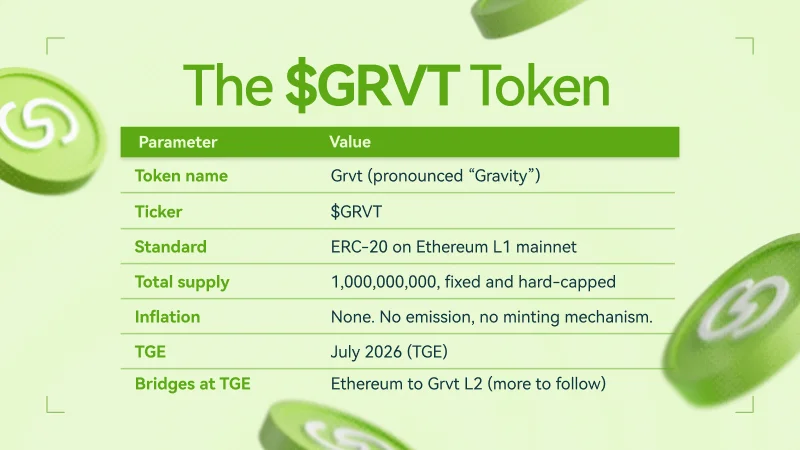
When discussing Grvt, it is important to distinguish between the network used by the platform and the network on which the GRVT token exists. GRVT is an ERC-20 token issued on the Ethereum mainnet. Its maximum supply is capped at 1 billion tokens at the smart contract level.
The Grvt trading infrastructure does not process every transaction directly on Ethereum. Instead, the project operates on a dedicated Layer 2 built with ZKsync’s ZK Stack technology.
This network uses a Validium model. Rather than storing all order and position data on Ethereum, some data is kept off-chain. Zero-knowledge proofs that verify transaction validity are then settled on Ethereum.
This allows Grvt to provide a fast trading infrastructure designed to resemble the order book experience of centralized exchanges. At the same time, it moves away from the traditional custody model in which users hand full control of their funds to an exchange. According to Grvt’s official documentation, withdrawals must be authorized with a key controlled by the user.
In short, the answer to “Which network is GRVT on?” is Ethereum. The answer to “Which network does the Grvt platform operate on?” is a dedicated Layer 2 and Validium infrastructure built with ZKsync ZK Stack.
Why was the project created?
Grvt’s origins are closely tied to counterparty risk on crypto exchanges. According to co-founder Hong Yea, the idea began taking shape in 2022. After leaving his career in traditional finance, Yea began developing a self-custodial hybrid trading platform with Matthew Quek and Aaron Ong.
The team wanted to preserve the speed and user experience of centralized exchanges while allowing users to retain control over their assets. Over time, this approach expanded beyond derivatives trading.
Today, Grvt also focuses on the problem of capital fragmentation across different platforms and accounts. In traditional finance, a user may hold cash at a bank, investments at a brokerage, and crypto assets on a separate exchange. A similar fragmentation exists in DeFi, where yield, swaps, derivatives, and RWA products are spread across different protocols.
Grvt aims to make it easier for the same capital to move between different use cases. For example, certain assets on the platform may continue earning yield while also being used as trading collateral.
Grvt’s History: Key Milestones
Grvt was founded in 2022. Its original goal was to build a derivatives trading platform with performance comparable to centralized exchanges, without requiring users to surrender full control of their funds.
During this stage, the team began working with Matter Labs, the developer behind ZKsync. ZK Stack became a key part of Grvt’s technical architecture because it offered low transaction costs, higher throughput, and infrastructure suited to privacy-focused applications.
In 2023, core features such as the order book, perpetual contracts, and options trading were tested on a closed alpha testnet. The project also expanded its community programs during the same year.
Closed Beta Testnet 1.0 launched in March 2024. Selected institutions and partners tested the system during the first phase, followed by a broader rollout to additional user groups.
The Open Beta Testnet became another important milestone in the third quarter of 2024. During this period, onboarding, reward programs, and bug bounty initiatives became key areas of focus.
Grvt also took a significant regulatory step that year. In December 2024, the project’s Bermuda operating entity received a Class M Digital Asset Business license from the Bermuda Monetary Authority. Class M is a modified licensing category in Bermuda for digital asset businesses operating under specific conditions and for a defined period.
Mainnet launch and product expansion
Grvt’s mainnet went live in December 2024. Perpetual futures were the platform’s first major product. The project’s token did not launch at the same time; the GRVT TGE took place roughly a year and a half later.
Following the mainnet launch, both trading volume and the number of products available on the platform began to grow. In an update published in May 2025, Grvt said total trading volume had reached $6.5 billion within roughly five months of launch, while the platform had recorded around 40,000 KYC-verified users.
Throughout 2025, institutional integrations, mobile applications, and investment products were introduced. The project also completed new funding rounds during this period.
In September 2025, Grvt announced the completion of a $19 million Series A funding round. According to a team profile published in February 2026, total funding had reached $34 million, while the project’s valuation stood at $540 million. Investors included Matrix Partners, Delphi Ventures, Hack VC, Further, and the ZKsync Foundation.
In 2026, Grvt began shifting from being primarily a perpetual DEX toward a broader financial platform. Yield Layer, Earn products, spot markets, and RWA-focused investment instruments became part of this strategy.
GRVT TGE and exchange listings
The GRVT Token Generation Event took place on July 30, 2026. This marked the end of a long gap between Grvt’s mainnet launch in 2024 and the launch of its platform token.
The token began trading on several centralized exchanges on the same day. OKX opened GRVT/USDT spot trading at 14:00 UTC on July 30. KuCoin, Bybit, and Bitget also listed the GRVT/USDT pair that day. MEXC launched both GRVT/USDT and GRVT/USDC markets.
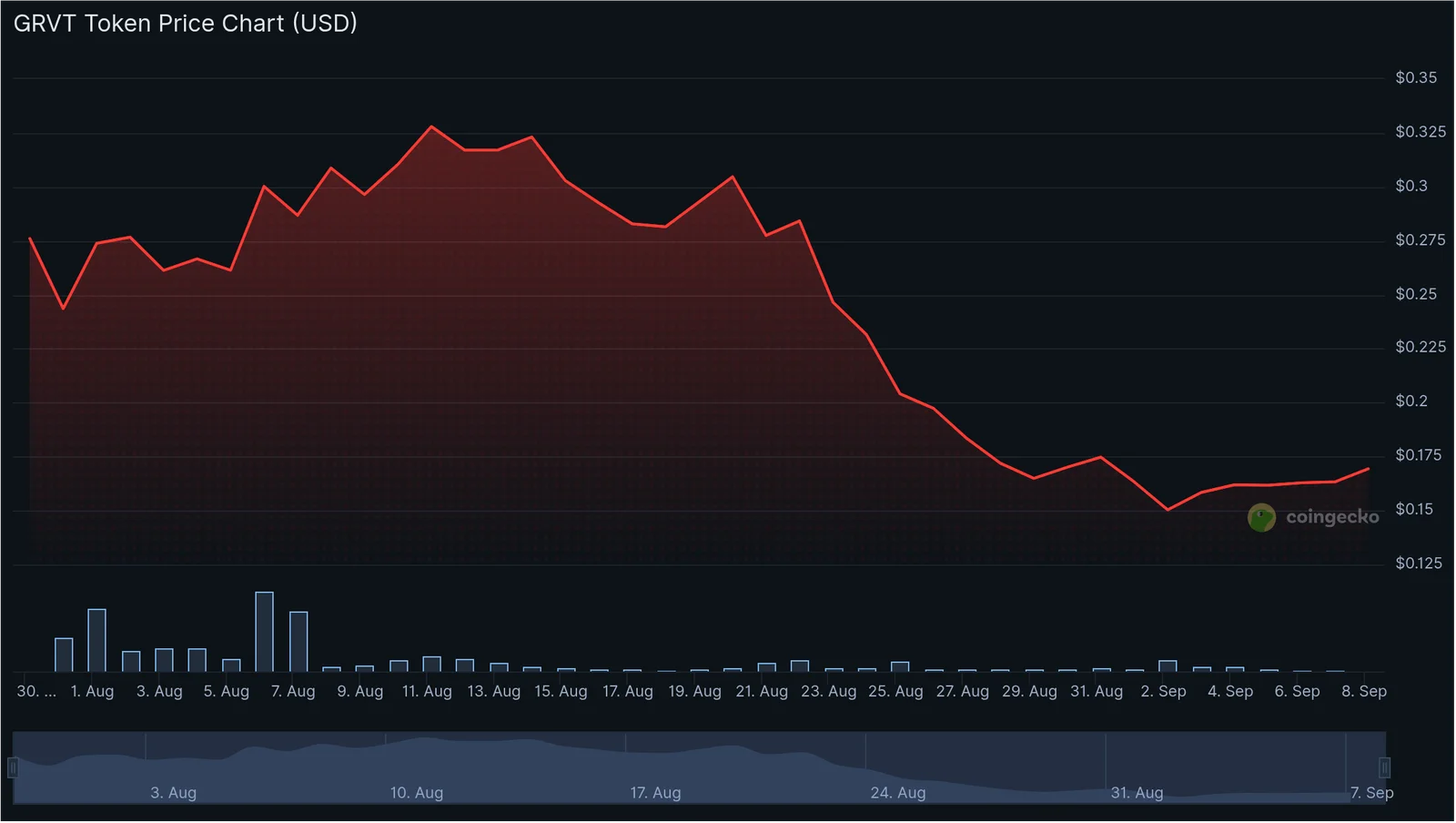
GRVT experienced significant volatility during its first days of trading. Market data shows that the token reached an all-time high of $0.4615 on July 30, 2026, before falling as low as $0.1458 on September 2.
As of September 8, 2026, GRVT is trading at around $0.166. Its circulating supply is approximately 114.31 million GRVT, while its market capitalization stands near $19 million. These figures may change continuously depending on market conditions.
How Does the GRVT Token Work?
GRVT’s primary role is to support the membership system within the Grvt ecosystem. The project does not describe the token as an equity stake, governance share, or revenue-sharing instrument.
According to the Grvt Litepaper, holding or staking GRVT may provide access to certain benefits across Earn, Trade, and Invest. On the Trade side, these benefits may include lower trading fees, greater capital efficiency, and access to advanced trading tools.
Within Earn, users may receive fee discounts on yield products offered by the platform. In Invest, membership level may provide access to a broader range of investment products.
There is an important distinction here. Holding GRVT does not automatically increase the yield generated by an investment product. Grvt’s current Litepaper states that users investing in the same product receive the same underlying product rate regardless of membership level.
The token’s utility is expected to expand over time. However, features that remain on the roadmap should not be treated as guaranteed until they are actually launched.
Supply and tokenomics
GRVT has a maximum and total supply of 1 billion tokens. The token follows the ERC-20 standard on Ethereum, and according to project documentation, there is no inflation mechanism that allows issuance above this limit.
The supply is divided into four main categories: ecosystem development, community airdrops, investors, and the team. In March 2026, Grvt announced that the total community allocation had been increased to 28% of supply. Of this amount, 10% was linked to Season 1 and 18% to the expanded Season 2 program.
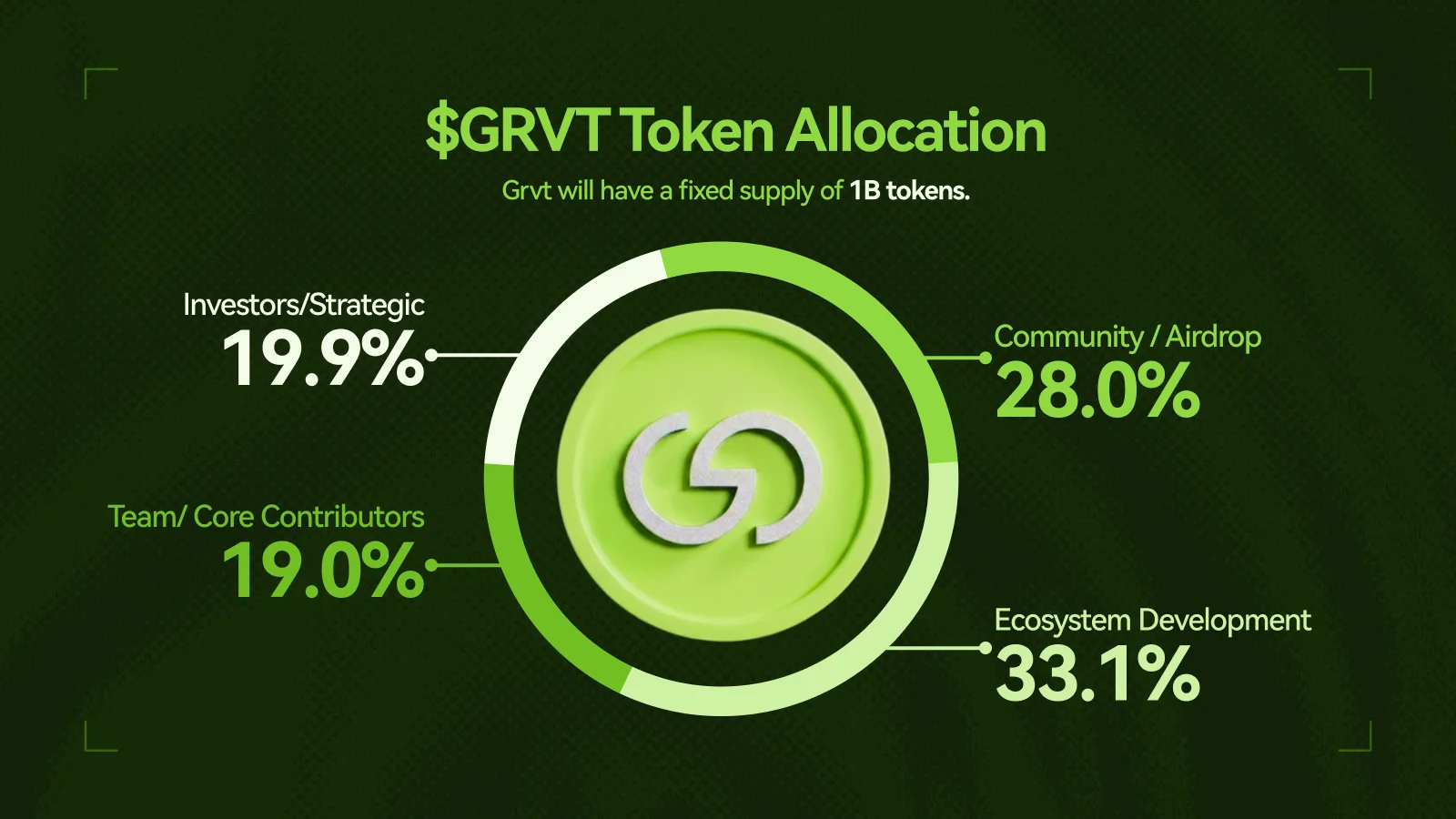
Not all tokens entered circulation at the TGE. According to the official Litepaper, team and investor allocations had 0% unlocked at launch. The general structure includes a 12-month cliff followed by a 36-month vesting period, although some later-stage Series A investors may follow a different schedule.
A portion of the ecosystem development allocation was unlocked at TGE for initial exchange liquidity and operations. The remaining allocation follows a six-month cliff and a subsequent 42-month vesting schedule.
For the community airdrop, only part of the earned allocation was released at TGE. The remaining tokens are distributed over a period of up to 12 months under user-specific schedules.
As of September 8, market data indicates that around 114.31 million of the total 1 billion GRVT supply is circulating. This represents roughly 11.43% of total supply. Future token unlocks are therefore an important factor to monitor.
Network, transactions, and security
The fact that GRVT is an ERC-20 token does not mean every transaction on the Grvt platform takes place on Ethereum Layer 1. The platform uses its own ZKsync-based Layer 2 infrastructure.
Within Grvt’s architecture, a significant portion of order matching and risk checks takes place off-chain. Valid state changes are then transferred to the dedicated Layer 2 and settled on Ethereum using zero-knowledge proofs.
The Validium model prevents all transaction data from being openly posted to Ethereum. This can be particularly relevant for institutional traders who may not want position sizes or trading strategies to be publicly visible on-chain.
The self-custody model is another important part of the architecture. According to Grvt, user funds are held in smart contracts and fund movements must be authorized with the user’s own key. The platform does not control the user’s private key.
This structure does not eliminate every risk. Smart contract vulnerabilities, Layer 2 infrastructure, bridges, Validium data availability, platform operations, and users’ own key management all remain separate risk areas.
Grvt’s core infrastructure has been reviewed by independent security teams including Spearbit DAO and NCC Group. Audits provide an additional security layer, although they cannot guarantee that a blockchain protocol will never experience vulnerabilities in the future.
Why Is Grvt Important?
One of the main issues Grvt targets is the fragmentation of capital across different financial applications. A user may need to move assets to a DeFi protocol to earn yield, to a DEX for leveraged trading, and to another platform for spot transactions.
This process can create additional time costs, transaction fees, and operational risks. Capital spread across multiple platforms may also be difficult to use simultaneously as collateral or liquidity.
Grvt’s One Balance model aims to reduce this problem. The platform is designed to allow users to access yield products, investment tools, and market trading with the same pool of capital.
The Yield Layer is one example of this approach. Grvt directs a portion of eligible reserves to DeFi protocols on Ethereum Layer 1 in an effort to generate yield from otherwise idle capital. One of its first integrations was with Aave V3’s USDT market.
The self-custody approach also aims to reduce custody risk associated with centralized platforms. Users retain control of the key required to authorize movements of their funds.
Grvt’s place in the ecosystem
Grvt is difficult to classify as a simple spot DEX. Its structure combines elements of a centralized exchange, perpetual DEX, DeFi yield protocol, and on-chain brokerage within the same platform.
Perpetual trading was one of Grvt’s first major product groups. Spot trading was added later. As Earn and Invest products expanded, the project increasingly positioned itself as a broader on-chain financial platform.
Real-world assets also play an important role in this strategy. Grvt aims to connect RWA products with a system that allows users to invest while, in some cases, maintaining capital efficiency.
Its collaboration with Centrifuge is one example. Announced in May 2026, the partnership focuses on integrating yield from tokenized treasury and credit strategies into Grvt’s self-custody products.
The project’s roadmap includes broader RWA offerings, unified margin, new investment vaults, secondary markets for vault tokens, copy trading, and fiat on-ramps. Some of these features remain under development, so existing products should be distinguished from planned features.
Risks and volatility
GRVT has a relatively short market history. Since the TGE took place on July 30, 2026, the token remains in the early stages of price discovery.
Its first weeks of trading highlighted this risk. Market data shows that GRVT fell from an initial high of $0.4615 to around $0.1458 within roughly one month.
The circulating supply also represents only a small share of the total supply. With roughly 11.43% currently circulating, future token unlocks may increase the amount of GRVT available on the market.
There are also project-level risks. Grvt relies on multiple technical layers, including smart contracts, a dedicated Layer 2, Validium infrastructure, DeFi integrations, and RWA products. While this expands the platform’s product range, it may also increase operational complexity and the overall attack surface.
Long-term demand for GRVT is closely linked to Grvt’s user growth, trading volume, and demand for new products. Slower platform growth or stronger competition from similar projects could affect the token’s utility.
Grvt’s Developers, Community, and Ecosystem
Founders and development team
Grvt was founded in 2022 by Hong Yea, Aaron Ong, and Matthew Quek. The three co-founders brought experience from traditional finance, technology, and banking.
Hong Yea is Grvt’s co-founder and CEO. Before launching the project, Yea spent more than a decade in traditional financial markets. He served as an Executive Director at Goldman Sachs and previously worked as a trader at Credit Suisse.
Aaron Ong is co-founder and CTO, overseeing the platform’s technical infrastructure. Ong previously worked as a Tech Lead at Meta and was involved in data privacy systems. At Grvt, he has played a role in the development of the ZKsync, Validium, and hybrid trading architecture.
Matthew Quek is co-founder and COO. Quek previously led the Blockchain & Payments team at DBS Bank and also worked at Singapore GovTech. At Grvt, he focuses on operations, regulatory processes, and the institutional side of the platform.
The project has raised significant funding from several investors. As of February 2026, the disclosed total of $34 million included backing from Matrix Partners, Delphi Ventures, Hack VC, Further, and the ZKsync Foundation.
Community and governance
The community has played an important role in Grvt’s token distribution model since the early stages of the project. During the testnet period, the project used points and reward systems to encourage trading, liquidity provision, and broader ecosystem participation.
The Genesis reward program created separate reward pools for traders, liquidity providers, and ecosystem participants. Some parts of the distribution mechanism were changed following community feedback and voting. For example, the previous badge system was replaced by a model that gave greater weight to points.
In 2026, the GRVT allocation reserved for the community was increased to 28% of total supply. This decision was closely tied to the extension of the Season 2 program.
Even so, GRVT should not be described as a traditional DAO governance token. The current Litepaper explicitly states that the token does not grant governance rights or ownership in the company. Its primary role remains focused on platform membership and utility benefits.
Partnerships and use cases
The Grvt ecosystem extends beyond its own Layer 2 network. The project aims to connect external liquidity sources, DeFi protocols, and RWA providers within a single user experience.
ZKsync is one of the project’s most important technical partners. Aave is also among the first DeFi integrations used by the Yield Layer.
On the RWA side, the collaboration with Centrifuge is designed to expand access to tokenized institutional assets. Grvt has also announced work with Plume to bring diversified RWA yields to the platform.
The project has also formed partnerships in liquidity and institutional trading. In 2024, Grvt said it was working with 16 market makers that had collectively committed $3.3 billion in monthly trading volume. Later integrations included institutional trading infrastructure providers such as CoinRoutes.
These integrations matter for GRVT because the token’s utility model is closely linked to platform growth. As Grvt brings more trading, yield, and investment products under one balance, the number of areas in which GRVT membership can be used may also increase.
Frequently Asked Questions (FAQ)
Here is the answers for FAQs about Grvt:
- What is Grvt and when was it launched?: Grvt is an on-chain financial platform designed to combine spot and perpetual trading, yield tools, and investment products under a single self-custody balance. The project was founded in 2022 by Hong Yea, Aaron Ong, and Matthew Quek. Closed Beta began in 2024, the mainnet launched in December 2024, and the GRVT token TGE took place on July 30, 2026.
- What is the GRVT token used for?: GRVT is the utility and membership token of the Grvt ecosystem. Holding or staking the token through eligible mechanisms may provide benefits such as lower trading fees, access to advanced trading features, and a broader range of products. GRVT does not represent company equity, revenue sharing, or automatic governance rights.
- Which network does Grvt operate on?: The GRVT token was issued as an ERC-20 token on Ethereum. The Grvt platform itself operates on a dedicated Layer 2 built with ZKsync ZK Stack and uses Validium technology. Transaction validity proofs are settled on Ethereum Layer 1.
- Who founded Grvt?: Grvt has three co-founders. CEO Hong Yea has a background in traditional finance. CTO Aaron Ong previously worked at Meta. COO Matthew Quek has experience at DBS Bank and GovTech. The project was founded in 2022.
- What is the GRVT supply?: GRVT has a maximum supply of 1 billion tokens. According to project documentation, the supply is fixed and there is no minting mechanism that allows unlimited inflation. As of September 8, 2026, approximately 114.31 million GRVT are in circulation.
- Is Grvt suitable for investment?: Whether GRVT is suitable for investment depends on an investor’s risk tolerance, time horizon, and market expectations. The token only entered the market in July 2026 and showed significant volatility during its first weeks of trading. The relatively low circulating supply compared with total supply also makes future token unlocks an important risk factor. Investors should consider tokenomics, utility, liquidity, and their personal risk profile before making any decision regarding GRVT or other crypto assets.
To stay up to date with Grvt’s self-custody model, ZKsync infrastructure, and developments across the GRVT token ecosystem, follow the JR Kripto Guide series.