Reports of billions of dollars in suspicious outflows from Binance wallets have raised major security concerns across the crypto market. Initial estimates put the transfers at $2.77 billion, while subsequent assessments suggested the amount could reach $5.8 billion. Binance said it was investigating a potential security issue, while founder Changpeng Zhao (CZ) stated that user funds were safe.
As the incident unfolded overnight on October 29–30, Tether and Circle reportedly froze stablecoins linked to the suspicious transfers. Tether CEO Paolo Ardoino said the company had frozen more than 1.567 billion USDT. However, Binance has yet to officially confirm a total loss figure.
Binance: Our Security Teams Are Investigating
Binance co-founder Yi He said in a statement on X that the company was aware of reports of a potential security issue and was actively investigating.

According to the statement, security teams are urgently reviewing all relevant information. The company said it would share updates through official Binance channels as soon as verified information became available.
Yi He also urged users to remain alert to scams. She warned against trusting unofficial links, messages, or requests for account information.
The statement confirms that the exchange is investigating the suspicious activity. However, the company has yet to provide a detailed assessment of the cause, the systems affected, or the full financial impact.
CZ: “User Funds Are Safe”
Binance founder and former CEO Changpeng Zhao also addressed the incident in a post on X. Opening with “User funds are safe!”, CZ said Binance appeared to have suffered a cyberattack.
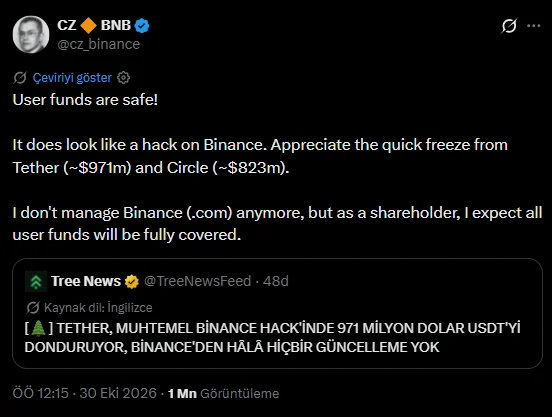
CZ thanked Tether for quickly freezing approximately $971 million and Circle for freezing $823 million in the initial response. He then noted that he was no longer involved in Binance’s day-to-day management, adding:
“I don't manage Binance (.com) anymore, but as a shareholder, I expect all user funds will be fully covered.”
CZ’s statement offered reassurance about user assets. However, his comments about covering funds reflect his expectations as a shareholder; details of any potential compensation plan from Binance remain unknown.
Estimates Put Suspicious Transfers at $5.8 Billion
Data flagged by onchain analyst Spreek shows approximately $3.55 billion in incoming transfers to an unlabeled wallet. Around $900 million of those assets was reportedly moved to other wallets afterward.
Coinbase executive Conor Grogan said in his post that the amount had reached as much as $5.8 billion. Blockchain security firm Blockaid also said it was investigating approximately $3.3 billion in suspicious outflows from Binance hot wallets across Ethereum, Arbitrum, and Avalanche.
The figures may reflect different scopes of analysis and reporting times. They therefore cannot be added together to calculate a total loss.
Similarly, assets entering one wallet and subsequently moving to other addresses do not represent a separate loss. Establishing the final damage requires tracing the transfers together and clarifying the status of the frozen assets.
Tether Updates Its Frozen USDT Total
Initial reports indicated that Tether had frozen approximately 971 million USDT, while Circle had frozen around 823 million USDC. That put the combined value of the two companies’ initial interventions at approximately $1.79 billion.
Tether CEO Paolo Ardoino later said the frozen amount had exceeded 1.567 billion USDT. Ardoino stated that protecting the industry and the company’s partners was a priority.
Combining Tether’s updated figure with the reported 823 million USDC frozen by Circle brings the total value of frozen stablecoins to more than approximately $2.39 billion. However, freezing assets does not mean they have been returned to Binance or that any potential losses have been fully covered.
Attention now turns to further announcements from Binance regarding the scope of the incident, its impact on user accounts, and the asset recovery process. As the company’s investigation continues, the method behind the suspected attack and the exact loss remain unclear.