As Aave, DeFi's largest lending protocol, surpasses a historic milestone in cumulative loan volume, tensions are escalating between the centralized governance team and the decentralized community. Aave, a leading lending protocol in the decentralized finance (DeFi) world, has set a precedent in the industry by exceeding the $1 trillion cumulative loan volume mark. However, this great achievement is overshadowed by a deep governance crisis straining the protocol's internal structure. Aave Labs CEO Stani Kulechov announced this milestone in a post on the X platform. "Ten years ago, neither DeFi nor Aave existed; they were just ideas. Today, Aave has become the backbone of on-chain lending; the engine of a new, open, global, and unstoppable financial system," said Kulechov. Describing this achievement as a concrete step towards Aave's goal of becoming "the world's largest and most efficient liquidity network," Kulechov pointed to a future where developers, banks, and fintech companies will be connected to the system by default. The numbers are truly impressive. Aave currently maintains its leadership among DeFi lending platforms with a total value locked (TVL) of $27.2 billion, while generating over $83.3 million in fee revenue in the last 30 days. This figure is almost four times the revenue of its closest competitor, Morpho. Aave Horizon, launched last August, is a private lending marketplace that allows institutional investors to borrow stablecoins against real-world assets, attracting big names like VanEck, WisdomTree, and Securitize.
Dispute inside
However, a serious crack is growing behind this bright picture. The disagreement between Aave Labs and the protocol's decentralized autonomous organization (DAO) has come to light with a funding proposal titled "Aave Will Win." This proposal envisages providing Aave Labs with up to $51 million in development funding in stablecoins; this is recorded as the largest funding proposal in the history of the DAO. In addition to the table, another separate package is on the table: in exchange for this offer consisting of $42.5 million worth of stablecoins and 75,000 AAVE tokens, Aave Labs is offering to transfer the revenue of all Aave-branded products to the DAO treasury.
The tension took on a new dimension with the announcement made by BGD Labs, one of the DAO's key service providers, on February 20th. BGD Labs announced that it would end its collaboration with the DAO, citing Aave Labs' decision to abandon the "highly mature and successful" V3 version and focus on developing V4. Kulechov's statement that V3 parameters would be gradually adjusted to encourage migration as V4 matured ignited this break.
"Product graveyard" discussion
The tension did not end there. Marc Zeller, founder of the Aave-Chan Initiative (ACI), published a comprehensive audit report scrutinizing Labs' performance at the Aave governance forum. The report described Aave Labs' self-developed products like Lens Protocol, GHO v1, and Horizon as a "Product Graveyard," claiming "zero success" in this area.
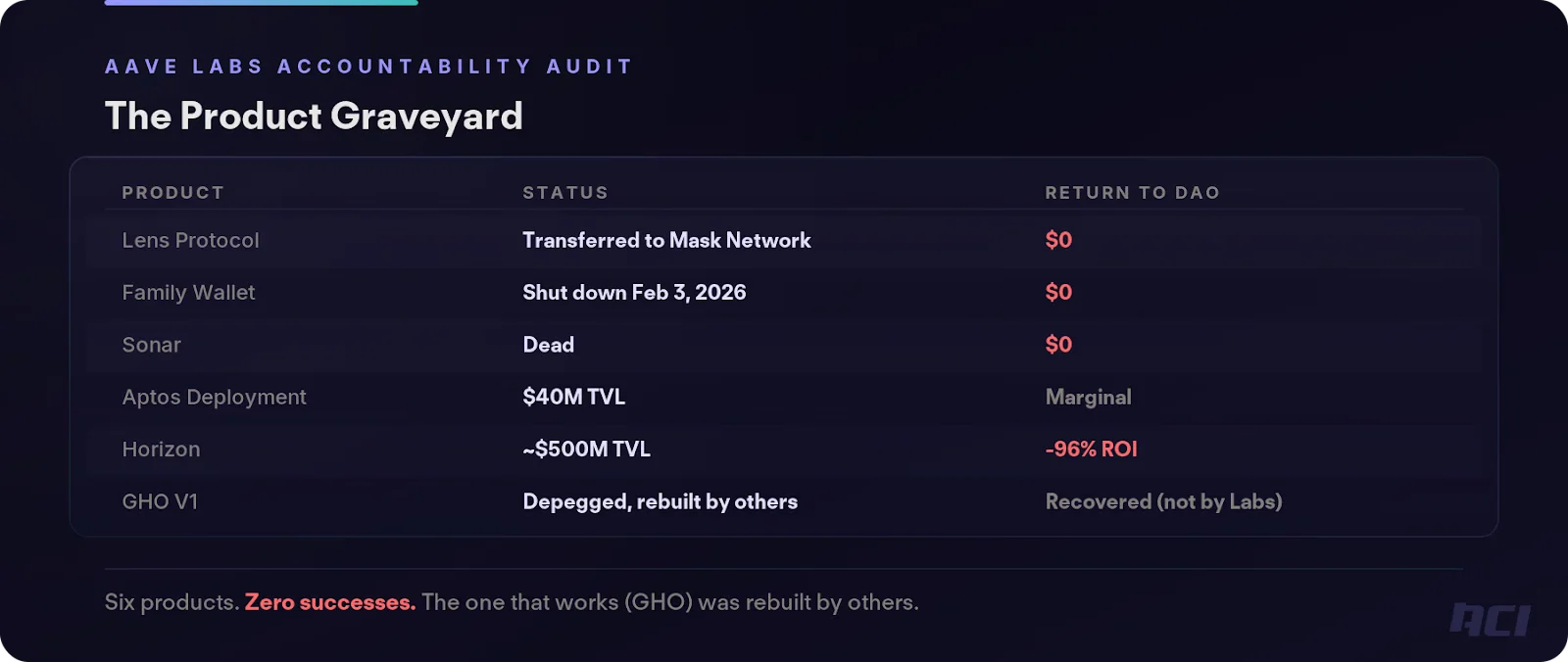
According to Zeller's criticisms, while Horizon managed to attract over $500 million in TVL, it produced a negative return on investment of 96 percent. Aave's own stablecoin, GHO v1, experienced an anchor shift and had to be rebuilt by BGD and TokenLogic. The picture is not bright on the business development front either: Potential partnerships with major players such as Coinbase's Layer 2 network Base, World Liberty Financial, Apollo, and Mantle failed to materialize. Furthermore, these gaps were filled by the competing protocol Morpho. Morpho took over the infrastructure of Coinbase's decentralized lending product and recently announced a partnership with Apollo Global Management, an asset manager with $800 billion in assets.
Token falls, leadership continues
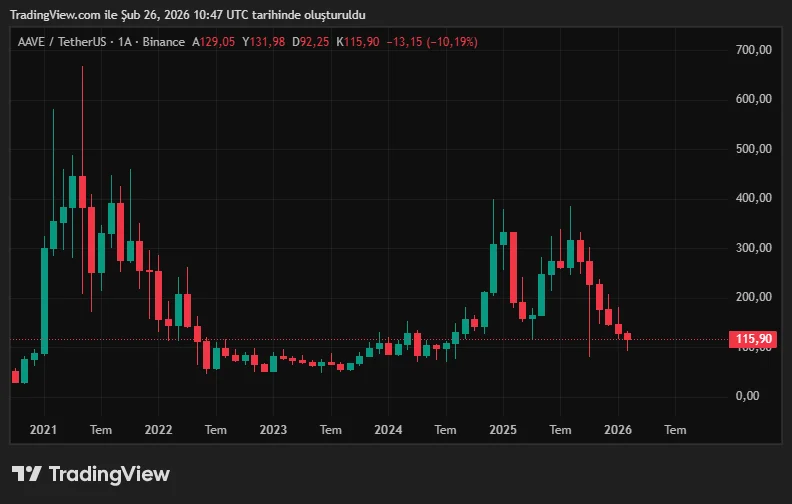
Despite all this internal turmoil, Aave maintains its leading position in the DeFi ecosystem. With a TVL of $27.5 billion across all chains, it holds over 28% of the DeFi market. Morpho, with 5.8 billion TVL, is the second-largest lending protocol and the sixth-largest platform overall in DeFi. On the other hand, the native token AAVE has fallen to levels not seen in years, compared to its peak values of $380 in December 2024 and $660 in 2021; it is currently trading around $122, which corresponds to a fully diluted value of $1.9 billion.