
Iran may be working on a remarkable model for the Strait of Hormuz, one of the most critical transit points for global energy trade. According to Fars News, a state-affiliated news outlet, the Iranian Ministry of Economy plans to manage ships passing through the strait not through direct transit fees, but through marine insurance and financial liability certificates. The use of Bitcoin in payments for this model has led the cryptocurrency market to closely monitor the issue.
Bitcoin could be at the center of the insurance model in the Strait of Hormuz
According to the news, the platform called "Hormuz Safe" aims to offer insurance services for maritime cargo passing through the Persian Gulf, the Strait of Hormuz, and surrounding waterways. The system allows cargo owners to purchase digitally verifiable policies, which become active after payment is confirmed. The plan also includes providing the cargo owner with a signed digital receipt. However, it is not yet clear how far the project has progressed. The website mentioned in the report only shows a landing page, and basic details such as policy terms, insurer information, deductibles, and claims processes are not clearly shared. Therefore, it has not been possible to confirm whether Hormuz Safe is actually operational or whether any cargo owner is using the platform.
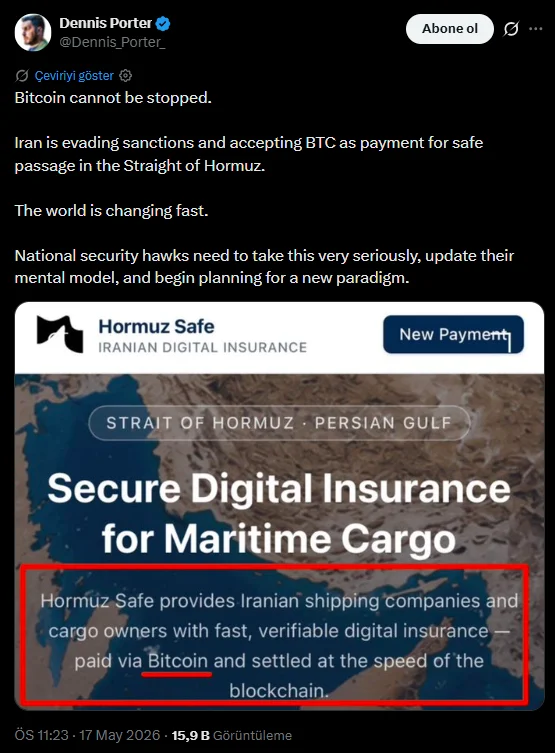
According to Fars News, this model could generate over $10 billion in revenue for Iran. However, it has not been explained on what basis this estimate is derived. Nevertheless, the logic of the proposal seems quite clear. Iran may be trying to monetize its strategic position on the Strait of Hormuz not directly through "transit fees," but through an insurance and certificate structure.
The Strait of Hormuz is considered one of the most sensitive energy corridors, through which approximately one-fifth of the world's oil trade passes. Therefore, any new payment or certificate system that could be implemented in the region concerns not only maritime transport companies but also energy markets, insurers, and international trade networks.
The Bitcoin option, however, constitutes the most controversial part of the plan. Iran has long been trying to reduce its dependence on dollar-based financial systems due to sanctions. A marine insurance platform that accepts Bitcoin payments seems, in this respect, consistent with Iran's broader strategy to overcome the pressure of sanctions. However, such a system carries serious compatibility risks. Payments to Iranian-linked state institutions or entities close to the state do not eliminate the risk of sanctions, even if they don't pass through the banking system. Whether the payment is made in Bitcoin, stablecoins, or other digital assets, it creates an area requiring legal scrutiny for shipowners, trading companies, and insurance organizations. Some news reports have suggested that Iran may previously demand Bitcoin payment per barrel of oil from ships passing through the Strait of Hormuz. Furthermore, it is known that some shipping companies operating in the region in the past have been targeted by scammers demanding cryptocurrency under the guise of secure passage. Therefore, the possibility that the site circulating under the name Hormuz Safe is fake cannot be entirely ruled out. Iran's shift towards Bitcoin instead of centralized stablecoins like USDT is also noteworthy. This is because stablecoin issuers can freeze wallets associated with sanctions. Bitcoin, however, does not have a central issuer that can freeze funds. This feature makes Bitcoin a more convenient payment method for countries under sanctions.