
The Zcash ecosystem has faced one of the most serious governance crises in recent years with a mass resignation. The entire development team behind the privacy-focused blockchain project, Electric Coin Company, announced their resignation due to deep disagreements with the board of directors of Bootstrap, the non-profit organization to which the company belongs. The decision has raised questions about Zcash's technical roadmap and the future of the ecosystem. Electric Coin Company CEO Josh Swihart stated in a statement on X that team members were "forced to leave in a non-constructive manner." According to Swihart, the board of directors pushed working conditions and authority to a point where it became impossible for the team to perform their duties effectively and ethically. According to the U.S. Department of Labor, this is called "constructive discharge," which technically means the resignation is not considered voluntary. Bootstrap is a 501(c)(3) organization established to support the Zcash ecosystem and oversee Electric Coin Company. In his statement, Swihart argued that board members Zaki Manian, Christina Garman, Alan Fairless, and Michelle Lai adopted an approach inconsistent with Zcash's core mission. However, he specifically emphasized that the protocol itself was not technically affected by this personnel change. Following the mass resignation, the ECC team began preparations to establish a new company to continue its vision of privacy-focused digital currency. Swihart stated that this step does not mean abandoning Zcash, but rather a result of the desire to independently pursue the goal of an "unstoppable private currency." It is also frequently recalled that thanks to Zcash's open-source and permissionless nature, the network continues to operate independently of any single institution or team. This development is the latest in a series of high-level departures from the Zcash ecosystem in recent years. Zooko Wilcox, the project's founder and longtime leader, stepped down as CEO in December 2023, and another key figure resigned from the Zcash Foundation board in early 2025. All these changes further fueled debates about the sustainability of the governance model.
The resignations came just weeks after ECC announced its internal restructuring plan on December 1st. This plan brought the core protocol and mobile development teams under a single leadership and unified marketing and communication activities. The aim was to improve user experience, particularly around the Zashi wallet, and reduce operational friction.
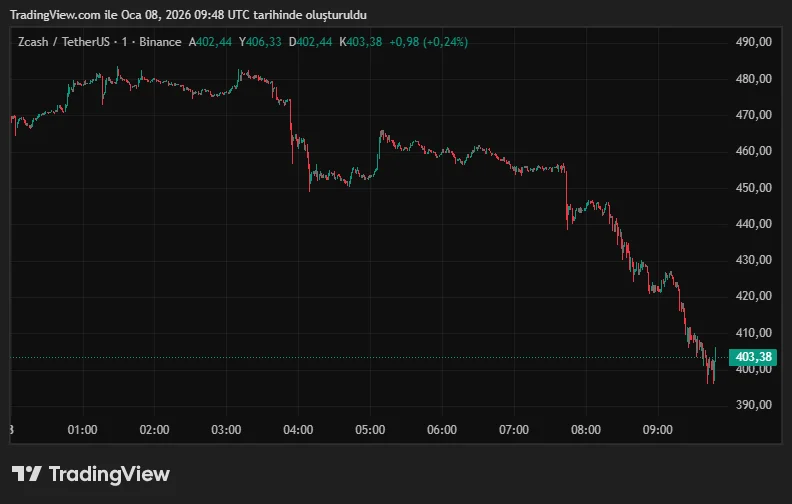
ZEC price experienced a drop
On the market front, the impact of the news was quickly felt. The ZEC price experienced a sharp pullback following the resignation news, followed by a volatile course with increased trading volume. The ZEC price fell by nearly 17% in the last 24 hours, from $490 to $405. Zcash, which previously re-entered the top 20 crypto assets with a market capitalization exceeding $10 billion in November, managed to remain positive on a monthly basis despite the recent pullback. However, the token is still trading well below its all-time peak in 2016.
While Zcash's complex governance structure aimed to increase decentralization from the outset, this multi-layered model has generated significant tensions over time. In the coming period, attention will be focused on the path the newly formed company will take and how Bootstrap and the Zcash Foundation will reshape the protocol development and funding mechanisms.