A significant milestone has been reached in the long-awaited regulatory clarity for the cryptocurrency market in the US. The Securities and Exchange Commission (SEC), in coordination with the Commodity Futures Commission (CFTC), published 68 pages of interpretive guidance categorizing crypto assets into five distinct categories. Within this framework, XRP was explicitly listed as an example of a “digital commodity”; the same list also included Aptos (APT), Avalanche (AVAX), Bitcoin (BTC), Bitcoin Cash (BCH), Cardano (ADA), Chainlink (LINK), Dogecoin (DOGE), Ethereum (ETH), Hedera (HBAR), Litecoin (LTC), Polkadot (DOT), Shiba Inu (SHIB), Solana (SOL), Stellar (XLM), and Tezos (XTZ).
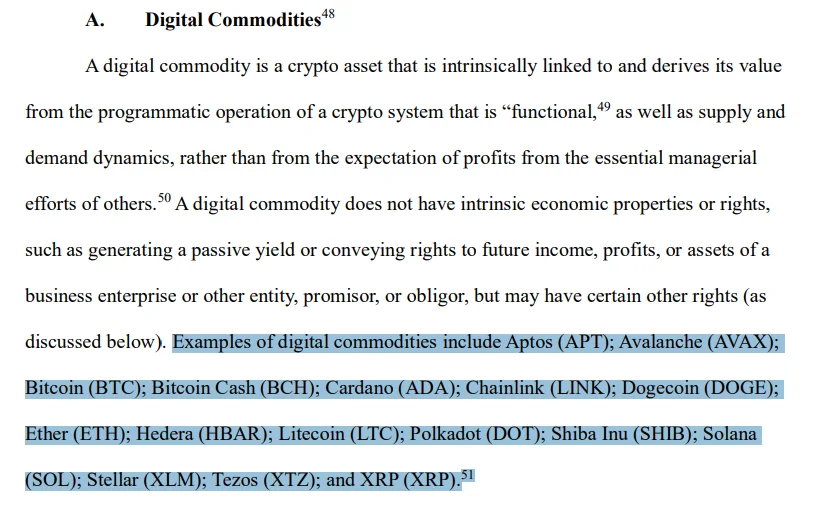
According to the SEC, digital commodities are not considered securities in themselves, but certain forms of presentation and sale may fall under the scope of investment contracts. The new guidance classifies crypto assets as digital commodities, digital collectibles, digital instruments, stablecoins, and digital securities. In the SEC text, digital commodities are defined as assets whose value derives not from the managerial effort of a team, but from the programmatic operation of a functional crypto system and the dynamics of supply and demand. The agency emphasizes that tokens in this category do not possess classic securities characteristics such as passive income, corporate profit, income rights, or ownership over a business. The inclusion of XRP under this heading is seen as one of the most significant developments in recent years regarding the asset's legal status in the US.
The guidance is noteworthy not only for mentioning XRP. The SEC states that it hasn't completely abandoned the Howey test, which has been central to crypto debates for years, but that the new interpretation clarifies how this test applies to crypto assets. In other words, instead of discarding the old approach, the agency is trying to make the framework more readable. According to Reuters, SEC Chairman Paul Atkins also presented this change as a step toward providing the clarity that has been lacking for years, saying that more enforceable rules should be introduced to the market. This change is particularly significant for XRP. Because the token has long been at the center of regulatory debates in the US, and the question of whether it is a security has created significant uncertainty for both exchanges and institutional players.
The fact that the SEC's latest guidance includes XRP among examples of digital commodities indicates that, at least in the institution's current interpretation, XRP is not considered a security in itself. The practical result of this could be a stronger legal basis for exchange listings, institutional use cases, and payment-focused integrations. However, it is too early to say that all risks have been completely eliminated, as the guidance explicitly states that certain transactions may be considered investment contracts depending on the context.
Other topics in the crypto space were also included in the guidance
On the other hand, the document is not limited to classification alone. The SEC and CFTC are also trying to clarify how federal securities laws will be applied to mining, staking, airdrops, and some token wrapping transactions. The guidelines state that under certain conditions, protocol staking activities do not constitute the issuance or sale of securities.