
Significant outflows were observed from spot Bitcoin and Ethereum ETFs in the US as the year drew to a close. According to data, US spot Bitcoin ETFs recorded a net outflow of $188.6 million on Tuesday, marking the fourth consecutive trading day of negative outflows. Spot Ethereum ETFs also saw a net outflow of $95.5 million on the same day. Reduced liquidity before the Christmas holidays and year-end portfolio adjustments are cited as key reasons for these movements.
Significant asset outflows from BlackRock, Grayscale, and Bitwise funds
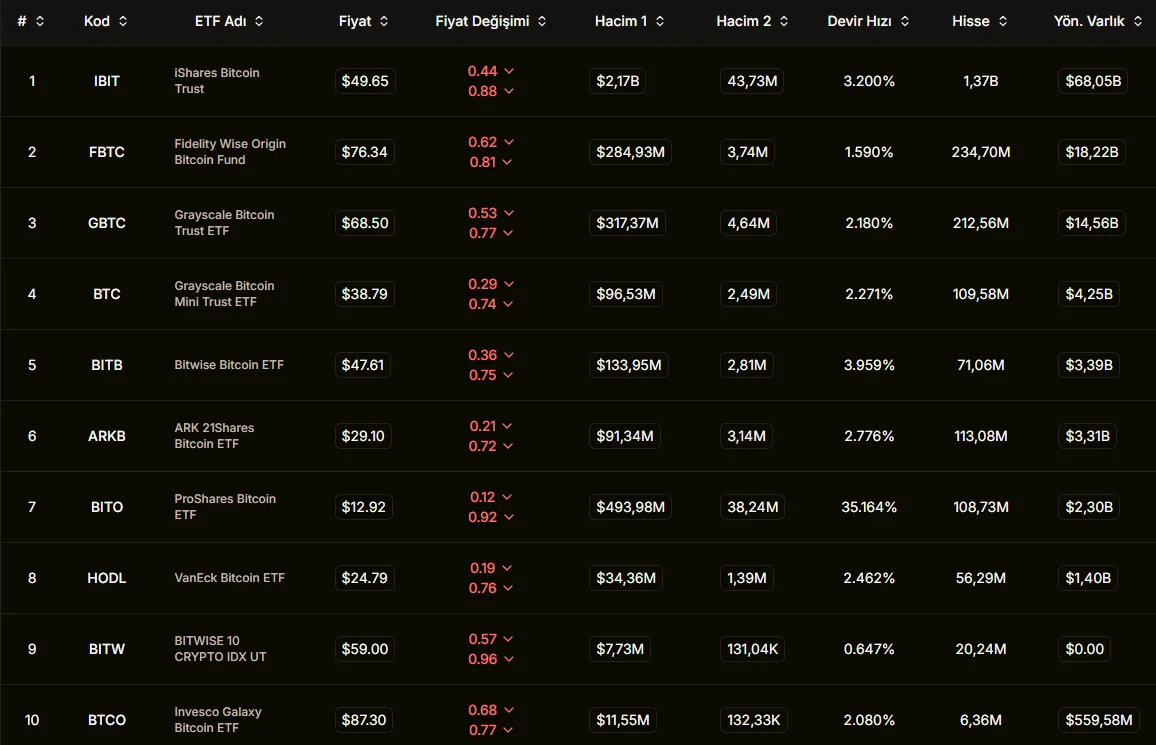
According to market data, the majority of outflows from Bitcoin ETFs were concentrated in the IBIT fund issued by BlackRock, with a single day outflow of $157.3 million. Fidelity's FBTC, Grayscale's GBTC, and Bitwise's BITB fund were among the other products that reported net outflows on Tuesday. On a weekly basis, spot Bitcoin ETFs experienced a total net outflow of $497.1 million last week. This chart indicates a complete reversal of the $286.6 million net inflow seen in the week ending December 12.
A similar picture emerges on the Ethereum side. Spot Ethereum ETFs, which recorded an inflow of $84.6 million the day before, saw a net outflow of $95.5 million on Tuesday. Leading the outflows was Grayscale’s ETHE fund, with a daily outflow of $50.9 million. This figure stood out as the highest single-day outflow recorded among Ethereum ETFs that day.
Market commentators believe that these ETF outflows do not indicate a lasting deterioration in investor confidence. Vincent Liu, CIO of Kronos Research, stated that these movements are more due to year-end dynamics. According to Liu, low liquidity, portfolio rebalancing processes, and profit-taking are among the main reasons for the outflows from Bitcoin and Ethereum ETFs. Similarly, LVRG Research director Nick Ruck stated that investors are reducing risk in the pre-Christmas period, with seasonal profit-taking and tax planning accelerating this process.
Rick Maeda from Presto Research emphasized that ETF inflows should not be exaggerated. Maeda said that fund flows have already been volatile in the last few months, and balance sheet adjustments are natural, especially after the volatile fourth quarter. Comparing this to previous years, Maeda noted that over $1.5 billion in outflows occurred from spot Bitcoin ETFs in the four trading days before Christmas 2024, compared to the relatively limited outflows currently seen.
Crypto prices also remained under pressure in line with this picture. Bitcoin fell 0.7% in the last 24 hours to $86,931, while Ethereum dropped 1.18% to $2,931. In contrast, spot XRP ETFs saw net inflows of $8.2 million, and spot Solana ETFs saw net inflows of $4.2 million. This situation indicates that investor interest is partly shifting towards different assets.
In contrast to this stagnation in the crypto markets, US stocks showed a strong performance. The S&P 500 rose 0.46% on Tuesday, closing at a historic high of 6,909.79 points. The Nasdaq Composite increased by 0.57%, while the Dow Jones Industrial Average rose by 0.16%. According to data released by the US Department of Commerce, the US economy grew by 4.3% on an annualized basis in the third quarter. This rate surpasses the 3.8% growth in the second quarter.
US markets will close early on December 24th and will be closed on December 25th due to the Christmas holiday. According to experts, the real signals will become clearer after the holiday, with the return of liquidity. Vincent Liu states that investors should closely monitor the weekly jobless claims data to be released on December 27th and price-driven fund flows. These indicators may offer a healthier picture in terms of market expectations for the first few months of 2026.