
Ethereum co-founder Vitalik Buterin said advances in AI-driven mathematics could affect the security of crypto assets. While urging the industry to take this possibility seriously, Buterin stressed that moving assets to new wallets in a panic could also lead to losses.
Buterin’s comments on X on October 7 followed Ethereum Foundation researcher Justin Drake’s call to prepare for “bunker mode.” The discussion centers on the possibility that the mathematical methods securing crypto transactions could weaken sooner than expected.
Buterin cautions against rushed wallet migrations
In his post, Buterin said he did not recommend rushing to move to new wallets. He described keeping assets in addresses that have never signed a transaction as a reasonable precaution when it is easy to implement.
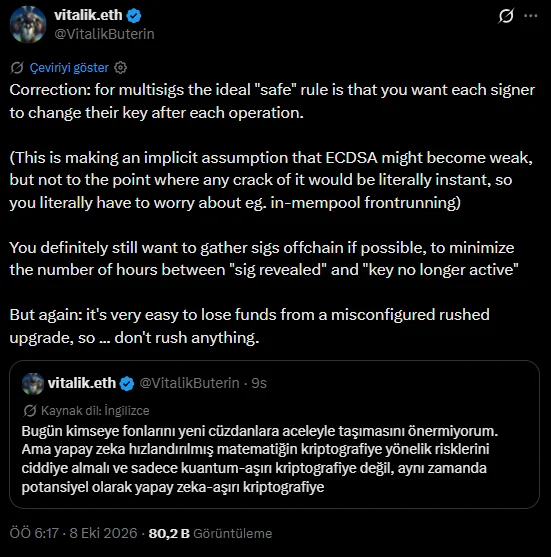
However, the Ethereum co-founder said that, in his own experience, botched migrations had caused greater losses than hacks. He highlighted how a change intended to improve security could introduce new problems during implementation.
Buterin reiterated the point in a follow-up post. He urged users to avoid hasty decisions, warning that a rushed and misconfigured migration could easily result in lost funds.
What does Justin Drake’s “bunker mode” call mean?
In his post, Justin Drake urged the industry to prepare for unexpected developments in cryptographic security. The researcher raised the possibility that the Elliptic Curve Digital Signature Algorithm, known as ECDSA, could be broken even before powerful quantum computers pose that threat.
In cryptography discussions, “Q-day” refers to the point at which quantum computers become capable of breaking widely used public-key cryptography. Drake’s warning rests on the idea that AI-assisted mathematical discoveries could change that timeline.
The researcher argued that, in a worst-case scenario, such a breakthrough could emerge within months rather than years. This timeframe does not describe an attack that has already happened or an established technical schedule; it reflects the adverse scenario behind Drake’s call for preparedness.
Drake recommended moving assets in a controlled manner to fresh addresses whose public keys have not yet been exposed. He also stressed that users should avoid panic and should not rush the transition.
AI could also challenge post-quantum security assumptions
Buterin’s assessment extends beyond the signature methods used by existing wallets. The Ethereum co-founder said security planning often assumes a scenario in which elliptic-curve systems are broken while hash functions and lattice-based methods remain secure.
In his view, AI-assisted mathematical research could also significantly affect the practical security of lattice-based systems over the next two years. Buterin specifically highlighted ML-DSA, fully homomorphic encryption, and other lattice-based constructions.
ML-DSA is among the post-quantum digital signature standards published by the U.S. National Institute of Standards and Technology (NIST) in 2024. NIST states that the method is believed to remain secure even against attackers with large-scale quantum computers.
Buterin’s remarks therefore represent an assessment of risks from future mathematical advances rather than an announcement that the standard has been broken.
Buterin recommended that developers choose more conservative security parameters for lattice-based systems and favor hash-based constructions wherever possible. For privacy protocols, he advocated sending encrypted records through off-chain mechanisms instead of storing them directly on the blockchain.
OpenAI’s mathematics research adds to the debate
The warnings came as AI’s role in mathematical research continues to expand. In an official announcement on October 6, OpenAI said it had released new mathematical results produced by an advanced internal model.
The company said it published the results on GitHub alongside Lean formalizations that allow many of the proofs to be checked by computers. The announcement describes progress in mathematical research; it does not present a result showing that ECDSA has been broken.
Drake viewed these developments as a reason for the industry to accelerate its preparations. Buterin, meanwhile, stressed that precautions against potential threats must also account for user error, reiterating his call for a controlled approach to asset migrations and security upgrades.