
The cryptocurrency market started the new week cautiously. Bitcoin's price fell to the $66,000 level due to increasing geopolitical risks and the pressure created in global markets by the sharp rise in oil prices. The decrease in global risk appetite negatively affected not only crypto assets but also Asian stock markets.
According to the latest data, Bitcoin lost approximately 1.87 percent in value in the last 24 hours, trading around $66,010. This level indicates a pullback of approximately 10 percent compared to the last peak of $73,500 recorded on March 5th.
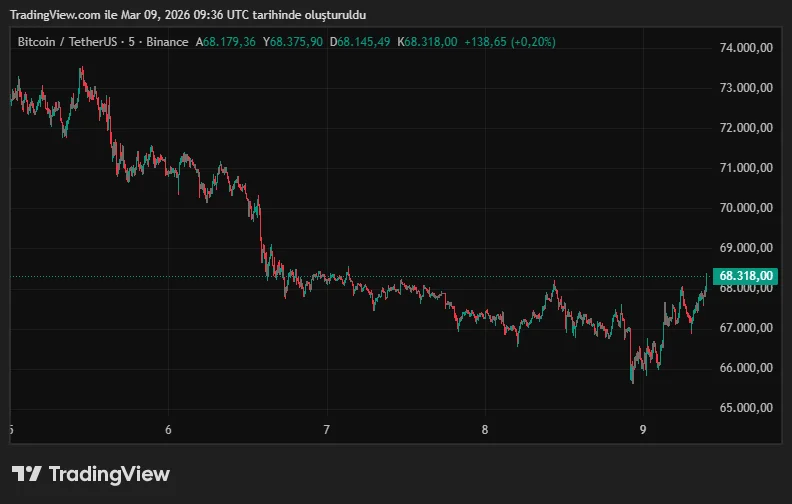
Thus, Bitcoin's price has returned to the levels before the short-lived rise last week.
Market research company CryptoQuant had previously stated that last week's rise might be a "relief rally" rather than the beginning of a new bull cycle. Recent price movements seem to support this view.
Oil prices created a shock effect in global markets
With the escalation of geopolitical tensions, oil prices have recorded a rapid increase in recent weeks. The price of crude oil rose above $110 per barrel, showing a daily increase of approximately 22 percent. The increase over the past month has exceeded 70 percent.
US President Donald Trump stated that the short-term increase in oil prices is "a small price to pay." Trump said that prices would rebalance once the Iranian nuclear threat is eliminated.
BTSE operations director Jeff Mei emphasized that oil prices could have far-reaching effects on the global economy. According to Mei, since oil is a basic input for many sectors, the increase in prices could trigger inflation and suppress global growth.
Mei also stated that the decline in Bitcoin is largely due to these economic concerns. However, he noted that the cryptocurrency has shown more resilience compared to past bear markets. According to the analyst, this may be due to the increasing share of institutional investors in the market.
Sharp declines in Asian stock markets
The rise in oil prices and increasing uncertainties have also led to significant losses in Asian stock markets. Economies dependent on energy imports were particularly affected by these developments.
Japan's leading stock market index, Nikkei, fell by approximately 7 percent on the first trading day of the week. South Korea's KOSPI index recorded a 7.9 percent drop. Hong Kong's Hang Seng index fell by 2.7 percent, and China's Shanghai Composite index lost 1.4 percent.
In recent years, it has frequently been stated that Bitcoin's correlation with traditional financial markets has increased. Data also supports this relationship. The 30-day Pearson correlation between Bitcoin and the Nasdaq Composite index reached 88 percent as of March 6.
ETF outflows and critical levels
Another factor increasing pressure on Bitcoin was the outflow of money from spot Bitcoin ETFs. A total net outflow of $576.6 million occurred on Thursday and Friday of last week.