
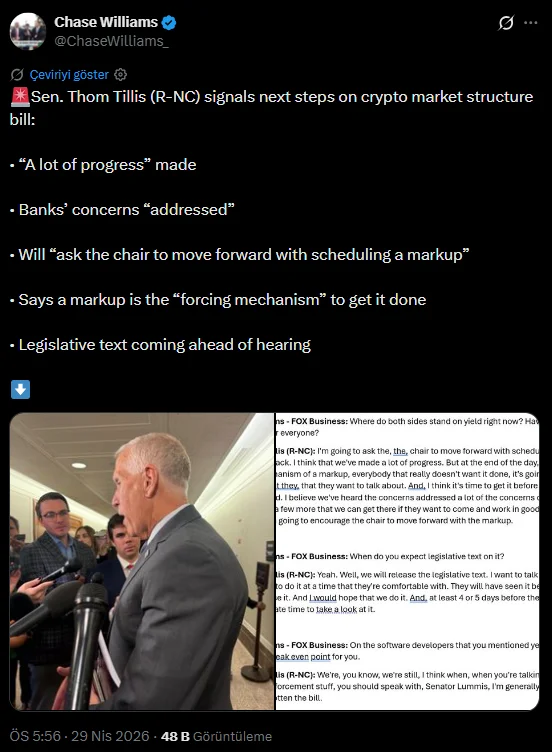
A comprehensive bill aimed at regulating the cryptocurrency market in the US has gained momentum again after a long period of uncertainty. In Senate negotiations, parties are discussing the possibility of moving to a critical "markup" process in mid-May, where the bill's provisions will be discussed and voted on in detail. However, despite the acceleration of the process, significant disagreements persist, particularly on issues such as ethical guidelines, stablecoin rewards, and regulations in the decentralized finance (DeFi) sector. Republican Senator Thom Tillis, in an interview with Fox Business, stated that he has requested Senate Banking Committee Chairman Tim Scott to establish a formal timetable for the bill's consideration. Tillis also indicated that he expects the new bill text to be ready a few days before the markup process. Nevertheless, he made it clear that he is not keen on proceeding with the bill in its current form. Specifically, Tillis stated that he would not support the bill if ethical regulations were not included, indicating that this issue has become central to the negotiations.
Stablecoins in the spotlight
One of the biggest sticking points regarding the bill is the incentive mechanisms for stablecoins. In addition, how DeFi protocols will be regulated and what tools will be used in the fight against crime are still unclear. The bill aims to regulate the crypto market in general and clarify the division of authority. In this context, it is planned to determine the division of duties between the US Commodity Futures Commission (CFTC) and the Securities and Exchange Commission (SEC). The similar regulation passed by the House of Representatives last year, known as "Clarity," is seen as a point of reference for the discussions in the Senate. On the Democratic side, ethical and illegal financing issues are particularly prominent. A statement from Senator Angela Alsobrooks' office emphasized that progress on these issues is needed to gain bipartisan support. However, Committee Chair Scott has not expressed a clear opinion on whether ethical regulations fall within his committee's jurisdiction. This situation creates uncertainty about which committee will shape the bill and how it will be brought to the final vote. Scott stated in his latest remarks that the process has entered the "red zone" and that Republican senators largely support the bill. The goal is to complete the committee stage in May and move the bill to the Senate floor in June or July. However, this requires the support of all Republicans and some Democrats, as a bill needs at least 60 votes to pass in the Senate. Political tensions are also complicating the process. Republican Senator John Kennedy's announcement that he will not support crypto regulation due to disagreements over a different bill reveals that party unity is not as strong as expected. At the same time, concerns that regulations in the DeFi space could weaken prosecutors' ability to combat financial crimes are deepening the debate. Ethical discussions have become even more visible due to the upcoming midterm elections. Democrats are expected to highlight the lobbying efforts of the crypto sector and Donald Trump's crypto connections in their election campaigns. While Trump's earnings from crypto ventures are estimated to reach billions of dollars, his family's ownership stakes in mining companies and the events he organizes for memecoin investors are also subject to criticism. Taking all these factors into account, the future of the bill remains uncertain. Industry sources estimate the chances of it passing this year at between 15 and 25 percent, while some analyses put the figure as high as 50 percent.