
VanEck CEO Jan van Eck said that the Bitcoin price is approaching its bottom. Speaking in an interview with CNBC, van Eck attributed the weak performance in 2026 to Bitcoin's four-year halving cycle and considered the current pullback a natural part of this historical structure.
Key Dynamics for Bitcoin Price
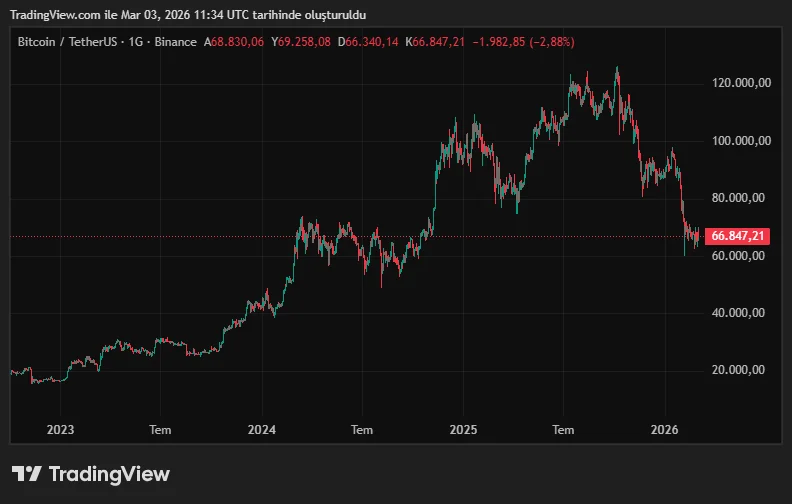
According to van Eck, there are two key elements that determine Bitcoin's price dynamics: the limited supply of 21 million and the block reward halving that occurs every four years. This mechanism halves the amount of Bitcoin miners receive and gradually reduces the new supply in the market. The CEO recalled that in past cycles, Bitcoin rose for three years, and experienced a sharp correction in the fourth year. He emphasized that 2026 also coincides with this "fourth year". “Bitcoin rises for three consecutive years, then pulls back significantly in the fourth year. 2026 is that fourth year. Therefore, we are in a bear market. However, we are currently seeing a bottom formation,” said van Eck, noting that they interpret price movements through cyclical structures rather than complex macro narratives. Indeed, historical data shows that post-halving peaks generally occur within 12 to 18 months. The decline of Bitcoin from its peak of around $126,000 to the $60-70,000 range in the last cycle is similar to corrections in past bear markets. The on-chain analytics company CryptoQuant also previously indicated a potential bottom formation between June and November 2026 in its assessment. However, there is no complete consensus among market participants. Some analysts argue that Bitcoin has become too institutionalized to be explained solely by the halving cycle. Strong demand for spot Bitcoin ETFs, global liquidity conditions, a weakening dollar, and positive developments on the regulatory front are suggested to be more decisive factors influencing the price. On the other hand, Bitcoin has shown signs of recovery in recent days. The price rose by over 7% on a weekly basis, settling in the $68,000 range. This movement coincided with increased geopolitical tensions following the US and Israeli airstrikes against Iran. While Iran's retaliatory actions increased risk perception in global markets, Bitcoin's limited but positive divergence was noteworthy.
Van Eck believes that this recovery may be partly linked to geopolitical developments. He pointed out that the use of crypto assets as a means of payment is widespread, especially in the Middle East, and stated that transfer channels outside the banking system gain importance during periods of uncertainty. He said that in a resolution process, fund movements could be made through crypto payment infrastructures instead of traditional banks.
6-12 months are critical
However, historical examples show that bear markets generally form a permanent bottom within 6 to 12 months. A few unsuccessful attempts at upward movement are considered normal during this period. Therefore, the question of whether the current recovery is the beginning of a new bull trend or a temporary relief rally is not yet clear. The Bitcoin market is once again at a critical juncture. For those who believe in the halving cycle, the picture is familiar; for those who emphasize the weight of institutional capital, however, a new era is underway. The price reaction in the coming months will show which of these two narratives is more dominant.