
The latest employment data from the US has presented a striking picture for global markets. The data released for February deviated significantly from economists' expectations, indicating an unexpected weakening in the US labor market. While an increase in non-farm payrolls was expected, the negative data came as a surprise to the markets.
According to data released by the US Bureau of Labor Statistics (BLS), non-farm employment decreased by 92,000 people in February. Market expectations were for an increase of approximately 55,000 people. The previous month's data showed an increase of 130,000 jobs. Thus, the strong performance seen in the US labor market in recent months has given way to a weaker picture than expected.
The unemployment rate also rose above expectations. From 4.3% in January, the unemployment rate increased to 4.4% in February. Economists had expected unemployment to remain at the same level. This increase is interpreted as a signal that a gradual cooling has begun in the labor market. However, the upward trend in wages continues. Average annual earnings rose to 3.8%, slightly exceeding expectations. Market expectations were at 3.7%. The fact that wage increases continue to exceed inflation indicates that the US economy is still resilient in some areas.
Surprise drop in employment surprised markets
The US labor market had performed stronger than expected in recent months. The 130,000 increase in employment announced in January had temporarily pushed expectations of an economic slowdown into the background. This data led to interpretations that the US Federal Reserve might be more cautious about cutting interest rates. However, the February data could change this picture. The negative non-farm payrolls figure brought the possibility of a slowdown in economic activity back to the forefront. Analysts note that the strong data, especially at the beginning of the year, may have been due to seasonal factors.
It was thought that temporary factors such as the holiday season and warmer weather increasing construction activity played a role in the stronger-than-expected employment increase in January. With these effects disappearing in February, a more realistic picture of the labor market may have emerged.
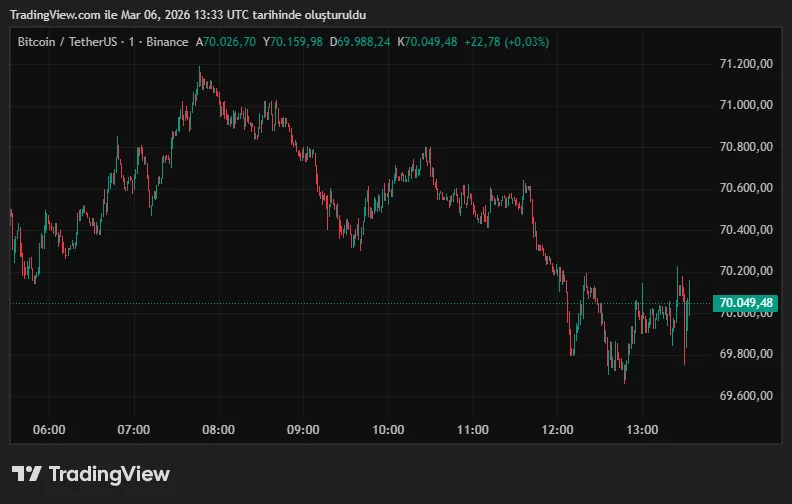
Short-term fluctuations were observed in the cryptocurrency market following the weak employment data from the US. Minutes before the data release, the Bitcoin price fell from around $70,600 to the $69,800 range. Although a limited recovery was seen afterwards, a cautious outlook prevailed in the market. At the time of writing, Bitcoin is trading at around $70,593, showing a loss of approximately 2.79% in the last 24 hours. On the intraday chart, it is noteworthy that selling pressure increased after the data, and a rapid drop below the psychological level of $70,000 was observed.
Critical Signals for Fed Policy
This weakening in the US labor market may also affect investors' expectations regarding the Federal Reserve's (Fed) monetary policy. Slower employment growth can be interpreted as the Fed being closer to interest rate cuts.
Fed officials have long emphasized that a strong labor market keeps inflationary pressures alive. Therefore, a significant cooling in the employment market is considered an important development that could increase the likelihood of monetary policy easing.
However, wage increases exceeding expectations presents a complex picture for the Fed. The continued rapid rise in wages has not completely eliminated concerns that inflation may be persistent.
Crypto markets were cautious before the data release.
The US employment data is considered an important indicator not only for traditional financial markets but also for cryptocurrency markets. This is because the Fed's interest rate policy can directly affect the price movements of crypto assets.
Before the data was released, a cautious outlook prevailed in the crypto market. Bitcoin was trading around $70,900, having lost more than 1% in the last 24 hours. Similarly, limited pullbacks were seen in major altcoins such as Ethereum, XRP, and Solana.
Analysts believe that weaker-than-expected employment data could create a positive catalyst for crypto markets in the medium term. A weaker labor market could increase the likelihood of the Fed moving towards interest rate cuts, which could be supportive for risky assets. However, the initial market reaction is expected to be quite volatile. Data that deviates from expectations can often lead to sharp short-term price movements in both traditional markets and crypto assets.