
The leak of the CLARITY Act draft, which closely concerns the stablecoin market in the US, has caused sharp fluctuations in both crypto companies and markets. The possibility of regulation directly targeting the revenue model of Circle, the issuer of USDC, in particular, led to a significant drop in the company's share value.
Circle Shares Fall Sharply
Following the leaked draft, Circle Internet Group shares fell by approximately 20%, from $126.64 to $101.17. This drop wiped out approximately $5.6 billion from the company's market capitalization. Similarly, Coinbase shares also lost 11% of their value.
The main reason for this sharp market movement was the signals that the CLARITY Act could prohibit offering "interest-like returns" on stablecoins. According to the draft text, all models that directly or indirectly generate interest income through stablecoins are targeted. This is particularly critical for Circle, as approximately 96% of the company's revenue comes from interest income earned from its USDC reserves. Some market commentators emphasize that the decline is not related to ARK Invest's sales. Despite Cathie Wood's $5.9 million sale on March 20th, the main trigger is said to be regulatory risk.
What does the yield ban mean?
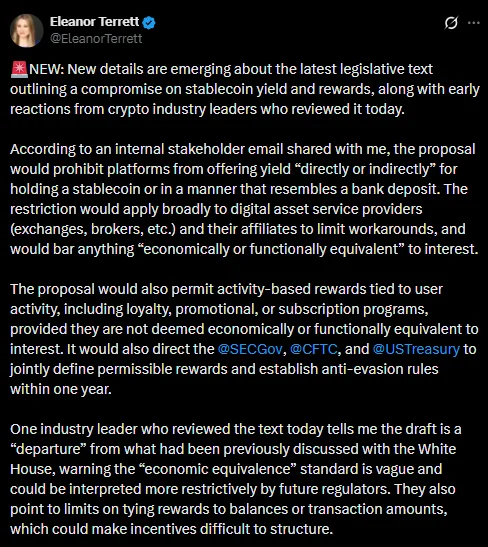
The draft regulation aims to prevent stablecoins from becoming a structure similar to interest-bearing deposits in banks. In this context, all incentive models that are "economically or functionally equivalent to interest" may be included in the ban.
However, a completely incentive-free structure is not envisioned. Rewards based on user behavior; for example, mechanisms similar to staking, loyalty programs, or incentives given in exchange for providing liquidity may be allowed within certain limits. However, how these limits will be drawn is not yet clear.
The US Securities and Exchange Commission (SEC), the Commodity Futures Commission (CFTC), and the Treasury Department are expected to define the framework of these incentive models within a year after the regulation comes into effect. During the same period, it is also planned to create additional rules against "attempts to circumvent the ban".
Disagreements deepen within the sector
The draft text has led to differing interpretations within the sector. Some experts believe the regulation is more restrictive than previous discussions with the White House. In particular, it is noted that the phrase "economic equivalence" can be interpreted broadly and could put many business models at risk.
Another group argues that this is an expected framework. According to this view, the regulation aims to protect the use of stablecoins as a means of payment while preventing them from being transformed into an interest-bearing investment vehicle. This approach means that the boundaries between traditional finance and crypto are drawn more clearly.