
BTC Technical Analysis
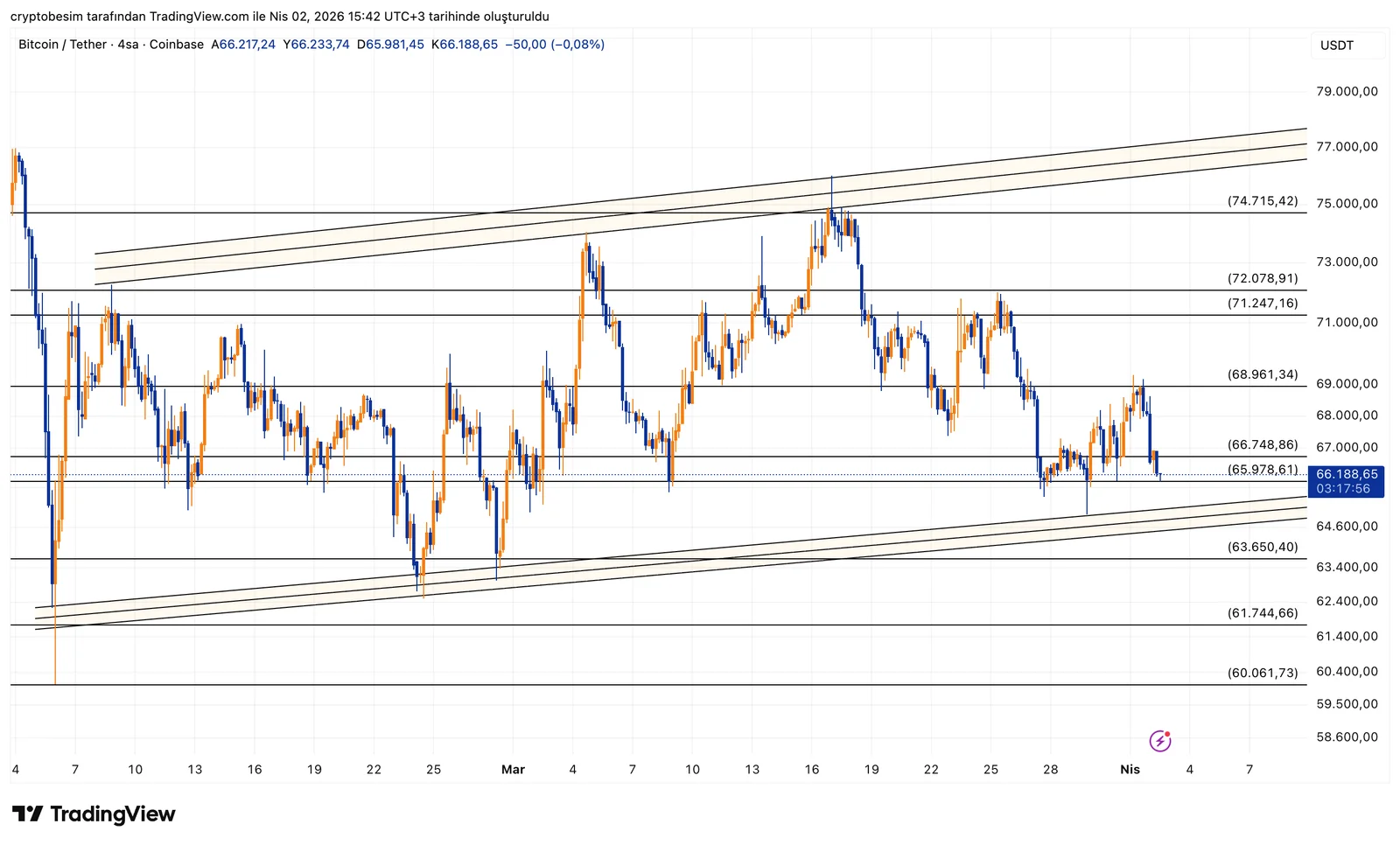
On the BTC side, the structure is progressing quite cleanly. The ascending channel has been working consistently for a while, and price continues to move within it in an orderly manner. At the same time, there is strong alignment with Fibonacci levels, meaning both horizontal support-resistance zones and the trend structure are supporting each other.
Currently, price has pulled back to the 66,000 level. This is not only a horizontal support but also an area where short-term balance is established. Just below it lies the trend support, which is the critical part. So rather than a single level, we are looking at a support zone.
As long as price stays above this area, the structure is not considered broken. Pullbacks remain within the trend, and the ground for upward attempts continues to form. That is why the reaction here is important.
On the downside, the 63,600–64,000 range is close to the lower boundary of the channel. If 66,000 is lost and price moves toward this area, it becomes the final support zone. Losing this region would signal structural weakness and bring the possibility of a deeper correction into play.
On the upside, during the first recovery, the 68,900–71,200 range becomes the target again. If this area is broken, price can move back toward the mid-upper band of the channel. Beyond that, 72,000 and 74,700 act as resistance levels.
In summary, price is currently near the lower part of the channel, at a critical zone. If this area holds, the trend continues. If it is lost, the structure weakens significantly in the short term.
- The 66,000 level acts as the main short-term support
- The 63,600–64,000 range is the lower boundary of the channel and the final holding area
- Losing this region increases the risk of a deeper correction
- The 68,900–71,200 range is the first recovery target
- 72,000 and 74,700 are upper resistance levels
These analyses do not provide investment advice and focus on support and resistance levels that are considered to offer short- and medium-term trading opportunities depending on market conditions. However, responsibility for execution and risk management lies entirely with the user. In addition, the use of stop loss is strongly recommended.