
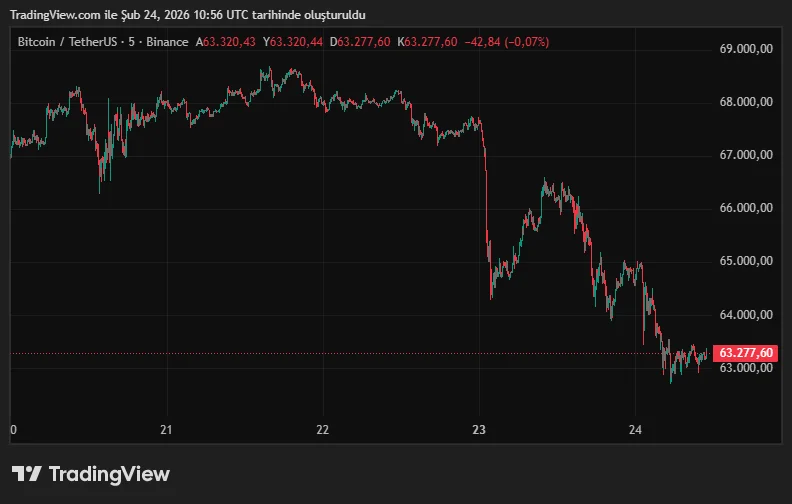
Bitcoin started the week weakly, falling below $63,000. Increased anxiety in global markets accelerated the flight from risky assets, and the cryptocurrency market also felt the effects.
The leading cryptocurrency was trading at around $63,073 at the time of writing. Having lost approximately 8% of its value in the last week, Bitcoin is once again approaching the $60,000 region it tested in early February. The monthly decline is approaching 30%. This suggests that the selling pressure may not be limited to short-term fluctuations.
The market deterioration is not limited to the charts. The Crypto Fear and Greed Index, which measures investor sentiment, fell to 8, entering the "extreme fear" zone. This level indicates a significant weakening of risk appetite in the market.
On the macro front, trade tensions are back on the agenda. US President Donald Trump's increase of temporary import tariffs from 10% to 15% has suppressed global risk appetite. This move, following the Supreme Court's annulment of the previous tariff framework, has increased uncertainty. The sell-off seen in stocks has also been reflected in crypto assets. Experts note that Bitcoin's current pullback is progressing in parallel with the weakness in stock markets. Rising geopolitical tensions and tariff uncertainty are causing investors to take cautious positions. In this environment, the $60,000 level stands out as a critical threshold for Bitcoin.
What other developments are affecting the Bitcoin price?
There is also a noteworthy picture on the miners' side. On-chain data shows that miners are experiencing one of the longest selling periods of the year. Since the beginning of January, the net position change of miners has been negative. This reveals that miners are selling reserves instead of accumulating.
The decline in revenue supports this trend. Monthly revenue from transaction fees on the network fell from 194 BTC in May last year to 65 BTC as of February. This decrease of approximately two-thirds shows that miners are facing cash flow pressure. As prices fall, declining revenues are becoming a factor that increases selling pressure.
Weakness is also noticeable on the institutional investor front. Spot Bitcoin ETFs have experienced uninterrupted outflows for six weeks. This is the longest weekly outflow streak since the launch of ETFs. The reduction of positions by large investors is increasing the fragility of the market.
In the derivatives markets, the liquidation of leveraged transactions has accelerated. A total of $381.89 million worth of positions were liquidated in the last 24 hours. Approximately $289 million of this consisted of long positions. In other words, transactions opened with the expectation of a rise were the most affected by the selling wave.
In Bitcoin, the $63,300 and $65,400 levels are being watched as important resistance levels in the short term. If these levels are regained, the possibility of a recovery may strengthen. However, a loss of $60,000 could accelerate sales and pave the way for a new wave towards the $54,000-$50,000 range.
The market is currently in a delicate balance. Miner sell-offs, ETF outflows, and macroeconomic uncertainty have all come together. The $60,000 level stands out as the boundary between stability and a deeper correction in this cycle. For investors, the price reaction around this region in the coming days will be crucial.