
Bitcoin struggled to hold above $65,000, but the sharp drop in the early hours of the week increased market volatility. Selling pressure seen as Asian trading began on Monday pushed the price down to below $64,000 overnight; however, a recovery above $65,000 was seen again by morning.
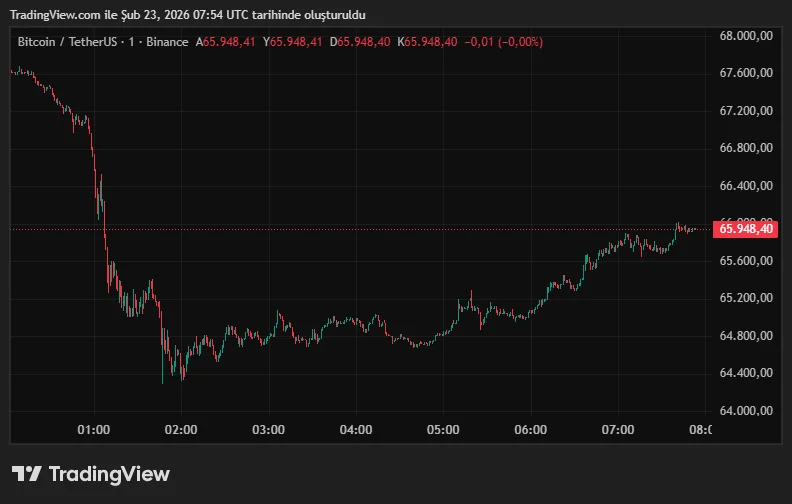
Sharp selling overnight, rebound buying in the morning
Bitcoin rapidly fell from $67,600 on Sunday night to around $64,300 in a short time. Losing over 4% in approximately two hours, the decline triggered chain liquidations, particularly in leveraged trades. According to market data, approximately $360 million worth of long positions were liquidated in just one hour. Daily total liquidations exceeded $240 million.
In the latest price, Bitcoin is trading in the $65,900 range. The intraday low was recorded around $64,400, while the $66,000 region is being watched as a short-term resistance. Following the sharp sell-off overnight, subsequent buying activity indicates that the market has not completely lost control.
Ethereum followed a similar trend. The ETH price fell by over 5%, dropping to the $1,850 range. XRP fell by approximately 6% to $1.33, while Solana's losses exceeded 8%. The weakness in major altcoins clearly revealed the narrowing of risk appetite.
The total cryptocurrency market capitalization fell by over 4% in 24 hours, dropping to around $2.2 trillion. This level is close to the lows tested during the year. Analysts emphasize that the $2 trillion threshold is psychologically critical.
What is behind the sell-off?
Macroeconomic developments stood out as the driving force behind the selling pressure. The 0.8% decline in US January pending home sales, the lowest level since data collection began in 2001, raised questions about the economic outlook. Weak data reinforced a cautious stance in risky assets. In addition, US President Donald Trump's announcement that he would raise the general tariff on all imports from 10% to 15% increased uncertainty in global markets. While the decision is said to take effect on February 24th, the fact that the new legal framework is controversial following the US Supreme Court's annulment of previous tariffs has made investors cautious. The sharp appreciation of the Japanese yen also affected global fund flows. The expectation that the Bank of Japan might move towards a tighter monetary policy led to a reduction in leveraged positions. This deepened selling pressure on risky assets, including cryptocurrencies. On the other hand, a five-week streak of net outflows from spot Bitcoin ETFs traded in the US is noteworthy. A total of $3.8 billion in outflows occurred in the last five weeks, while net outflows since the beginning of the year reached $4.5 billion. This weakening in institutional demand is seen as one of the factors increasing pressure on prices. However, some indicators do not point to an entirely pessimistic picture. It is reported that large investors have accumulated approximately 200,000 BTC in the last month. Furthermore, the decline of short-term risk indicators to levels similar to past cycle lows points to a possible search for equilibrium from a technical perspective.
In the short term, the $60,000 level stands out as strong support, while sustained levels above the $65-66,000 band could strengthen the market's recovery momentum. The re-emergence of $70,000 largely depends on a decrease in macroeconomic uncertainty and the resumption of inflows from the ETF market.