
April inflation data in the United States renewed caution across global markets. According to the Consumer Price Index released by the Bureau of Labor Statistics, annual inflation rose to 3.8% in April. This marked the highest level in three years. Annual inflation had stood at 3.3% in March and 2.4% in February.
Markets had expected inflation to rise to 3.7%. However, the reported figure came slightly above expectations. The main driver behind the increase was the sharp rise in energy prices. The conflict in the Middle East has started to weigh on the U.S. economy, especially through higher fuel prices.
According to the data, gasoline prices rose 28.4% year over year. Core inflation, which excludes volatile food and energy prices, also increased from 2.6% in March to 2.8%. This raised concerns that price pressures may not remain limited to energy.
Oil Prices Put Pressure on Markets
Energy prices stood out as one of the most important parts of the report. The closure of the Strait of Hormuz caused a sharp increase in global crude oil prices. This development directly affected pump prices in the United States. According to AAA data, gasoline prices reached $4.50 per gallon on Tuesday. Diesel prices also climbed to $5.64, approaching an all-time high.
In recent days, optimism over a possible ceasefire deal had helped limit energy prices to some extent. However, that optimism weakened after U.S. President Donald Trump described Iran’s response to the latest proposal as “unacceptable.” Trump also said the possibility of a month-long ceasefire was under serious pressure.
Higher fuel prices are creating a new source of pressure for household budgets and business costs in the United States. For this reason, some lawmakers proposed suspending federal fuel taxes to provide temporary relief for drivers. Still, such a move may have only a limited effect on inflation. The main source of the price increase appears to be the tightening in global energy supply rather than domestic tax rules.
Bitcoin Tries to Stay Above $80,000
Following the inflation data, the crypto market also showed a cautious outlook. According to market data, Bitcoin was trading around $80,803 at the time of writing. The leading cryptocurrency was down 0.37% over the past 24 hours, while its daily trading range stood between $80,487 and $82,041.
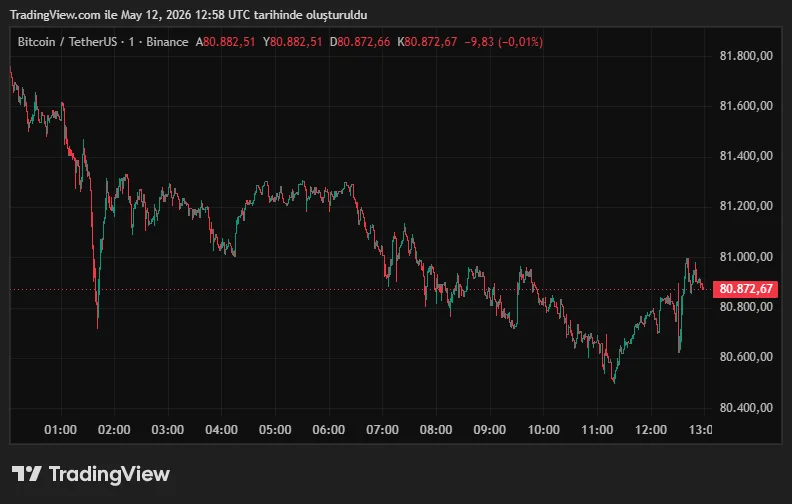
The short-term chart shows that Bitcoin moved in a volatile range during the day. The price traded near $81,800 in the early hours before facing downward pressure and falling toward the $80,500 area. It later saw a limited recovery and moved back above $80,800. This move shows that investors are closely watching inflation data and energy-driven macro risks.
Bitcoin’s gain of more than 13% over the past 30 days suggests that the broader trend has not fully weakened. However, the 24-hour decline and limited weekly loss show that the market has become more sensitive to new data. In particular, the renewed acceleration in U.S. inflation may strengthen expectations that the Fed will take a more cautious approach to rate cuts.
For the crypto market, this picture can be read in two ways. On one hand, high inflation may support Bitcoin’s long-term “store of value” narrative. On the other hand, expectations that interest rates may stay higher for longer could pressure risk assets. For this reason, Bitcoin’s attempt to hold above $80,000 will remain important for short-term market sentiment.
Markets are now watching both energy prices and signals from the Fed. If inflation remains persistently above 3%, volatility may increase across a wide range of risk assets, from stocks to cryptocurrencies. For Bitcoin, the $80,000 level stands out as short-term support, while the $82,000 area appears to be the first resistance zone.