
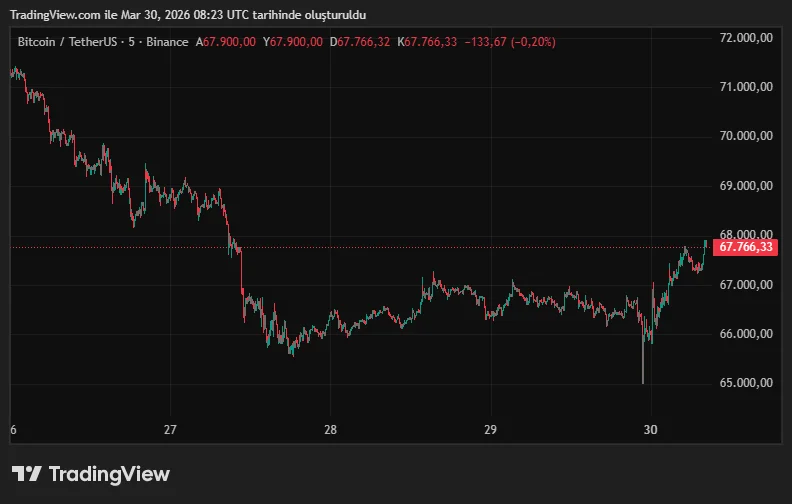
The cryptocurrency market is exhibiting a cautious outlook in recent days, influenced by rising geopolitical tensions and macroeconomic uncertainties. Bitcoin, after rising to levels as high as $71,000 last week, has retreated and is trying to find equilibrium around the $66,000 mark. This lack of direction in the market indicates that the "risk aversion" trend is gaining strength, particularly with the escalating US-Iran tensions in the Middle East.
After experiencing a brief but sharp drop over the weekend, Bitcoin price fell to $65,000 before recovering and trading in the $66,000-$67,000 range. However, the fact that the price is still below last week's peaks reveals that investors are maintaining a cautious stance. On the other hand, it is noteworthy that Bitcoin is trading approximately 47% below its October 2025 target of $126,000.
Geopolitical tensions and oil prices are putting pressure on the market
According to analysts, the weak market outlook is fundamentally rooted in the ongoing tension between the US and Iran. Iran's attacks on some countries in the Gulf region and the deadlock in diplomatic talks are increasing uncertainty in global markets. Developments, particularly around the Strait of Hormuz, are triggering concerns about energy supply, causing oil prices to rise.
Rising oil prices, in turn, are pushing inflation expectations higher. This weakens the likelihood of the US Federal Reserve cutting interest rates, putting pressure on risky assets. Cryptocurrencies are also exhibiting a similar performance to traditional risk assets, experiencing selling pressure.
The fact that the fear and greed index, which measures market sentiment, is at the "extreme fear" level indicates that investor psychology remains weak. Experts believe that if current conditions continue, Bitcoin could retreat towards the $60,000 level.
The ETF market reversed direction
Another reflection of macroeconomic pressure was seen in spot Bitcoin ETFs. While a total net outflow of approximately $290 million was experienced last week, the $225 million outflow seen on the last trading day of the week was particularly noteworthy. This figure was recorded as the sharpest single-day outflow of the week. One of the largest outflows occurred in BlackRock's IBIT fund. The outflow of over $200 million from this fund in a single day was noteworthy.
Analysts state that these outflows are largely related to the "risk-off" trend and quarter-end portfolio rebalancing. However, some experts emphasize that weekly ETF data alone does not indicate a structural trend change, and that hedge fund strategies also play a role in these flows.
Individual and institutional investors diverge
One of the interesting developments in the market is the divergence in the behavior of individual and institutional investors. While individual investors largely remain cautious and stay away from the market, institutional investors are said to be acting with a longer-term perspective.
The renewed inflows into spot Bitcoin ETFs in recent months and the preparation of new products by some large financial institutions indicate that structural demand continues on the institutional side. According to experts, historically, in periods where such divergences occur, the direction of institutional investors can be decisive in the long term. Eyes on macroeconomic data and possible scenarios
The US macroeconomic data to be released in the coming days is also being closely monitored in the market. It is thought that a short-term recovery in risky assets may be seen, especially if unemployment claims and non-farm payroll data come in below expectations.