AI16Z, once at the center of the AI-focused cryptocurrency frenzy, has gone from a multibillion-dollar valuation to the brink of closure in just 19 months. Shaw Walters, founder of Eliza Labs, announced that the project was ending all support for its successor token, ELIZAOS, and told holders to sell their tokens.
In an Aug. 4 post on X, Walters said ELIZAOS no longer had a future. The ElizaOS Foundation is winding down, while the team will no longer pursue token buybacks, supply reductions or other measures designed to support the price.
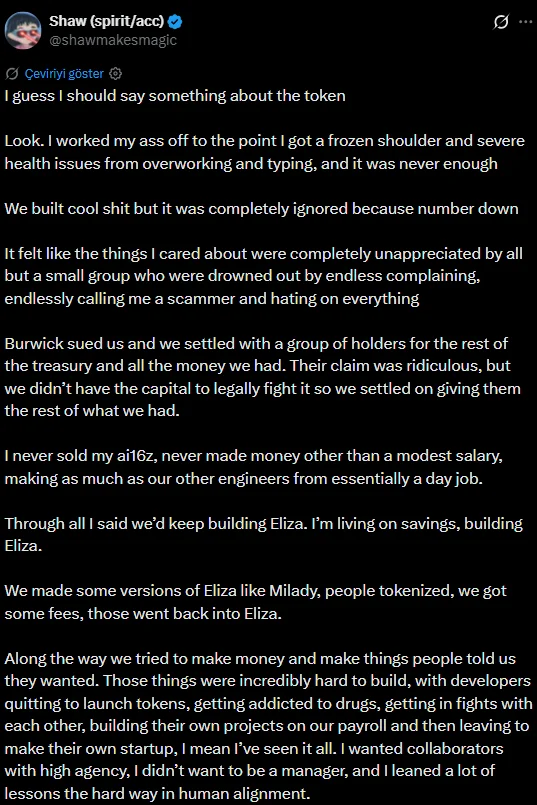
“The token is dead. Completely,” Walters wrote. He said he would continue developing the ElizaOS software but made it clear that he had no plans to launch another token to fund the project.
ELIZAOS lost 97 percent of its value
Following the announcement, ELIZAOS traded near $0.00031, giving the token a market capitalization of approximately $2.3 million. That level represented a decline of roughly 97 percent from its peak.
The project’s original token, AI16Z, reached a market capitalization of $2.39 billion on Jan. 2, 2025. Daily trading volume climbed to $291 million at the time, making AI16Z one of the largest cryptocurrencies in the AI token sector.
The team later launched a migration that replaced AI16Z with ELIZAOS. Despite the transition, CoinGecko continues to list the abandoned AI16Z contract as a separate asset. Its market capitalization stood at around $375,000 in the early hours of Aug. 5.
Walters said the tokens held in his personal wallet were once worth approximately $25 million. According to the founder, their value fell toward zero as the project encountered mounting problems and lost market confidence.
Lawsuit drained the foundation’s treasury
A proposed class-action lawsuit played a decisive role in the closure of the ElizaOS Foundation. Walters said the foundation transferred its remaining tokens and available cash to settle with a group of holders represented by Burwick Law.
Burwick Law filed the proposed class action in the U.S. District Court for the Southern District of New York in April. The plaintiffs raised allegations of false advertising, deceptive business practices, negligent misrepresentation and unjust enrichment.
According to the complaint, the team marketed the project as an “autonomous, AI-managed venture fund.” The plaintiffs, however, alleged that Walters and other insiders retained control over the project and its investment decisions.
The lawsuit also addressed the dilution of existing holders during the migration from AI16Z to ELIZAOS. The plaintiffs claimed that entities controlled by the project’s managers received 40 percent of the newly minted tokens.
Walters described the holders’ claims as “ridiculous.” Still, he said the ElizaOS Foundation lacked the capital required to fight a prolonged legal battle and therefore chose to settle.
The financial terms of the settlement remain undisclosed. Eliza Labs and Burwick Law have yet to provide detailed information about how much holders received or the current status of the federal case.
The AI16Z name had also sparked controversy
The project launched on Solana under the AI16Z name in October 2024. The name was an apparent reference to “a16z,” the widely used abbreviation for Silicon Valley venture capital firm Andreessen Horowitz.
Andreessen Horowitz objected to the use of the name, contributing to the project’s decision to rebrand as ElizaOS. Walters and his team later changed the token’s name to ELIZAOS and began moving holders to the new contract.
The transition aimed to achieve more than resolving a branding dispute. The team also sought to emphasize its open-source ElizaOS AI agent framework and move the project away from its identity as a speculative token.
However, falling prices, criticism of the token migration and the lawsuit disrupted that strategy. Walters argued that investors ignored the software tools developed by the team because the token’s price continued to decline.
The AI agent frenzy proved short-lived
AI16Z became one of the leading projects in the rapidly growing AI agent token category in late 2024. It attracted attention with a venture capital model in which token holders participated as partners while an AI agent supposedly made investment decisions.
Truth Terminal and the GOAT token launched around it played an important role in the rise of this market narrative. GOAT reached a market capitalization of $1.2 billion within days of its October 2024 launch, fueling demand for tokens linked to AI agents.
Projects such as Virtuals Protocol and AI16Z subsequently reached multibillion-dollar valuations. The sector promised to build a new crypto economy around software agents capable of controlling their own wallets, posting on social media and making independent decisions.
The open-source ElizaOS software will continue operating despite the token’s collapse. ELIZAOS holders, meanwhile, have been left without foundation support, a buyback program or another migration plan.