U.S. inflation came in line with expectations in July, prompting only a limited reaction across the crypto market. Bitcoin held near $64,000 following the release but failed to begin a strong rally.
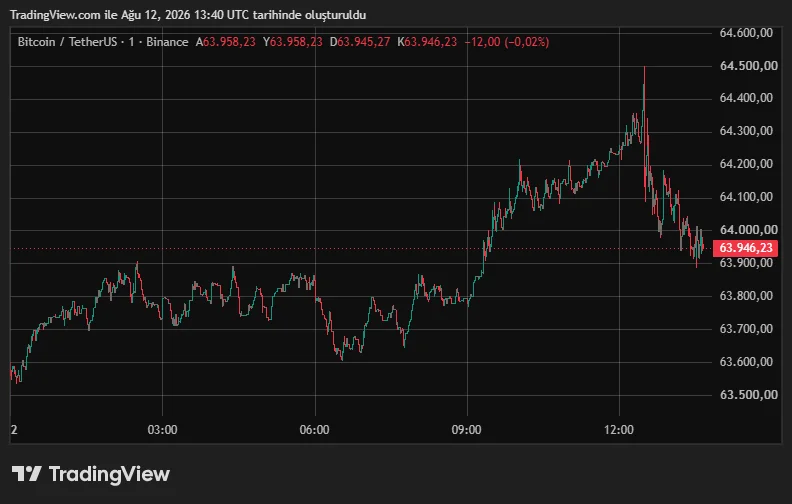
Bitcoin was trading at around $63,900 as of 4:30 p.m. Turkish time. BTC was down approximately 0.4% over the previous 24 hours after moving between an intraday low of $63,204 and a high of $64,298.
Ethereum hovered near the $1,900 mark. With the U.S. inflation figures matching forecasts, Bitcoin and altcoins avoided a sharp repricing in either direction.
U.S. inflation matched expectations
According to the U.S. Bureau of Labor Statistics, the Consumer Price Index rose 0.1% month over month in July. Annual inflation eased from 3.5% in June to 3.4%.
Market expectations also pointed to a monthly increase of 0.1% and an annual rate of 3.4%. The report therefore did little to change investors’ existing positions on the interest-rate outlook.
Core CPI, which excludes volatile food and energy prices, increased 0.2% month over month in July. Annual core inflation slowed from 2.6% to 2.5%.
The energy index fell 1.5% during the month, while gasoline prices declined 2.9%. Shelter costs rose 0.1% and accounted for roughly two-thirds of the monthly increase in headline inflation.
Despite the slowdown, annual inflation remains above the Fed’s 2% target at 3.4%. This prevented uncertainty surrounding monetary policy from disappearing entirely.
Bitcoin remains below $64,000
Bitcoin was trading between $63,700 and $64,000 before the inflation report. The price briefly fluctuated following the release but remained within its established trading range.
The figures matching expectations contributed to BTC’s muted reaction. A lower-than-expected inflation reading could have reduced the probability of another rate increase more decisively and supported risk appetite across crypto assets.
A higher-than-expected result could have pushed U.S. Treasury yields and the dollar higher, placing pressure on Bitcoin. Since the report triggered neither scenario, BTC remained close to $64,000.
Bitcoin has traded within a broad range of $62,000 to $66,000 in recent weeks. The inflation report did not provide a strong enough catalyst to push BTC beyond those boundaries.
The first resistance levels to watch in the short term are $64,300 and $65,000. If selling pressure increases, attention could return to $63,200, followed by the $62,000 region.
Ethereum hovers around $1,900
Ethereum traded near $1,900 following the inflation report. ETH moved between $1,855 and $1,919 over the previous 24 hours.
Holding above $1,900 will be important for Ethereum’s short-term recovery. If the level is lost, traders could begin watching $1,850 and $1,800 as potential support areas.
The broader altcoin market also showed a limited response. Some lower-cap tokens recorded independent gains, but the inflation report did not spark a market-wide wave of buying.
Why does the Fed’s decision matter for Bitcoin?
Fed funds futures are pricing in an approximately 55% probability that the central bank will leave its policy rate unchanged within the 3.50%–3.75% range at its September 15–16 meeting. That expectation changed only slightly following the inflation report.
Keeping rates unchanged could reduce the risk of further monetary tightening for Bitcoin. Higher interest rates and bond yields can draw investors toward yield-bearing traditional assets and weaken liquidity across the crypto market.
Expectations of lower interest rates can place pressure on the dollar and Treasury yields, supporting risk assets such as Bitcoin. However, the Fed has yet to signal a rate cut, while inflation remains above its target.
The U.S. economy’s loss of 23,000 jobs in July is another factor that could make it harder for the central bank to raise rates. The Fed is now trying to balance elevated inflation against signs of weakness in the labor market.
Which data will the crypto market watch next?
The next major event for crypto investors will be the U.S. Producer Price Index, due on August 13. Producer inflation can provide information about the cost pressures facing businesses and the possible direction of consumer prices in the coming months.
The Fed will also receive August employment and consumer inflation figures before its September meeting. Those reports could shift the balance between a rate increase and another hold.
The renewed rise in oil prices is also being closely monitored by the crypto market. If higher energy costs feed into August inflation, concerns about tighter Fed policy could return.
Bitcoin’s short-term outlook remains tied to the $62,000–$66,000 range. Although the inflation report helped limit downside risks, a lasting break above $66,000 may be needed before a new upward trend can emerge.