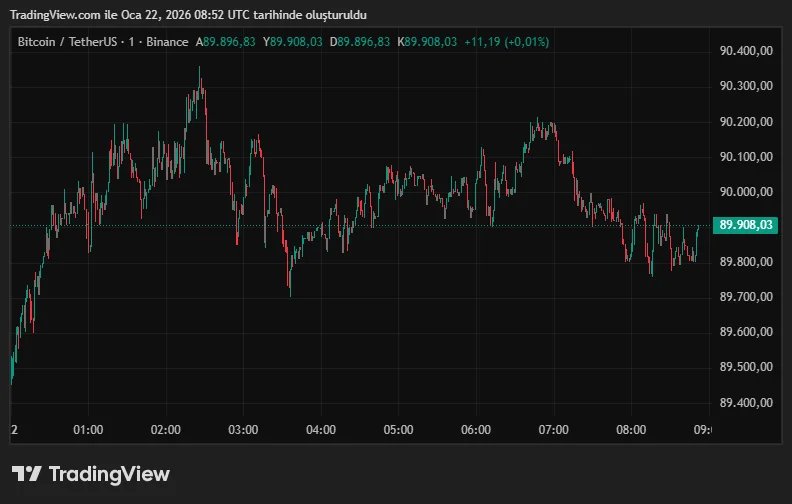
Cryptocurrency markets experienced sharp fluctuations following Donald Trump's messages in Davos. Bitcoin briefly dropped below $88,000 before recovering to the $90,000 level. This movement was driven by Trump softening his tariff threats against Europe over Greenland. This reversal created a sudden relief in crypto markets, which have become extremely sensitive to macroeconomic developments in recent days.
The volatile trend once again demonstrated the impact of Trump's Davos engagements at the World Economic Forum on cryptocurrency prices. At the beginning of the week, harsh tariff rhetoric against Europe and rising global bond yields weakened risk appetite, leading to rapid sell-offs in crypto assets. The sharp sell-offs, particularly in long-term Japanese government bonds, tightened global financial conditions and forced investors to exit risky positions. However, the picture changed during Asian trading. Trump's statement that he would refrain from imposing tariffs on European countries that oppose US control over Greenland softened the market tone. Trump described this statement as "a framework for a future agreement." This statement reinforced the perception that a new trade war is not on the horizon in the short term and triggered a recovery in the crypto markets.
Donald Trump's softening of tariff rhetoric eased tensions in crypto
Bitcoin quickly recovered, approaching $90,000 after falling to around $87,300 overnight. Despite being positioned as an alternative store of value, Bitcoin continues to react with investors' risk-aversion reflexes during periods of uncertainty. A similar picture was seen in the altcoin market. Ethereum tested below $3,000 in the sell-off, then rose above $3,020, limiting its daily losses. Solana recovered to around $130, while XRP approached the $1.95 level again. Cardano rebounded from weekly lows, heading towards $0.37. Dogecoin also recovered some of its losses around $0.127. The overall picture pointed to a temporary search for equilibrium rather than a strong risk-on rally. The striking aspect of the market was the speed of these movements. Trump's harsh rhetoric triggered sell-offs, while equally rapid messages of conciliation reversed the price trend. Such "whipsaw" movements are becoming increasingly common in this market, where algorithmic and leveraged trading, reacting instantly to macroeconomic events, is gaining prominence. Diplomatic contacts also played a role in this process. Trump announced a "very productive" meeting with NATO Secretary General Mark Rutte and that an agreement had been reached on a framework for the future of Greenland and the Arctic region. Following this announcement, he stated that the planned tariffs on European Union countries would not take effect on February 1st. These messages, of course, also affected traditional markets. US futures indices rose, with the Nasdaq and S&P 500 gaining approximately 1.3 percent during the day. Gold, which approached record levels due to safe-haven demand, gave back some of its gains. In the coming days, investors will closely watch whether the relief stemming from Davos will be permanent. As of writing, the Bitcoin price has fallen to $89,750.