Standard Chartered Bank argues that Ethereum’s sharp price decline in recent months has fallen far behind what on-chain data suggests. The bank compares ETH’s current situation to Amazon stock during the 2001 dot-com crash.
Geoffrey Kendrick, Global Head of Digital Assets Research at Standard Chartered, referred to a 2018 speech by Jeff Bezos in a report shared on Thursday. Bezos had said that Amazon’s stock fell from $113 to $6 at the time, while the company’s internal metrics continued to improve throughout the same period. Kendrick makes the same point for ETH: the price is falling, but what is happening in the background has little to do with that.
“AMZN stock has risen 1,000x from its 2001 lows on a split-adjusted basis. ETH will also catch up with its internal metrics sooner or later. It is only a matter of timing,” Kendrick said.
Transaction volume and TVL hit records despite price decline
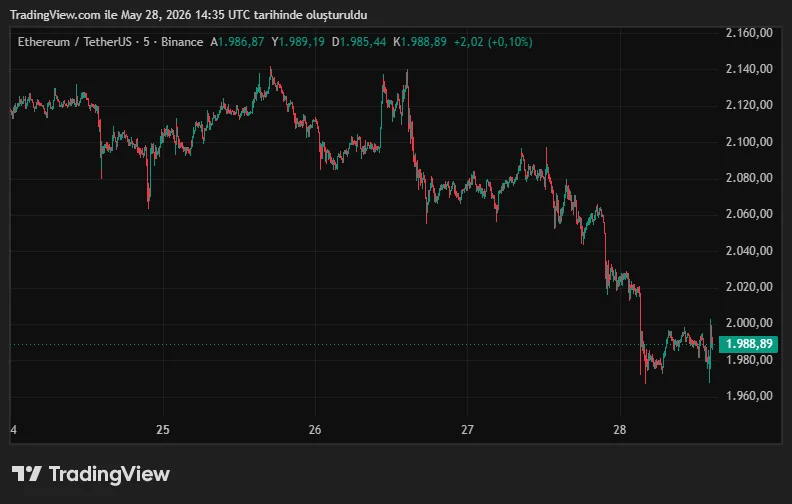
ETH has lost around 57% of its value since its August 2025 peak and is currently trading around $2,000. The ETH/BTC ratio has also declined by 37% over the same period. However, Ethereum’s transaction count and total value locked (TVL) measured in ETH remain close to all-time highs. In other words, the network is being used; the price is simply masking that activity.
According to Kendrick, this divergence is not permanent. Strong metrics will eventually be reflected in the price. The bank maintains its targets of $4,000 by the end of 2026 and $40,000 by the end of 2030. It also expects the ETH/BTC ratio to move back toward its 2021 highs, near the 0.08 level, by the end of this decade.
Stablecoin and RWA growth could support Ethereum
At the center of Kendrick’s bullish scenario are stablecoins and the growth of real-world asset (RWA) tokenization.
Currently, 54% of all stablecoins are on Ethereum. Since the beginning of 2026, one-third of Ethereum transactions have consisted of stablecoin transfers, while 60% of gross TVL also falls into this category. The bank forecasts that the total stablecoin market cap could rise from the current $321 billion to around $2 trillion by the end of 2028, representing sixfold growth. Such expansion would also proportionally increase Ethereum’s weight within the ecosystem.
The picture is even more striking on the tokenized RWA side. Ethereum accounts for 62% of non-stablecoin RWAs and 68% of active on-chain credit. Kendrick expects this sector to grow 50x by the end of 2028 and reach $2 trillion. “If RWAs multiply as we expect, the importance of this sector for Ethereum will become much more visible. Transaction counts and TVL will continue to break records, which will push the price higher,” he said.
Ethereum Economic Zone and regulatory groundwork
Kendrick also sees the upcoming Ethereum Economic Zone (EEZ) project as an important catalyst. EEZ is expected to allow assets to move more freely across the Ethereum ecosystem and reduce composability problems between protocols. It is also expected to reduce reliance on bridges, which have historically been vulnerable to cyberattacks. This could mark a step forward in both security and usability.
On the regulatory front, progress on the Clarity Act in the United States, the crypto market structure bill, also stands out. Kendrick believes a clearer legal framework would support decentralized finance (DeFi) growth and Ethereum activity.
In short, the picture is clear: the Ethereum network has become an infrastructure capable of carrying transactions and value at this scale. The price has not yet reflected this. Standard Chartered believes it is only a matter of time before this divergence closes. Here's Ethereum's current price: