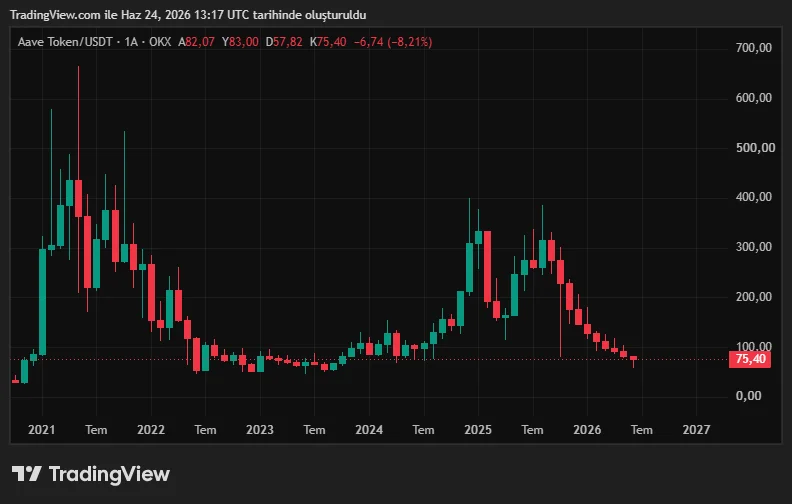
Geoff Kendrick, head of digital assets research at Standard Chartered, has initiated coverage of decentralized lending protocol Aave and set a price target of $3,500 for the token by the end of 2030. The target implies an increase of roughly 50x from AAVE’s current level of around $70.
According to Kendrick’s report, if this forecast materializes, Aave will outperform both bitcoin and ether over the same period. The analyst said the protocol has moved past the cyber theft incident that took place in April and that assets have started returning to the platform. Kendrick believes Aave is well positioned to maintain its dominance in on-chain lending.
The April incident, which shook the sector, began with the collapse of KelpDAO’s rsETH bridge. Attackers used around $290 million worth of stolen tokens as collateral on Aave to borrow real assets. This exposed Aave to a potential loss risk of up to $230 million, triggered panic withdrawals among depositors and showed how a vulnerability in one protocol can spill over into the broader DeFi ecosystem.
Aave’s Revenue Is Growing Rapidly
Kendrick compared Aave to a blockchain-based automated bank that operates without employees or human decision-making. At its peak in October 2025, the protocol held around $75 billion in deposits; the analyst said this figure would place it among the 30 largest banks in the United States.
The numbers support this picture. Aave generated $907 million in revenue during 2025 and has already added another $333 million in 2026. Behind this increase is a structural change. With the “Aave Will Win” proposal, which passed in April 2026 with around 75% support, all of the protocol’s revenue streams began flowing into the DAO treasury. Protocol fees that were previously tracked at around $140 million are now consolidated under a single accounting view.
The protocol’s GHO stablecoin also contributes to revenue. It generated more than $14 million in annualized revenue by the end of 2025, and this revenue stream operates largely independently of broader market volatility. By the end of 2025, Aave controlled 61.5% of active loans in the decentralized lending sector and 52.4% of total value locked. The protocol’s total value locked across chains remains above $20 billion.
Institutional Interest Is Rising
It is not a coincidence that one of the world’s largest banks has initiated research coverage of a DeFi protocol. Standard Chartered’s report highlighted that Aave came through the $292 million sector-wide exploit in April 2026 without suffering a serious protocol failure.
Kendrick expects the value of tokenized real-world assets used in DeFi applications to increase 37-fold by the end of the decade. Since Aave’s revenue model is directly linked to lending activity and deposits, the bank believes the protocol’s growth will also be reflected relatively directly in the AAVE token. The report also pointed to the potential restart of Aave’s token buyback program as another catalyst. Horizon, an initiative designed to support permissioned lending against tokenized real-world assets, could accelerate adoption by attracting traditional financial institutions.
Risks Remain on the Table
Standard Chartered’s decision to initiate coverage also has a practical implication for institutional investors. Institutional buyers that require a research basis before investing now have such a source. This removes a bureaucratic barrier that may have previously kept some capital on the sidelines.
However, risks should not be ignored. DeFi lending protocols inherently carry smart contract risk, oracle risk and governance risk. The $292 million sector-wide exploit in April 2026, even though Aave was not directly affected, served as a reminder of the category’s structural vulnerabilities. Governance concentration is another factor to watch. The “Aave Will Win” proposal passed with 75% support, but in most protocols, DAO participation rates remain low enough for a relatively small group of large token holders to influence outcomes.
Despite the recent weakness in the broader crypto market, the report added that the backdrop for digital asset prices is improving and that Aave is expected to be among the beneficiaries as capital returns to DeFi. AAVE is trading at around $76, up 5% over the past 24 hours.