The U.S. Securities and Exchange Commission (SEC) has officially closed its nearly four-year investigation into Aave Protocol without making any sanctions recommendations. This decision removes some of the long-standing regulatory uncertainty surrounding DeFi projects, both specifically regarding Aave and generally. Aave founder and CEO Stani Kulechov confirmed the SEC's closure in a public statement. This marks the end of the investigation, which began in late 2021 and early 2022 as part of a wave of increased oversight of DeFi protocols. During this process, the SEC focused on protocols offering lending, borrowing, and liquidity services without intermediaries, moving beyond centralized exchanges. While the SEC did not publicly disclose the scope of the investigation, market observers believed the focus was on whether the AAVE token could be assessed under U.S. securities laws and whether the protocol's operations were subject to registration requirements. The Aave team cooperated with regulators throughout this period, maintaining contact with SEC personnel for years. In June 2025, a meeting between Aave representatives and the SEC's Crypto Task Force was a significant milestone in this process.
The closure of the investigation without sanctions was announced via a notification letter, codenamed "HO-14386," issued in accordance with standard SEC practice. The letter stated that agency personnel did not plan to recommend any sanctions at this stage, emphasizing that the decision did not constitute an "acquittal" and that there was no legal obstacle to reopening the case in the future.
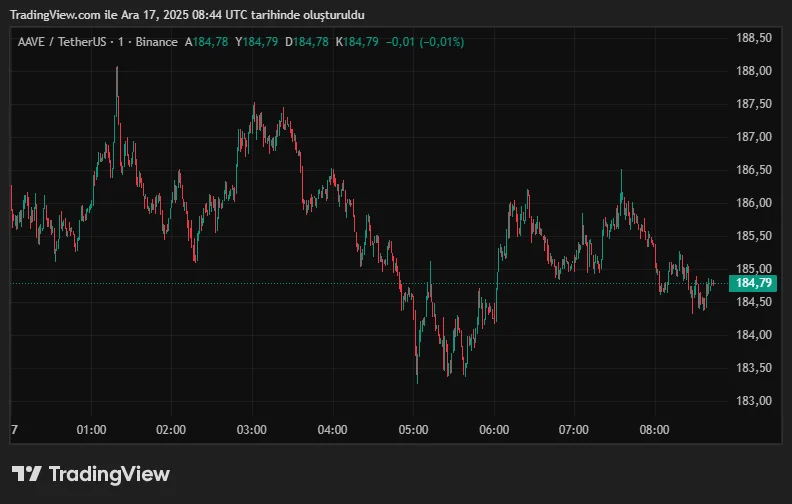
On the market front, the development had a positive impact on the AAVE price in the short term. The token rose to $194 during the day before falling to $184.
From the perspective of Aave users, the decision allows the protocol to continue its operations without the risk of sudden sanctions from the US. At the same time, the reduction in regulatory uncertainty surrounding the platform's core products strengthens user confidence and expectations of short-term stability.
On the other hand, the Aave case became the latest in a series of high-profile crypto investigations closed without charges throughout 2025. In December, Ondo Finance also announced the end of its multi-year SEC investigation into tokenized real-world assets and the ONDO token. The dismissal or withdrawal of cases against many major players such as Coinbase, Kraken, Robinhood, OpenSea, Uniswap Labs, Consensys, and Crypto.com signals a significant shift in the SEC's approach. This shift came alongside a leadership transformation within the institution and a move away from "regulation through litigation" to clearer policy guidance.
Aave's 2026 Roadmap
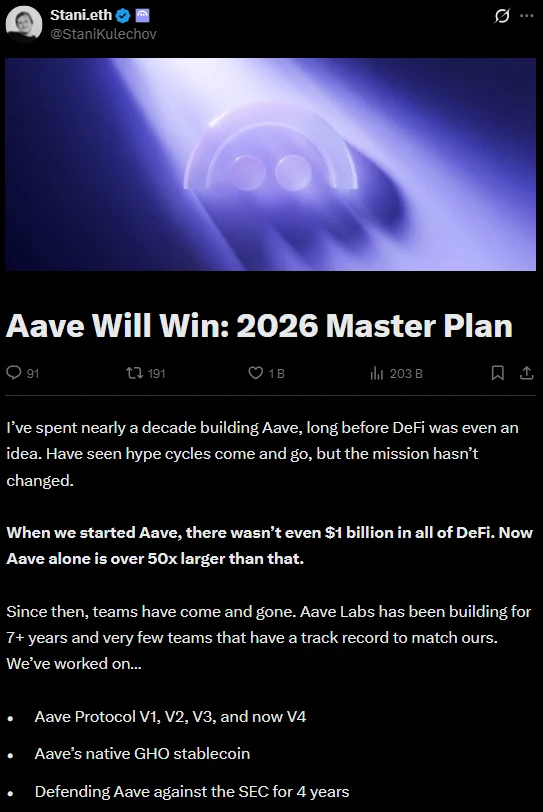
Immediately following the SEC decision, Stani Kulechov also shared Aave's 2026 roadmap with the public. Kulechov stated that although 2025 will be the "most successful year" to date for the platform, Aave's potential is only just beginning. The 2026 plan rests on three main pillars: Aave V4, Horizon, and the Aave App.
Aave V4 aims to offer a comprehensive update, from lending and borrowing pools to the user interface, liquidation parameters, and cross-chain liquidity structure. Designed with a Hub and Spoke model, this structure aims to pave the way for customizable marketplaces connected to a central liquidity pool. On the Horizon side, strong growth is targeted in the real-world assets (RWA) sector; the current net deposits of $550 million are planned to exceed $1 billion in 2026. On the mobile side, the Aave App is expected to reach a wider audience, making DeFi accessible to mainstream users.
In addition to all these announcements, Kulechov also revealed that he personally purchased approximately $9.8 million worth of AAVE.