
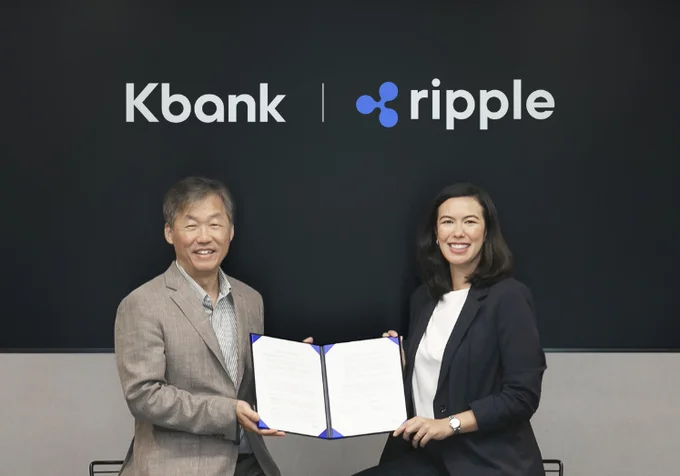
One of South Korea’s pioneers in digital banking, K Bank, has entered into a strategic partnership with Ripple to test blockchain-based solutions for cross-border remittances.
Under the agreement, K Bank is leveraging Ripple’s global payment network and blockchain infrastructure to assess whether it can achieve tangible improvements in speed, cost efficiency, and transparency in international money transfers. At the center of the project is Ripple’s SaaS-based digital wallet solution, Palisade.
Test process deepens in second phase
The partnership is not entirely new; the two parties had previously launched a proof of concept (PoC). In the initial phase, transfers were tested through a separate application. During this stage, K Bank used its in-house wallet infrastructure to observe the system’s core functionality. However, as the project progressed, the need for a more scalable and regulation-compliant structure became increasingly clear.
Accordingly, the project has moved into its second phase. In this stage, the bank is virtually integrating customer accounts with its internal systems to create a testing environment closer to real-world conditions. At the same time, key metrics such as transaction stability, security, and performance are being analyzed in detail. Another notable development is K Bank’s shift from its proprietary wallet to evaluating Ripple’s Palisade solution.
Palisade’s ready-made infrastructure stands out with advanced security layers, hardware security modules, and multi-layered authorization systems. This could significantly reduce the complexity of regulatory obligations such as anti-money laundering (AML), sanctions screening, and key management, which would otherwise arise from building a system from scratch. Additionally, its compliance-ready structure has the potential to shorten time to market.
The testing process is not limited to technical infrastructure. K Bank is also experimenting with on-chain transfers alongside partners in the United Arab Emirates and Thailand. In this model, funds move directly عبر blockchain rails, reducing reliance on traditional intermediaries and enabling near-instant settlement.
This development is also significant for Ripple’s expansion strategy in Asia. The company recently announced a partnership with South Korean insurance giant Kyobo Life to tokenize government bond settlements. This initiative aims to enable near real-time settlement of government securities while also exploring stablecoin-based payment infrastructure.
The rapid evolution of regulatory frameworks across Asia is paving the way for such initiatives. Markets such as South Korea, Japan, Hong Kong, and Singapore are moving quickly to establish clearer rules for crypto assets and stablecoins. This, in turn, is making it increasingly attractive for banks and financial institutions to test blockchain-based solutions.