
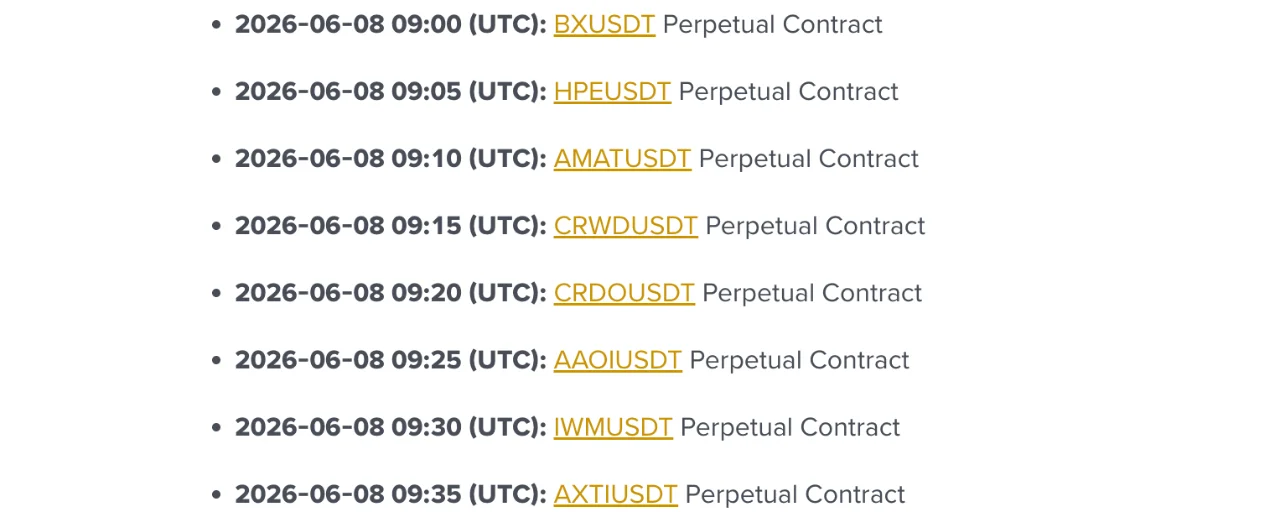
Binance Futures gradually added eight new USDS-margined perpetual futures contracts to its listings starting June 8, 2026. The contracts went live one by one within hours; the first one, BXUSDT, opened today at 12:00 p.m. Turkish time, followed by the others at five-minute intervals.
The listed contracts are BXUSDT, HPEUSDT, AMATUSDT, CRWDUSDT, CRDOUSDT, AAOIUSDT, IWMUSDT and AXTIUSDT. All contracts are settled in USDT.
What Assets Do They Track?
Each contract is linked to a different stock or fund traded in traditional financial markets:
- BXUSDT: Blackstone Inc. (NYSE: BX)
- HPEUSDT: Hewlett Packard Enterprise (NYSE: HPE)
- AMATUSDT: Applied Materials (Nasdaq: AMAT)
- CRWDUSDT: CrowdStrike Holdings (Nasdaq: CRWD)
- CRDOUSDT: Credo Technology Group (Nasdaq: CRDO)
- AAOIUSDT: Applied Optoelectronics (Nasdaq: AAOI)
- IWMUSDT: iShares Russell 2000 ETF (NYSE Arca: IWM)
- AXTIUSDT: AXT Inc. (Nasdaq: AXTI)
The list covers a fairly broad range of assets, from large-scale private equity and cybersecurity to semiconductor equipment and small-cap equity exposure.
Contract Terms
Binance set uniform parameters for all eight contracts. The minimum order size is 0.01 units of the relevant asset, while the minimum notional value is 5 USDT. The tick size is 0.01. The funding rate is calculated every eight hours, with the cap limited between +2.00 percent and -2.00 percent. The funding interest rate is zero. Maximum leverage is set at 20x.
Trading is available 24/7, and Multi-Assets Mode is also supported.
TradFi Contracts Continue to Expand
With this move, Binance continues to expand its product lineup that offers access to TradFi assets through crypto infrastructure. The exchange has listed similar contracts before, but this time the selection leans heavily toward technology names. Companies such as CrowdStrike and Applied Materials have frequently been on the radar of both institutional and retail investors in recent periods.
TradFi, short for Traditional Finance, refers to the conventional banking and exchange-based financial system where instruments such as stocks, bonds and ETFs are traded. In the crypto industry, the term is used to distinguish traditional financial markets from decentralized finance and digital asset markets.
The inclusion of the IWM contract is also notable. This ETF tracks the Russell 2000 Index and is considered one of the key indicators of small-cap company performance in the United States. Giving crypto investors leveraged access to this index opens a new door for cross-market position diversification.
Key Points to Watch
Leveraged trading can lead to significant losses, especially during periods of high volatility. Leverage of up to 20x can magnify potential gains, but it also increases risks by the same degree. Since Binance has based these contracts on stock and ETF price movements, investors need to pay attention not only to the crypto market, but also to the performance of the relevant companies and the broader macroeconomic backdrop.
The exchange continues to expand its product range. As institutional interest in crypto derivatives grows, demand for TradFi-based contracts is also increasing in parallel.