
May employment figures from the United States came in at nearly twice market expectations, adding further pressure on Bitcoin and the broader crypto market. According to data released by the U.S. Bureau of Labor Statistics (BLS) on Friday, the economy added 172,000 new jobs last month, while economists had expected a figure of around 85,000. The unemployment rate came in at 4.3 percent, in line with expectations.
Bitcoin price edges lower
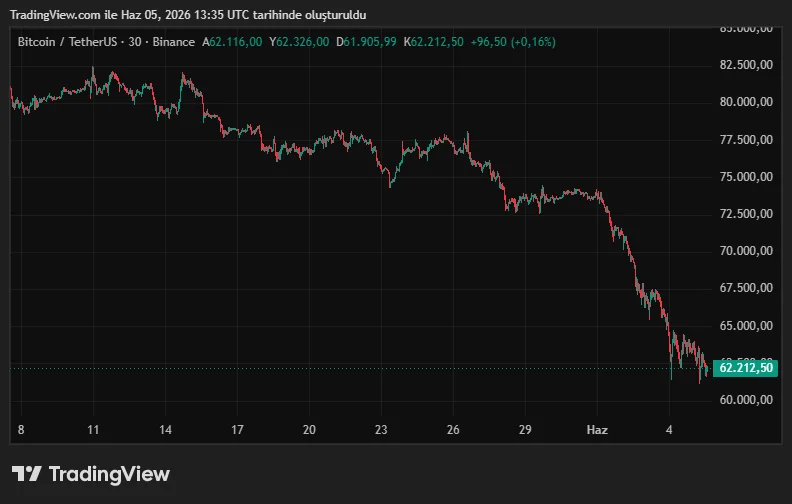
Following the report, Bitcoin struggled to hold below the $62,000 level and changed hands around $61,900 during the day. This showed that the crypto market had still failed to recover after the sharp declines seen the previous night. The overall picture was already under pressure; once such a strong employment report was added to the equation, buyers preferred to remain cautious.
Why does this data matter so much? Because it carries a stronger message than it may initially seem. Such resilience in the labor market confirms that the Fed is in no hurry to cut interest rates. On the contrary, the stronger-than-expected figures suggest that additional rate hikes may remain on the table this year. The bond market reached the same conclusion: after the report, the 10-year U.S. Treasury yield jumped to 4.52 percent.
Crypto was not the only market affected. Nasdaq 100 futures fell 1.2 percent. Crude oil slipped only slightly, while gold lost 1.1 percent and dropped to around $4,400. In an environment where overall risk appetite was narrowing, it was not realistic to expect Bitcoin to break away from the broader market and move higher on its own.
Economic indicators show that the U.S. economy continued to surprise markets this week. Both the ISM Manufacturing PMI and the ISM Services PMI came in above expectations, and both remained in expansion territory. Taken together, these figures strengthen the central bank’s position; there is still no urgent need for a rate cut.
Although equity markets have followed a different path, some cracks have started to become visible. The S&P 500 has maintained its upward trend for nearly ten weeks and has gained about 10 percent since the start of the year. However, Broadcom’s weaker-than-expected artificial intelligence chip demand forecast in the semiconductor sector slightly dampened the optimism that had built up in that area.
Turning back to Bitcoin, the short-term picture remains unclear. The lower end of the 24-hour price range stood at $61,394, while the upper end was $64,353. The technical outlook is weak; a weekly decline of 14.77 percent is not something that can be ignored. The 30-day loss has reached 24.19 percent, showing that the pressure seen since March is still continuing.
The macro environment is not creating an easy backdrop for crypto. The continuation of high interest rates limits inflows into risk assets. Every strong employment report strengthens the possibility that the Fed will maintain its tight stance for longer; this remains a factor weighing on assets such as Bitcoin. The market is now trying to hold around $62,000 after pricing in a major break from the upward trend that had been in place since the summer of 2024.
The next critical data point will be inflation. Once the consumer price index (CPI) is released, the Fed’s next move will become clearer. If employment remains strong while inflation continues to prove sticky, expectations for rate cuts could be pushed back even further; this would create another headache for crypto and other risk assets.
For now, the market is in a cautious waiting mode. Bitcoin is showing neither a clear breakdown signal nor a strong recovery. The $61,000-$62,000 range remains a critical support zone for the time being.