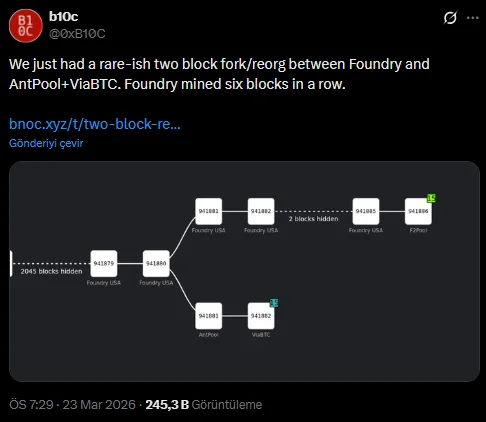
The Bitcoin network witnessed a rare technical event on Monday. A temporary fork, caused by different mining pools producing blocks almost simultaneously, resulted in a two-block "reorganization" (reorg). The event once again demonstrated the network's workings and how its consensus mechanism operates. According to the data, the process began with the formation of competing chains at block heights 941881 and 941882. Foundry USA Pool created its own chain, while AntPool produced an alternative block at the same height. Then ViaBTC pushed AntPool's chain one block further. Simultaneously, Foundry continued to expand its own branch. This short-lived competition presented a different picture than the forks that are sometimes seen on the Bitcoin network but are usually limited to a single block. This time, the competition lasted for two blocks, and therefore it was recorded as a "two-block reorg".
The chain with the most manpower won
Bitcoin's fundamental consensus rule is based on the chain with the highest total "proof of work" value being considered valid. The same mechanism came into play in this case.
Foundry USA Pool's continued production of blocks made its own chain "heavier." Having achieved a series of seven blocks in total, Foundry surpassed competing chains. As a result, the nodes on the network accepted this chain with more manpower as the "canonical," or valid, chain. With this development, blocks produced by AntPool and ViaBTC became "stale blocks." That is, although technically valid, they did not earn rewards because they were outside the final chain.
The balance of mining power was decisive
It is believed that Foundry's high hash rate played a role in its victory. According to current data, Foundry USA Pool controls approximately 32.2% of the Bitcoin network's hash power. In contrast, AntPool's share is 15.7%, while ViaBTC's is 7.2%. This distribution increases the probability of larger pools finding consecutive blocks during short-term forks. However, this alone does not indicate an abnormal development. According to experts, each miner's probability of finding the next block is directly proportional to their hash rate.
Why is a two-block reorg rare?
Single-block reorganizations can occur from time to time on the Bitcoin network. The main reason for this is that blocks reach different nodes at different times and there is simultaneous block production.
However, two-block reorgs are less common. For this to happen, competing chains need to run close to each other for at least two blocks. This has a lower probability in terms of both timing and network latency.
No transactions were lost
One of the most frequently asked questions in such events is the fate of transactions. However, no transactions were lost during this reorg. Transactions within stale blocks were either already on the winning chain or returned to the transaction pool, pending processing in subsequent blocks. This once again demonstrated the Bitcoin network's resilience in maintaining data integrity. While this two-block reorg might seem unusual at first glance, it's actually a natural part of Bitcoin's design. The network automatically selects the strongest chain in response to short-term forks, reverting to a single, accurate historical record. This event serves as a recent example of the system working as expected.