
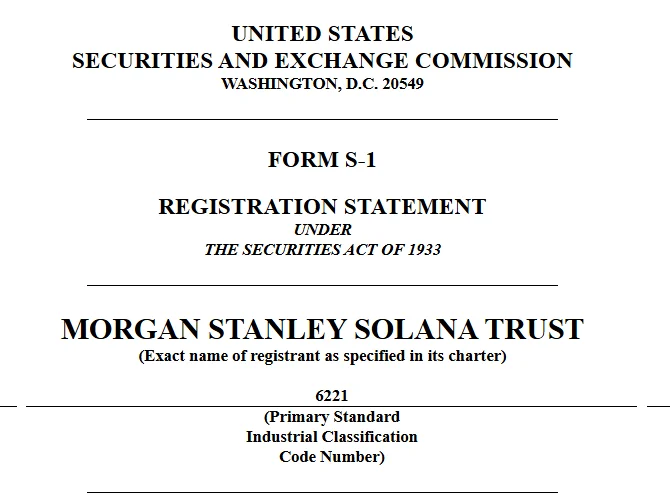
US-based investment bank Morgan Stanley has taken its moves into the cryptocurrency markets a step further. The company has formally applied to the U.S. Securities and Exchange Commission (SEC) for exchange-traded funds (ETFs) that will track Bitcoin and Solana prices. According to documents released on Tuesday, Morgan Stanley submitted S-1 registration statements for two separate funds, "Morgan Stanley Bitcoin Trust" and "Morgan Stanley Solana Trust."
Morgan Stanley applies for Bitcoin and SOL
This move by the Wall Street giant, which manages approximately $6.4 trillion in assets, shows the increasing interest of traditional financial institutions in the crypto ETF market. In particular, the inclusion of a staking feature in the Solana ETF application indicates that Morgan Stanley aims to integrate on-chain return models into its products, not just price tracking.
This is noteworthy in terms of bringing crypto assets together with classic investment instruments in a more complex and functional way. If the applications are approved, Morgan Stanley will be in the same league as major issuers like BlackRock and Fidelity, who are prominent in this field after spot Bitcoin ETFs in the US receive the green light in January 2024. This shows that the position of crypto assets within mainstream investment products is steadily strengthening. Data also reveals that the interest in crypto ETFs is not limited to applications alone. The total trading volume of spot crypto ETFs listed in the US has exceeded $2 trillion. While it took over a year to reach the first $1 trillion volume, the subsequent $1 trillion increase occurred in just about eight months, highlighting the acceleration in liquidity and trading appetite in the market. The total value of assets held in spot Bitcoin ETFs alone has exceeded $123.5 billion. This figure corresponds to approximately 6.6% of Bitcoin's total market capitalization. Despite prices recently hovering below the $100,000 level, strong demand for ETFs reflects the long-term perspective of institutional investors. Morgan Stanley's move also aligns with changes in the US regulatory climate. Following Donald Trump's return to the presidency, the SEC appears to have adopted a more favorable approach towards crypto. Thanks to new and more general listing standards approved in September 2025, eligible crypto ETFs can now be launched more quickly, without going through lengthy individual 19b-4 rule change processes. The shortening of these approval processes, which previously took up to 240 days, has significantly increased the appetite of traditional financial institutions. Last year, Morgan Stanley set an allocation cap limiting digital assets to 4% for "opportunity-focused" portfolios. This approach parallels that of competitors such as BlackRock and Grayscale. The bank is also taking steps to gradually open up access to crypto assets in all customer accounts, including retirement accounts.