
Bitcoin, Ethereum and other major cryptocurrencies fell on Friday. The sell-off was mainly attributed to Beijing-based Moonshot AI releasing a free artificial intelligence model that outperformed Anthropic’s best model in coding tasks.
Moonshot unveiled Kimi K3 on Thursday. By Friday morning, AI and semiconductor stocks were falling across Asian markets. Market participants dubbed the event the “Kimi moment,” a reference to the DeepSeek shock that erased nearly $600 billion from Nvidia’s market value in a single session 18 months ago.
What does the model do?
Moonshot’s model has 2.8 trillion parameters and a context window of one million tokens. That makes it roughly four times larger than the previous version.
K3 uses a mixture-of-experts architecture. For each task, it activates only 16 of its 896 internal experts. This keeps operating costs relatively low despite the model’s size. According to information shared in the company’s technical blog, the architectural changes provide around 2.5 times greater scaling efficiency than the previous model.
K3 ranked first on Arena’s Frontend Code leaderboard with a score of 1,679. Anthropic’s Claude Fable 5 followed with 1,631 points, while OpenAI’s GPT-5.6 scored 1,618.
K3 led six of the seven categories. Moonshot’s previous model ranked 18th on the same leaderboard, meaning the company climbed 17 places with a single release. However, K3 still trails the top configurations from Claude and OpenAI in general knowledge and reasoning tests. Its advantage is therefore concentrated in a specific field rather than extending across every category.
The licensing terms are causing more concern in markets than the pricing itself. K3 is an open-weight model, and Moonshot plans to make the full version publicly available on July 27. Anyone will be able to download the model and run it on their own hardware free of charge.
Anthropic released Fable 5 last month, while OpenAI launched GPT-5.6 a week ago. Both are closed-source, paid models. The assumption supporting hundreds of billions of dollars in AI infrastructure spending was that the most advanced models would remain scarce, expensive and primarily American. A free Chinese model taking the top spot in a coding leaderboard directly challenges that premise.
Moonshot’s domestic rivals were among the hardest hit. Shares of Z.ai fell 27%, while MiniMax dropped around 16%.
Domino effect across markets
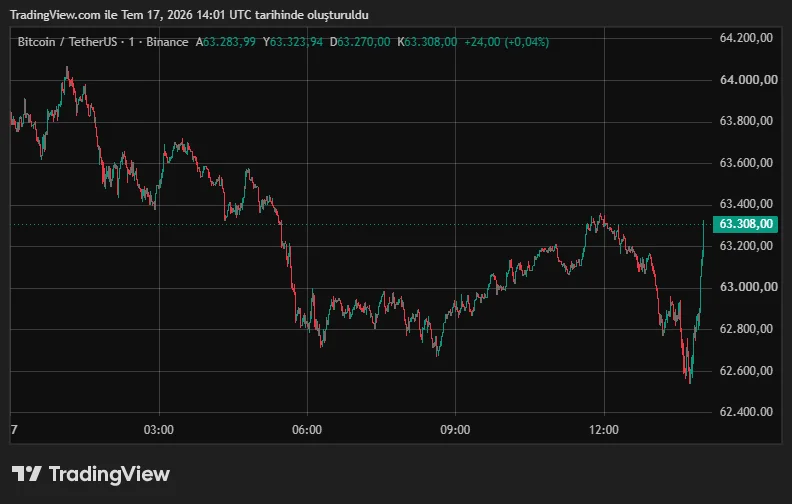
Bitcoin fell to around $63,000 on Friday. The cryptocurrency lost 1.7% over the previous 24 hours and 2.2% on a weekly basis.
According to market data, ETH held near $1,836 and maintained a weekly gain of 2.4%. Hyperliquid suffered the steepest decline, falling 8% over 24 hours and 12% for the week.
Nasdaq 100 futures declined 1.8%, while S&P 500 futures dropped 0.9%. A semiconductor exchange-traded fund lost 3% in premarket trading. Taiwan’s stock market entered correction territory, while Asia’s main benchmark fell to its lowest level in two months. European markets proved relatively resilient because of their lower exposure to the technology sector.
The central question behind the sell-off has been hanging over markets since the beginning of the month: Will the hundreds of billions of dollars invested by AI companies generate sufficient returns? TSMC’s results this week failed to provide a clear answer.
The crypto market has been caught in the same current throughout the quarter. Softer inflation data pushed Bitcoin toward $65,000 earlier this week, although that move was driven by macroeconomic conditions. The sell-off in semiconductor stocks is now pulling prices in the opposite direction. The Federal Reserve will meet on July 28–29.
The miners’ fragile bet
The most tangible risk for the crypto sector lies in the business models of mining companies rather than in on-chain data. Over the past two years, Bitcoin miners have increasingly transformed themselves into landlords for AI data centers. They signed long-term contracts with model developers based on the assumption that demand for computing power used in training and inference would continue to rise.
This strategy relies on scarcity. If advanced AI capabilities can be obtained for free through an open-source model that requires fewer resources, tenants may have less reason to sign these contracts. That could undermine the miner-to-AI transformation strategy that has supported the valuations of many publicly traded Bitcoin companies.
DeepSeek’s release delivered the same lesson 18 months ago. The market reaction was sharp but brief. Nvidia recovered, Bitcoin rebounded and capital expenditure continued to rise.
The difference this time may lie in how crypto is positioned. In January 2025, Bitcoin fell alongside technology stocks because it was treated as a risk asset during a risk-off session. In July 2026, it is behaving more like a leveraged reflection of the AI capital cycle. One week, it rises on the back of a Korean chip listing; the next, it falls after a new model announcement from China.
K3’s model weights will become publicly available in ten days. That is when the market will find out whether its leaderboard performance holds up under broader scrutiny.