JPMorgan analysts say that the main factor driving Bitcoin's short-term price movements is no longer miners' selling pressure, but MicroStrategy's (Strategy/MSTR) balance sheet strength. According to a report published by the bank on Wednesday, the company's ability to stay afloat without selling its Bitcoin holdings creates a critical signal of confidence in the market; it could even be decisive in BTC overcoming the current pressure.
Pay attention to Strategy for Bitcoin!
Analysts emphasize that the recent hashrate and difficulty drops on the Bitcoin network are attributed to two key factors. China's recent reiteration of the ban, citing increased private mining activity, and the withdrawal of high-cost miners outside of China due to rising energy prices and the suppression of the BTC price. Normally, a decrease in hashrate increases miners' revenues; however, JPMorgan notes that this benefit has not materialized because the Bitcoin price is still below its production cost. The bank estimates that Bitcoin's average production cost fell from $94,000 in November to $90,000 as of December. This cost is highly sensitive to electricity price assumptions; every $0.01 kWh increase equates to an additional cost of approximately $18,000 for high-cost generators. Consequently, some miners have been forced to sell BTC in recent weeks due to profit pressure.
According to JPMorgan, despite this outlook, miners are not the primary price determinant. The bank's key indicator is MicroStrategy's "enterprise value/Bitcoin reserve" ratio. This metric, calculated by dividing the sum of debt, preferred stock, and market capitalization by the value of the company's BTC holdings, is currently at 1.13. A ratio above 1 means MicroStrategy will not be forced to sell BTC to meet its debt and dividend obligations, preventing a new sell-off in the market. The report also highlights MicroStrategy's recently established cash reserves of $1.44 billion. This reserve is sufficient to cover the company's dividend and interest payments for up to two years. JPMorgan states that this step makes forced BTC sales unlikely "for the foreseeable future." Analysts believe this reserve serves as a significant buffer for market stability and that the current weakness in Bitcoin may therefore be limited.
In addition, MSCI's decision in mid-January is also being closely watched. JPMorgan believes that the possibility of MicroStrategy being removed from the indexes has been largely priced in by the markets, and states that a negative decision would create limited additional pressure. Conversely, it is stated that if the company remains on the indexes, both MSTR shares and Bitcoin could see a strong recovery.
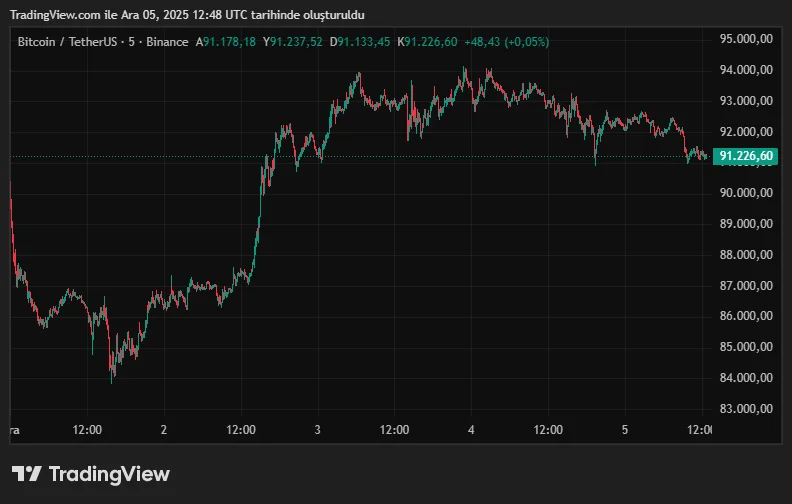
Despite all the short-term uncertainty, the bank's long-term model remains optimistic about Bitcoin. JPMorgan's theoretical price target, derived from its volatility-adjusted comparison of BTC to gold, remains at $170,000. Analysts predict that if the market stabilizes, Bitcoin could approach this value within the next 6-12 months. Market data indicates that the BTC price is currently trading around $91,200.