Ethereum has completed its second major network upgrade of the year, activating the Fusaka update on the mainnet. This 17th major update, following Pectra, launched approximately seven months ago, marks a new era in the network's scaling roadmap. The most notable innovation is the data sampling system called "PeerDAS." This technology fundamentally updates Ethereum's data availability architecture and significantly expands the capacity of the rollup ecosystem.
PeerDAS, a new era in blob capacity and L2 costs
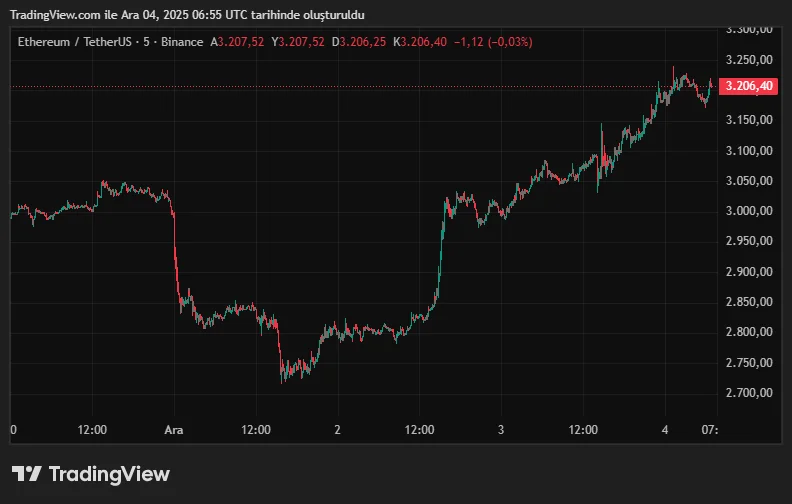
Fusaka went live at block number 18,200,000. After weeks of testing on the Holesky, Sepolia, and Hoodi testnets, the teams completed the final preparations. Immediately after the activation, the Ethereum price fluctuated between $3,150 and $3,210, with volume rising from $28.2 billion to $32 billion within six hours. Santiment data indicates a strong accumulation from "shark" wallets holding between 1,000 and 10,000 ETH. PeerDAS, at the heart of the update, allows each node to retain only samples of the data blob without downloading it. This approach reduces bandwidth overhead and paves the way for an approximately eightfold increase in blob capacity. Ethereum developers say PeerDAS is the practical embodiment of the long-planned "sharding" vision. Vitalik Buterin particularly emphasized this point, saying, "The sharding model envisioned since 2015 is finally operational."
Fusaka's Blob Parameter Only (BPO) mechanism is also noteworthy. Thanks to this system, blob capacity can be increased without requiring a full hard fork. By January, blob targets are planned to be increased to 14, and the upper limit to 21. The "blob fees approaching zero" issue seen after the Dencun pandemic is being addressed with base fee adjustments and a new pricing model. This will create more predictable costs for rollups, and a gradual increase in the ETH burn rate is also expected. The update brings a series of infrastructure improvements not only on the data side but also on the security and UX side. The adjustment to the gas limit cap reduces DoS risks by preventing a single transaction from consuming the block transaction fee (gas). Native support for the SECP256R1 curve accelerates device-based signature and passkey integrations. EIP-7939, which improves zero-knowledge tools, also points to Ethereum's long-term resilience and post-quantum security goals.
Industry players agree that Fusaka is an "infrastructure-driven transformation." Institutions like Alchemy, Boundless, and Sygnum Bank state that this update will reshape the rollup economy, creating more regular batch releases, a more stable L1 cost structure, and broader validator participation. The emphasis on predictability, particularly for enterprise tokenization projects, is particularly prominent.
The Ethereum Foundation aims to release major updates twice a year from now on. Researchers have already begun work on the next major update, "Glamsterdam," planned for 2026. The effects of Fusaka will become more apparent in the coming months with the increase in network capacity and the decrease in L2 fees.
Following the developments, the ETH price rose by almost 5 percent and rose above $3,200.