
The Federal Reserve kept interest rates unchanged at its first meeting chaired by Kevin Warsh, but delivered a more hawkish message than expected. The impact was immediate: Bitcoin declined for a third consecutive day, institutional money began flowing out of exchange-traded funds, and the relief rally triggered in equities by the peace agreement with Iran failed to reach the crypto market.
Fed Decision and Warsh’s First Test
The Federal Open Market Committee unanimously voted on Wednesday to keep its policy rate unchanged within the 3.50%-3.75% range. Markets had already priced in the decision; the surprise came elsewhere.
The committee raised its inflation forecasts and slowed the projected pace of interest rate cuts compared with its March outlook. Nine of the 18 members even raised the possibility of a rate hike this year. The median projection placed the policy rate at 3.8% by the end of 2026, a significant increase from the 3.4% forecast in March.
Matt Mena, senior crypto research strategist at 21Shares, said the decision carried unusual weight despite being widely expected because it marked Warsh’s first meeting as Fed chair. Mena noted that the real signal came from the updated projections, which showed that policymakers remained concerned about inflation despite easing geopolitical tensions and falling energy prices.
The meeting also provided the first clues about Warsh’s communication style. Unlike statements issued during the Jerome Powell era, the document was kept notably brief and excluded the forward-guidance language Powell used throughout his tenure. Warsh said the format was designed to present “the facts” rather than steer market expectations.
Broad-Based Selling Hits the Market
The crypto market’s reaction was swift and widespread. Bitcoin slipped below the $64,000 level following the decision and traded between $63,800 and $63,900. That range corresponds to the midpoint of the rally it had built over the previous 11 days.
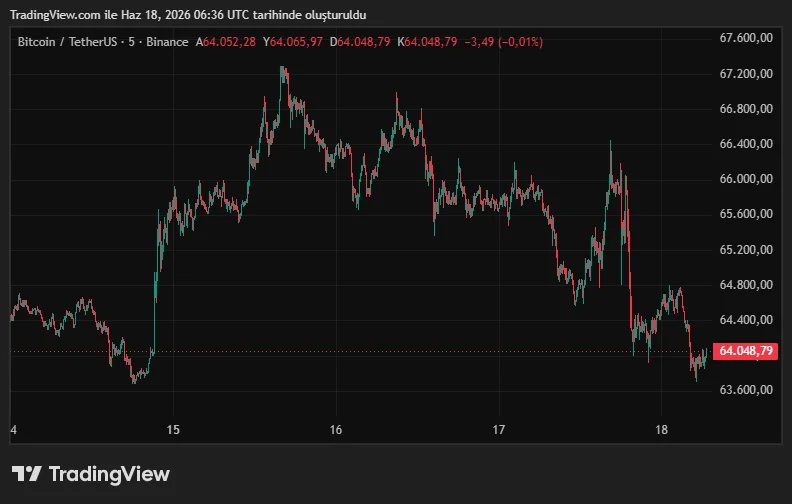
Ethereum declined by between 3% and 3.6%, falling as low as $1,733. XRP dropped nearly 4% to $1.17, while Solana lost between 3% and 3.6% and traded at around $71.
Hyperliquid’s HYPE token, the week’s standout performer, recorded the sharpest decline. After reaching an all-time high the previous day, HYPE fell nearly 7% to the $69-$72 range. The token nevertheless remains up by around 28% on a weekly basis. Tron was the only major cryptocurrency to finish the session in positive territory.
The GMCI 30 Index, which tracks the 30 largest cryptocurrencies, declined by 2.6%, bringing its year-to-date loss close to 36%. Selling pressure extended beyond crypto; gold fell by 2.2%, while silver declined by nearly 4%.
Iran Agreement Lifted Stocks, but Not Crypto
Another major development announced on the same day directed market attention elsewhere. US President Donald Trump signed an interim agreement that ended the war with Iran and reopened the Strait of Hormuz.
Equity markets welcomed the news. S&P 500 futures rose by 0.9%, while Nasdaq futures gained 1.5%. Brent crude fell toward $78.
Crypto assets failed to benefit from the relief. The divergence suggests that the market is currently responding more strongly to the Fed’s policy stance than to geopolitical developments.
ETF Outflows Signal Waning Institutional Demand
The institutional picture became even clearer. US spot Bitcoin and Ethereum ETFs returned to net outflows on Wednesday. According to SoSoValue data, Bitcoin funds recorded $82 million in net withdrawals, while Ethereum funds lost $29 million.
The outflows were broad-based. BlackRock’s IBIT recorded $31 million in withdrawals, while ARKB lost $44 million. Every Ethereum ETF ended the day with net outflows.
The move suggests that institutional buying, which helped fuel the recovery rally in recent weeks, has paused for now. The total cryptocurrency market capitalization has remained around $2.26 trillion since Tuesday’s close, while expectations for interest rate cuts, one of the rally’s main drivers, have largely faded.
Gerry O’Shea, head of global market insights at Hashdex, said Bitcoin is likely to remain confined to a $60,000-$70,000 range in the coming weeks unless a major catalyst emerges. According to O’Shea, developments such as the signing of the CLARITY Act, which would regulate the structure of the crypto market, or a further easing of tensions between the US and Iran could provide the trigger needed to break that range.
O’Shea also said that recent initial public offerings and artificial intelligence stocks have diverted attention away from the crypto market. However, he expects capital to return as institutional participation grows and regulatory rules become clearer.