
ETHZilla has officially exited its Ethereum accumulation strategy. The company announced that it sold approximately 24,291 ETH, using $74.5 million to repay debt. This move may indicate the end of its strategy, which previously focused on long-term Ethereum accumulation through a "Digital Asset Treasury" (DAT) approach.
Ethereum Treasury Company Sells Out
ETHZilla had previously planned to transform its balance sheet into an Ethereum-centric structure, even considering the possibility of purchasing up to $10 billion worth of ETH in the long term. However, the recent sale shows that the company no longer positions itself as an ETH-focused balance sheet company. In this new framework, Ethereum has ceased to be a strategic asset and has become a liquidity and financial balance tool.
Looking at the background of the sale, it appears that this decision was not a one-off. According to regulatory filings, ETHZilla sold the ETH in question at an average price of slightly over $3,000 per token. The sale was part of a mandatory repayment agreement under convertible bond obligations. Following the transaction, the company's remaining Ethereum holdings decreased to approximately 69,800 ETH, with a current market value of around $207 million. Ethereum price is currently trading slightly above $2,950.
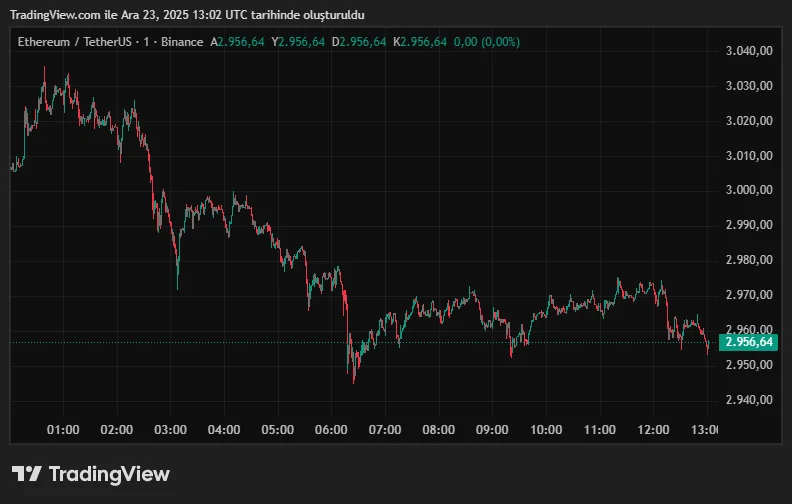
This December sale, when considered alongside the previous transaction in October which involved the disposal of approximately $40 million worth of ETH, demonstrates that balance sheet cleaning has become a priority. The October sale, intended to fund a share buyback program, was criticized by some investors. Despite this, management has clearly indicated that it views crypto assets not as a long-term store of value, but as a source of financing that can be used when needed. The real turning point for ETHZilla is the strategic shift. The company is now shifting its focus to the tokenization of real-world assets. According to the company, auto loans, real estate, and aviation equipment are among the priority areas. This approach moves the company away from crypto-native treasury models and closer to the fintech and structured finance world.
With this shift, ETHZilla is also redefining how assets are valued. The size of Ethereum assets will no longer be a primary valuation metric. Instead, revenue generation, operational performance, and cash flow will take center stage. The company's decision to close its public mNAV (net asset value) dashboard is seen as part of this transformation. This move means reduced transparency for crypto-focused investors who monitor on-chain data in real time.
From a market perspective, ETHZilla's decision points to a broader trend. Rising interest rates, increasing borrowing costs, and the weakness in Ethereum's price in recent months are forcing leveraged or scale-limited companies to take more cautious steps. In this environment, there is a shift towards cash flow-generating and more predictable revenue models instead of aggressive crypto accumulation.
General comments within the crypto community do not directly interpret this move as a "bear market signal." Many analysts argue that the decision is pragmatic and that institutional capital is increasingly shifting towards revenue-driven infrastructure and real asset tokenization.