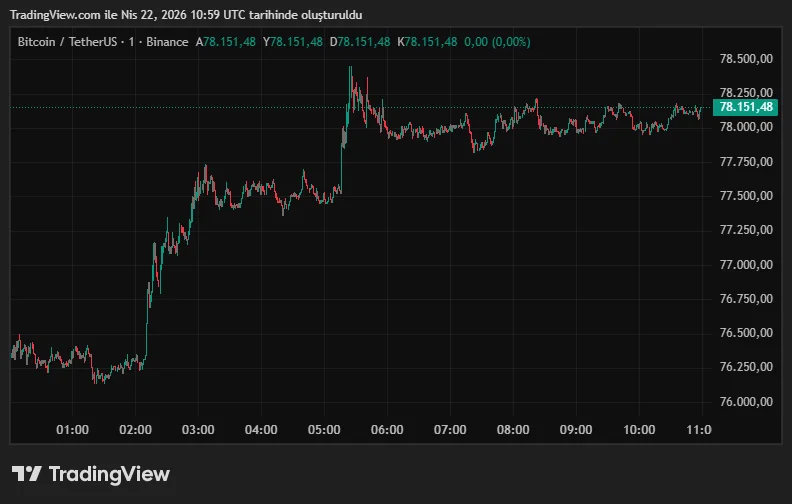
The cryptocurrency market regained upward momentum in the middle of the week. With Bitcoin surpassing the $78,000 level, a limited but significant recovery was observed in both major crypto assets and the overall market capitalization. Data shows that Bitcoin gained over 2% in the last 24 hours, trading around $78,000, while Ethereum similarly rose over 2.5%, surpassing the $2,300 mark. A rise of over 2% is also noticeable in the total crypto market.
Truce extended, risk appetite returns
The cryptocurrency market turned upward again in the middle of the week. Bitcoin gained approximately 2% in the last 24 hours, trading around $78,000; Ethereum rose over 2.5%, surpassing $2,300. A rise of over 2% is also seen in the total market capitalization.
No single factor is enough to explain the rise. Capital inflows into spot Bitcoin ETFs are significant: Funds have recorded uninterrupted net inflows for three weeks, drawing in a total of approximately $1.8 billion. As institutional buying continues, it becomes easier to absorb downward pressure.
The short squeeze factor
There is also a short squeeze component. Funding rates are still negative, meaning that short positions continue to accumulate in the market. With the increase in the amount of open positions, this structure provides fertile ground for new squeeze waves.
A short squeeze is a chain reaction of buying that occurs when investors holding short positions in the market are forced to close their positions to cut their losses in the face of rising prices. Opening a short position simply means: you borrow an asset, sell it, buy it back when the price falls, and pocket the difference as profit. But if the price doesn't fall as expected and rises, your debt starts to grow. It becomes necessary to close the position, i.e., buy back the asset, before the loss becomes unbearable.
These purchases push the price even higher; the price pushing it upwards puts other short position holders under the same closing pressure. The cycle feeds itself. In the case of Bitcoin, this is the current situation: funding rates are negative, meaning those holding short positions in the futures market pay more fees than those holding long positions. This indicates that pressure on the short side is still high. When the price breaks upwards, these positions become squeezed and have to close; each closing signals a new purchase, and each purchase signals a new price increase. This mechanism is one of the main reasons why short-term rallies are so sharp and fast.
Trump's statements
On the macro front, Trump announced he would extend the ceasefire, giving time for negotiations. Iran also stated that the Strait of Hormuz would remain open. These are not permanent solutions, but they were sufficient for short-term relief. They boosted both the crypto market and US stocks.
There is also a noticeable movement in sentiment indicators. The Fear & Greed Index, which fell to 8 at the beginning of April, is now at 33. It is still in the "fear" zone; panic has subsided, but confidence has not yet returned. A significant portion of retail investors are still hesitant about the rise; According to some analysts, this situation actually supports the rise, because purchases in a low-expectation environment push prices up faster. Experts believe that technically, the $78,000 to $83,000 range is crucial. If this region cannot be maintained, the picture will change. For a broader bull run, in addition to price movement, improved liquidity and the participation of altcoins in the rise are needed. For now, not all of these conditions have been met.