Michael Saylor’s long-repeated “never sell” stance has become the center of a new debate after Strategy’s latest earnings call. The company’s Executive Chairman openly stated for the first time that Strategy could sell Bitcoin to meet its dividend obligations. The comment marked a notable shift in tone for a company that has long treated its Bitcoin reserves as almost untouchable.
Since its rebranding in 2025, Strategy has clearly positioned itself as a “Bitcoin treasury company.” Its business model is largely built around increasing its Bitcoin holdings, raising capital through shares and debt instruments, and using that capital to buy more BTC. However, the latest remarks show that this model is becoming more complicated under the pressure of dividend payments and market valuation.
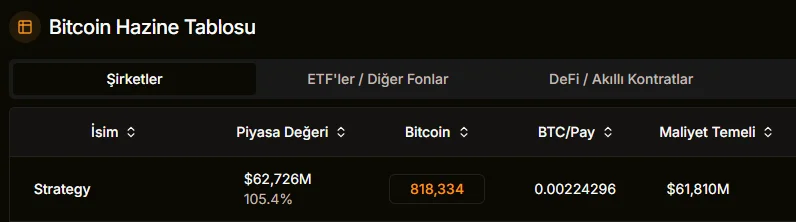
As of May 11, 2026, the company holds 818,334 BTC. The market value of this reserve is estimated at around $66 billion. This amount represents roughly 3.9 percent of Bitcoin’s total issuable supply. For this reason, the possibility of Strategy buying or selling Bitcoin is closely watched not only by the company’s shareholders, but also by the wider market.
Saylor steps back: “If we sell one BTC, we will buy 10 to 20 more”
After his remarks during the earnings call, Saylor partially softened his tone in interviews released over the weekend. While he acknowledged that Strategy may occasionally sell Bitcoin, he stressed that the company would continue to accumulate BTC on a net basis. According to Saylor, even if the company sells one Bitcoin, it aims to be in a position to buy 10 to 20 more during the same period.
This approach suggests that Saylor is trying to redefine his “never sell” message rather than abandon it entirely. He said Bitcoin is capital and that the company should end each year with more BTC than it had at the beginning of the year. In other words, Strategy now accepts that Bitcoin can be used as a financial tool when needed, while still keeping long-term accumulation as its main goal.
Strategy CEO Phong Le framed the issue in a similar way. Le said the company would consider selling Bitcoin to fund dividend payments only if doing so proved more beneficial for shareholders. Pointing especially to the “Bitcoin per share” metric, Le said the company would act based on mathematical calculations rather than ideology.
Dividend burden increases selling pressure
At the center of the debate is Strategy’s growing structure of preferred shares. The company has several instruments carrying dividend obligations, including STRK, STRF, STRD and STRE. However, the most notable item is STRC. STRC carries a variable 11.5 percent dividend paid monthly in cash. Given its $8.5 billion outstanding face value, this program alone creates an annual payment burden of roughly $982 million.
Under normal conditions, Strategy prefers to cover this burden through new share sales. The company’s so-called “flywheel” model is also based on this mechanism. When MSTR shares trade at a premium to the net value of the company’s Bitcoin holdings, Strategy can raise capital by issuing new shares. This capital is then used to buy more Bitcoin, while the increase in BTC holdings raises the company’s net asset value.
However, this cycle becomes fragile when the company’s market value moves too close to the value of its Bitcoin reserves. Strategy’s mNAV ratio currently stands at 1.01. This shows that the company’s market value carries only a limited premium over its Bitcoin assets. If mNAV falls below 1, new share issuance could dilute BTC per share instead of increasing it. In such a scenario, the company would be left with several difficult options: borrowing more, issuing shares despite dilution, or selling Bitcoin.
First-quarter loss
Strategy’s first-quarter 2026 results also strengthened this debate. The company reported a loss of $12.54 billion in the first quarter. Of that amount, $14.46 billion came from unrealized losses tied to the decline in Bitcoin’s price. Bitcoin’s temporary drop to $63,000 during the period showed once again how sensitive the company’s balance sheet is to BTC price movements.
By contrast, revenue from the company’s software business stood at $124.3 million. This figure is far from enough to cover dividend obligations on its own. Although CEO Phong Le said the software and artificial intelligence business is gaining momentum and that the first quarter was the strongest software quarter in the past decade, the market’s main focus remains on Bitcoin reserves and the company’s financing model.
The market reacted quickly after Saylor’s comments. Strategy shares fell more than 4 percent in after-hours trading following the earnings call. However, in the latest trading session, the stock closed up 4.31 percent at $187.59. Although the stock has recovered strongly over the past month, it remains in negative territory on a six-month basis.