A critical week has begun for the CLARITY Act, a long-awaited bill for the U.S. crypto market. The Senate Banking Committee is preparing to review the bill on May 14, aiming to bring clearer federal rules to the crypto asset market. According to Reuters, the committee session will take place at the Dirksen Senate Office Building in Washington, D.C., and will be a key step in determining whether the bill can move forward in the Senate process.
The CLARITY Act aims to clarify under which conditions crypto assets should be treated as securities and under which conditions they should be considered commodities. In this respect, the bill could give a legal framework to the long-running jurisdiction debate between the SEC and the CFTC. For crypto companies, this process could mean lower risks linked to lawsuits, enforcement actions and regulatory uncertainty while operating in the United States. For Bitcoin, XRP and the broader altcoin market, the issue is not limited to regulation; it is also being watched closely because of its potential impact on institutional capital flows.
Markets prepare for three scenarios
Three main scenarios stand out ahead of the May 14 session. If the bill passes through the committee without major changes, the crypto market could see it as a historic regulatory breakthrough. In that case, short-term risk appetite around Bitcoin may strengthen, while expectations for ETF growth and institutional demand could revive.
In the second scenario, the bill could advance with some amendments. This would show that the process has not completely stalled, though it could require further reconciliation between the House and Senate versions. According to Galaxy Digital’s assessment, for the CLARITY Act to reach the White House, it must first pass the Banking Committee, then secure 60 votes in the Senate, be aligned with other Senate texts and eventually be reconciled with the version previously passed by the House.
The third scenario is a delay in the vote or the bill getting stuck in committee. Analysts believe such a development could put short-term pressure on Bitcoin and the broader crypto market. Investors see this bill as an important opportunity to move away from the “regulation by enforcement” era in U.S. crypto policy.
Democratic votes are at the center of the process
According to Galaxy Digital, several Democratic members of the Senate Banking Committee could play a key role in the bill’s progress. In the firm’s assessment, Ruben Gallego and Angela Alsobrooks are viewed as more constructive toward a crypto framework, while Mark Warner, Catherine Cortez Masto, Andy Kim and Raphael Warnock are seen as more conditional “deal-maker” figures. Lisa Blunt Rochester is being watched as a possible swing vote.
This picture shows that Republican support alone may not be enough for the bill to move forward. Kara Calvert, Coinbase’s vice president of U.S. policy, also said at Consensus 2026 that the CLARITY Act would need 60 votes in the Senate and bipartisan support to become law.
Stablecoin provision remains controversial
One of the most sensitive parts of the bill is stablecoin yield. The compromise prepared by Senator Thom Tillis and Senator Angela Alsobrooks would ban passive yield on idle stablecoin balances, while allowing rewards linked to activity such as payments, transfers or platform use. According to Reuters, banking groups argue that this area is still too broad, while crypto companies say a full ban on third parties offering stablecoin yield would be anti-competitive.
DeFi oversight, protections for open-source software developers, anti-money laundering rules and ethics provisions restricting government officials from profiting from crypto holdings are also among the disputed topics in the bill. Galaxy Digital notes that these issues may not derail the process on their own, but together they create serious risks that could complicate the timeline.
Why it matters for Bitcoin
For Bitcoin investors, the CLARITY Act sends an important signal about how the U.S. crypto market could become integrated into the institutional financial system. Clearer rules could reduce legal risk for exchanges, custody firms, ETF issuers and banks. In the medium term, this could translate into more institutional products, stronger liquidity and broader investor participation.
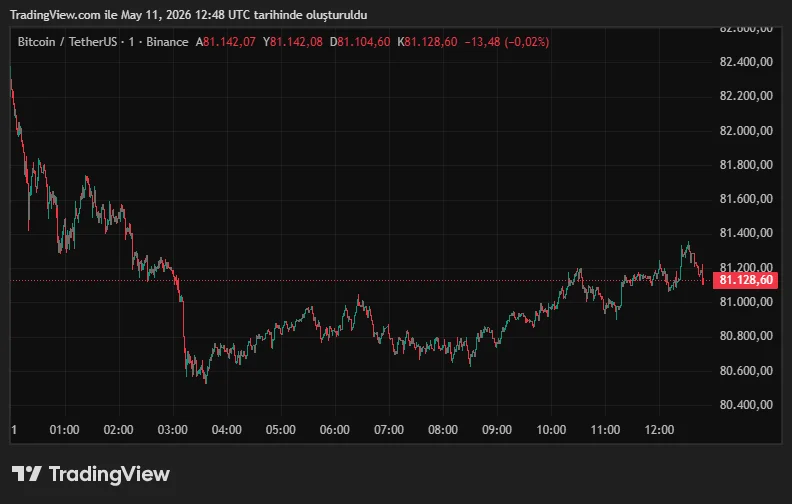
According to current market data, Bitcoin is trading slightly above $81,000. During the day, it moved between $80,397 and $82,394. The May 14 committee process may not determine Bitcoin’s short-term direction on its own. Still, every signal from Washington could quickly reshape regulation-driven expectations in the Bitcoin market.