United Stables (U) is a stable crypto asset designed to operate with a 1:1 peg to the U.S. dollar. This type of asset, more commonly known in the crypto market as a “stablecoin,” generally aims to keep its value close to a traditional currency such as the dollar. Since U Coin has this structure, it is evaluated more by its ability to maintain its dollar peg than by expectations of price appreciation.
The main goal of United Stables is to make dollar usage on blockchain more organized, faster, and more efficient. Today, the crypto market uses many dollar-linked assets such as USDT, USDC, USD1, and similar stablecoins. However, when these assets create separate liquidity across different networks, exchanges, and decentralized finance applications, market depth can become fragmented.
U Coin stands out with its claim of bringing this scattered structure together under a single dollar layer. Instead of letting different dollar-pegged assets operate in disconnected ways, the project aims to make them usable within a shared transaction and payment infrastructure. According to its official website, U is defined as a U.S. dollar-linked stablecoin issued by United Stables Limited and operating on BNB Chain and Ethereum.
Definition and Origins of United Stables
United Stables was developed to create a more unified dollar flow in the stable crypto asset market. Rather than simply offering a new dollar asset, the project focuses on bringing together different dollar-pegged assets already used in the market within a more efficient structure.
From this perspective, the starting point of U Coin is based on a common issue in the crypto market. There are many stablecoins representing the same value, but these assets are not always used in the same trading areas or with the same level of depth. USDT may stand out on one exchange, while USDC may be more common in another decentralized application. On another network, USD1 or a different dollar-linked asset may be preferred more widely.
For users, this means a need for conversion, transaction costs, and fragmented liquidity. United Stables aims to reduce this fragmentation with U Coin. The project offers a model in which different dollar-pegged crypto assets can be used as collateral for minting U.
According to BNB Chain, U is positioned as the first stable asset model on BNB Chain that allows dollar-backed stablecoins such as USDT, USDC, and USD1 to be used directly as minting collateral. This structure aims to gather existing liquidity within a single shared layer instead of fragmenting it further.
How Does U Coin Work?
The working logic of U Coin is based on maintaining its dollar peg and moving different dollar-linked assets into a shared area of use. Users or institutions provide certain backing assets to mint U. These backing assets may consist of traditional cash reserves or other dollar-pegged crypto assets considered reliable.
The most notable point here is that the project does not rely only on a cash-backed model. United Stables offers a broader reserve structure in which some dollar-linked assets can also be used as collateral for minting U. In English sources, this model is called a “stablecoin-inclusive reserve model.” In Turkish, it can be explained as a “reserve model that also includes stablecoins.”
Thanks to this structure, U aims to bring different dollar assets in the market together around itself. For example, instead of USDT, USDC, or USD1 creating separate areas of use, these assets are intended to be used as collateral for minting U. In this way, the project aims to provide a smoother transition between dollar-pegged assets.
U’s operation on blockchain also makes transactions easier to track and simplifies connections with different applications. BNB Chain stands out with low transaction costs and a broad user base, while Ethereum is seen as an important network because of its wider decentralized finance infrastructure. U’s presence on both networks prevents the project from being limited to a single blockchain environment.
What Is U Coin Used For?
The main use case of U Coin is to serve as a transaction asset representing dollar value on blockchain. Users can use U in trading, decentralized finance applications, payments, and large-scale institutional transactions.
On the trading side, U can be used as a dollar equivalent between different crypto assets. When users want to protect themselves against market volatility, they may move into stable crypto assets that maintain a value close to 1 dollar. For this reason, U works more like a dollar layer that provides transaction convenience than an investment asset expected to rise in price.
On the decentralized finance side, U can be used in areas such as borrowing, lending, yield generation, and providing market depth. A user may deposit U into a pool to provide trading depth or carry out borrowing transactions through U. These use cases increase the importance of stable crypto assets within DeFi.
On the payment side, U offers a structure that can be used for cross-border money transfers and institutional settlement. Traditional money transfers can sometimes be slow and costly. Stable assets operating on blockchain aim to make this process faster and more traceable.
United Stables’ official website states that U is designed for trading, payments, decentralized finance, institutional settlement, and AI agents. This shows that the project is moving toward a broader payment and data transaction infrastructure.
History of United Stables: Key Milestones
The public journey of United Stables gained momentum toward the end of 2025. The project announced that U Coin was launched on BNB Chain and Ethereum on December 18, 2025. This launch made U accessible on two major blockchain networks from the very beginning.
During the launch period, U’s main narrative was built around reducing fragmentation in the stablecoin market. The project described itself less as a new stable asset and more as a structure that aims to bring different dollar-linked assets together within a single transaction layer. For this reason, U’s history is important not only because of its launch date, but also because of the specific problem it aims to solve.
The announcement from BNB Chain made U’s positioning clearer. U stood out with a model in which assets such as USDT, USDC, and USD1 can be used directly as minting collateral. This structure showed that the project is not merely trying to compete in the stablecoin market, but is also trying to unite existing dollar flows around itself.
One of U’s first important milestones was its Binance listing. Binance announced that it would list United Stables on the spot market on January 13, 2026. Trading opened with the U/USDT and U/USDC pairs. Binance also launched a zero-fee campaign for these trading pairs during the listing period.
This listing became an important step that increased U’s visibility. For stable crypto assets, exchange access matters not only in terms of price, but also in terms of usability. The more trading areas an asset enters, the easier it becomes for users to buy it, sell it, and move it to different applications.
U’s price history should also be evaluated within this historical context. Since U is not a crypto asset that targets price growth in the traditional sense, its price history should be examined not by asking “how much did it rise,” but by asking “how close did it remain to 1 dollar?”
According to market data, as of May 25, 2026, the U coin price is around $0.999. The same data shows a market capitalization of around $1.06 billion and a circulating supply of approximately 1.06 billion U.
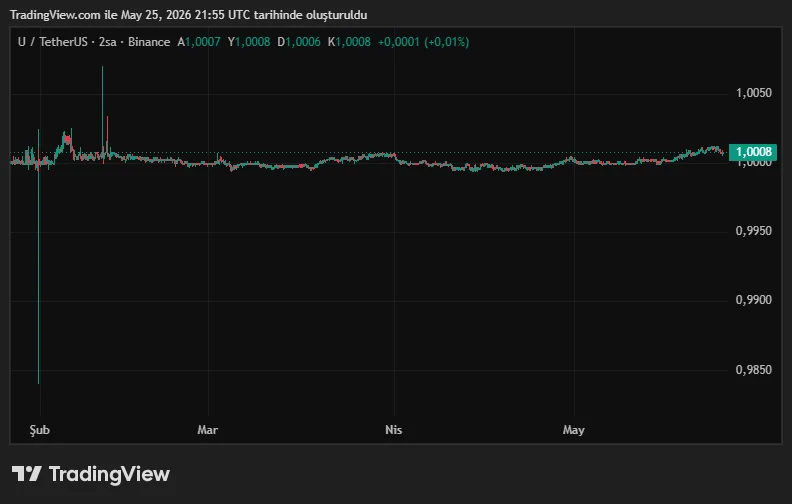
Market data shows U’s all-time high at $1.01 and its all-time low at $0.9682. This range can be used to understand how much U has deviated from its dollar peg. Small deviations are possible in stablecoins under normal market conditions, but long-lasting and deep deviations are closely watched in terms of trust.
Another important topic in U’s history is its ecosystem connections. Its official website lists names such as Binance, Trust Wallet, Binance Wallet, Ceffu, HTX, TokenPocket, PancakeSwap, Venus, Lista, and SafePal.
Why Is United Stables Important?
The importance of United Stables comes from its focus on a core issue in the stablecoin market. Although dollar-pegged assets are widely used in the crypto market, their areas of use often remain fragmented. Separate dollar pools emerge across different exchanges, networks, and applications.
This can make the user experience more difficult. A user may be using USDC in one application but may need to switch to USDT for another transaction. These transitions can create time costs, transaction fees, and price differences. U Coin aims to create a shared dollar layer that could reduce these kinds of transitions.
For this reason, United Stables can be described not only as a payment asset, but also as an infrastructure that seeks to unify market depth. If the project succeeds, users may be able to move more easily between different dollar-linked assets. This could create a more organized transaction environment in decentralized finance applications.
U’s operation on BNB Chain and Ethereum is also important. BNB Chain has a broad user base for fast and low-cost transactions. Ethereum, on the other hand, is considered one of the most established networks in decentralized finance. U’s presence on these two networks provides an important foundation in terms of both transaction convenience and application connectivity.
In stable crypto assets, the most important issue is the reserve structure. Users want to trust that these assets will remain close to 1 dollar, that there is sufficient backing behind them, and that they can be redeemed when necessary. For this reason, the long-term success of U Coin depends not only on its technical structure, but also on how its reserves are held and how transparently they are reported.
According to United Stables’ official statement, U is issued as a stablecoin linked to the U.S. dollar. It is stated that fiat reserves are held at accredited banking institutions, while digital asset reserves are held through licensed or qualified custodians. This statement shows that the project aims to build a multi-layered backing and trust framework.
Still, it is necessary to be cautious in this area. In the stablecoin market, reserve statements, independent audits, and legal compliance documents are closely monitored. Users should look not only at the project’s promotional texts, but also at regularly published reports, custody structures, and legal disclosures.
U Coin’s ability to maintain its value is closely tied to this trust relationship. If users trust the reserve structure, U’s chances of staying around 1 dollar become stronger. If confidence weakens, stable assets can quickly deviate from their dollar peg.
Use Cases on Blockchain
U Coin’s operation on blockchain separates it from traditional digital dollar systems. While dollars in a bank account move only within certain financial institutions, assets like U can move across supported networks between wallets, exchanges, and decentralized applications.
This structure is especially important for decentralized finance applications. Users can use U in lending platforms, liquidity pools, or payment tools. Institutions can also benefit from blockchain-based stable assets to complete large transactions more quickly.
U’s use on the payment side is also noteworthy. Cross-border transactions can sometimes take a long time in the traditional banking system. Dollar-pegged assets operating on blockchain claim to make this process faster and more traceable.
The idea of payment infrastructure for AI agents also appears in the project’s current narrative. The goal here is to allow automatically operating software to make small payments or cover transaction costs directly on blockchain. Although this area is still at an early stage, U positions itself as a dollar asset suitable for these new forms of use.
United Stables’ Developers and Community
The issuing organization behind United Stables is stated as United Stables Limited. The official website describes U as a U.S. dollar-linked stablecoin issued by United Stables Limited. The project positions itself as a “stablecoin liquidity layer” and operates on BNB Chain and Ethereum.
The project’s vision is built around bringing different dollar-pegged assets closer to a single area of use. This vision points to something different from simply launching a new coin. United Stables aims to make dollar-linked crypto assets work in a more efficient and interconnected way.
On the community side, U’s growth largely depends on the expansion of its use cases. In stable assets, the community structure may not be shaped around voting and decision-making processes as it is with governance tokens. Here, users’ main focus is on trust, access, transaction convenience, and market depth.
Exchanges, wallets, custodial services, and decentralized finance applications play an important role in U’s ecosystem. The more wallets and applications support a stablecoin, the more likely it is to be used in everyday transactions. For this reason, not only the technical structure, but also ecosystem connections will be decisive in United Stables’ growth path.
Ecosystem and Partnerships
United Stables’ ecosystem includes centralized exchanges, wallet providers, custodians, and decentralized finance applications. The presence of names such as Binance, Trust Wallet, Binance Wallet, Ceffu, HTX, TokenPocket, PancakeSwap, Venus, Lista, and SafePal on the official website shows that the project is trying to reach different user groups.
These connections can expand U’s use cases. Exchanges make it easier to buy and sell U. Wallets help users store and transfer U. Decentralized finance applications create space for U to be used in lending, liquidity provision, and yield strategies.
A strong ecosystem has special importance for stable assets. In stablecoins, minting and reserve models alone are not enough. Where users can use the asset, which trading pairs they can access, and which applications they can move it to are just as important as the technical structure.
The Future of United Stables
The future of United Stables is directly connected to the growth of the stable crypto asset market. In the crypto market, dollar-linked assets are used across a wide area, from trading to decentralized finance applications. As long as this usage continues, interest in more efficient and unified dollar layers may also continue.
For U Coin, the most important issue will be maintaining its dollar peg reliably. For this, the reserve structure must remain strong, transparent, and regularly traceable. In the stablecoin market, loss of trust can have very fast consequences. Therefore, United Stables’ long-term position will be shaped more by trust and usage stability than by technical features alone.
Its presence on BNB Chain and Ethereum gives U a broad starting ground. However, for the project to become permanent, it needs to be used in more applications, appear in more trading pairs, and become an asset users prefer in their everyday transactions.
Regulators’ approach to the stablecoin market may also be decisive for U’s future. Legal rules in the U.S., Europe, and Asia affect how stable crypto assets can be issued, how they are supervised, and which institutions can operate in this field. Therefore, U’s future depends not only on the internal dynamics of the crypto market, but also on the global regulatory process.
Frequently Asked Questions (FAQ)
Below, we will cover some frequently asked questions and answers about United Stables (U):
- What is United Stables (U), and when was it launched?: United Stables (U) is a stable crypto asset designed to operate with a 1:1 peg to the U.S. dollar. The project was launched on BNB Chain and Ethereum on December 18, 2025. U’s main goal is to move the market depth fragmented across different dollar-pegged crypto assets into a more unified structure.
- Is U Coin a stablecoin?: Yes. U Coin operates as a dollar-pegged stablecoin. In Turkish, this can be explained as a stable-value crypto asset. U’s goal is not to constantly increase its price, but to maintain a value close to 1 dollar.
- Who issued United Stables?: U Coin is issued by United Stables Limited. Its official website defines U as a U.S. dollar-linked stablecoin operating on BNB Chain and Ethereum.
- What is U Coin used for?: U Coin can be used in trading, decentralized finance applications, payments, institutional settlement, and programmable payment systems. Its main function is to provide a stable asset that represents dollar value on blockchain.
- Why does U Coin trade close to 1 dollar?: U Coin is designed to be linked to the U.S. dollar, so its price is expected to remain close to 1 dollar. This structure is supported by reserves and market transactions. The price may briefly move above or below 1 dollar, but the main goal for stablecoins is to keep these deviations limited.
- Which blockchain networks does U Coin operate on?: U Coin operates on BNB Chain and Ethereum. These two networks make it easier for U to reach different user groups and decentralized applications.
- Why does U Coin not rise much in price?: Since U Coin is a stable crypto asset, it does not target price appreciation. For this reason, U is not structured as an asset expected to rise to levels such as 2 dollars, 5 dollars, or 10 dollars. U’s success is measured by its ability to keep its value close to 1 dollar.
- What problems does United Stables aim to solve?: United Stables aims to solve the fragmented market depth problem in the stablecoin market. The project tries to move the scattered structure created by different dollar-pegged assets such as USDT, USDC, and USD1 into a more unified dollar layer.
- Is U Coin suitable for investment?: U Coin is not a classic investment asset evaluated with price appreciation expectations. Since it is a stablecoin, its main purpose is to maintain its dollar peg. Users should evaluate U by considering its reserve structure, transaction areas, legal status, and ability to maintain its dollar peg.
- How does the United Stables reserve model work?: United Stables uses a reserve-based model to support U’s dollar peg. According to official statements, fiat reserves are held at accredited banking institutions, while digital asset reserves are held through licensed or qualified custodians. In addition, dollar-pegged assets such as USDT, USDC, and USD1 can also be used as collateral in U minting.
Follow the JR Kripto Guide series for the latest information on United Stables and the stable crypto asset market.