
OpenGradient is a blockchain infrastructure that aims to run artificial intelligence models on a decentralized network and make these processes verifiable. The project’s native asset, OPG, is used within the network for payments related to artificial intelligence inference, enabling model developers to generate revenue, rewarding node operators, staking, ecosystem incentives and governance processes.
The main starting point of OpenGradient is the growing problem of trust and transparency in artificial intelligence infrastructure. Today, many artificial intelligence applications operate through the application programming interfaces of centralized service providers. Users often cannot independently verify which model is being used, whether the model output has been altered or which system commands are running in the background.
OpenGradient seeks to solve this problem by bringing blockchain and artificial intelligence together within the same infrastructure. The project aims not only to run artificial intelligence models, but also to make the process of running these models provable. In this respect, OpenGradient is positioned less as a conventional artificial intelligence token and more as a verifiable artificial intelligence inference infrastructure.
Definition and Emergence of OpenGradient
OpenGradient is a decentralized artificial intelligence infrastructure that brings together AI and blockchain technologies. The project aims to run machine learning models, large language models and AI agents in a secure, auditable and verifiable way.
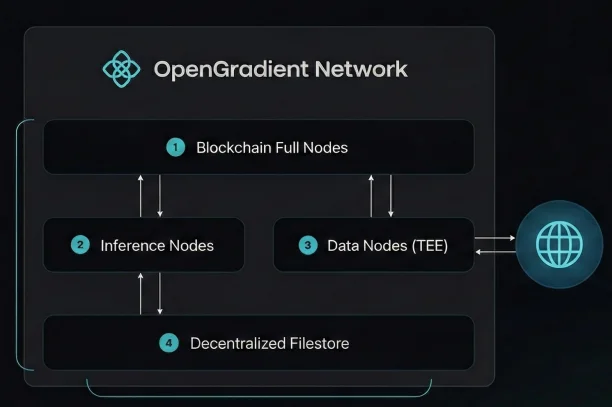
To understand OpenGradient, it is necessary to understand the concept of “inference.” Inference refers to the process through which an artificial intelligence model produces an output based on a given input. When a user sends a message to an AI chatbot, when a DeFi application performs risk analysis or when an AI agent makes an on-chain transaction decision, an inference process runs in the background.
In traditional AI services, this process takes place on centralized servers. The user usually sees only the result. OpenGradient, on the other hand, wants to make this process more open and verifiable. Whether a model has actually been run, which outputs were produced and whether the process is reliable can be supported by blockchain-based proofs.
For this reason, OpenGradient’s goal is not merely to host AI models. The project seeks to turn the process of running AI models into a reliable infrastructure for Web3 applications. This structure becomes especially important in areas where the margin for error must be low, such as finance, data analysis, automation, governance and AI agents.
The Purpose Behind OpenGradient’s Emergence
The main idea behind OpenGradient’s emergence is that artificial intelligence should not be limited to closed and centralized infrastructures. AI models are becoming increasingly involved in decision-making processes. Despite this, users often cannot verify how these decisions are produced.
This becomes an even more critical problem in the Web3 world. If an AI agent manages a wallet, creates a DeFi strategy, performs on-chain transactions or makes automated decisions on behalf of a user, the model output behind that decision must be verifiable. Otherwise, the user is forced to rely solely on the service provider’s statement.
At this point, OpenGradient highlights the idea of “verifiable AI” instead of “trust-based AI.” The project aims to benefit from the auditability provided by blockchain infrastructure while keeping the performance of AI applications as fast as centralized services.
What Does the HACA Architecture Mean?
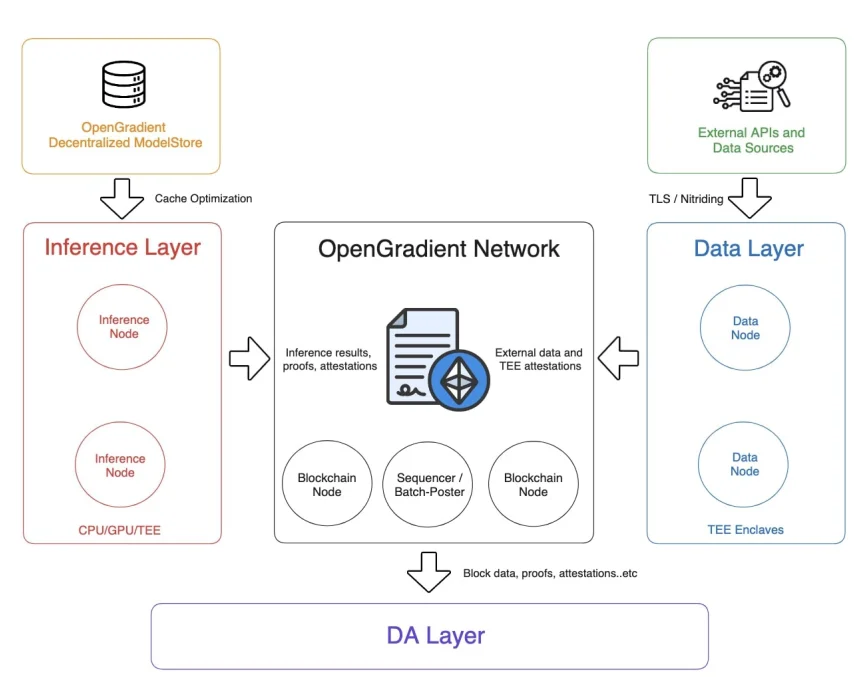
At the center of OpenGradient’s technical structure is the Hybrid AI Compute Architecture, or HACA. This architecture separates the part where AI inference is executed from the part where verification takes place.
In traditional blockchain networks, every validator is expected to re-execute the same transaction. This model is suitable for token transfers or simple smart contract transactions. However, the same method is not practical for artificial intelligence models. Large models require GPUs, processing takes longer and outputs are not always as predictable as simple financial transactions.
OpenGradient tries to solve this problem through different types of nodes. Inference nodes run AI models. Full nodes take part in the proof and settlement processes. Data nodes provide secure access to external data sources. In this way, each node type focuses on its own task and the entire network is not forced into a single verification model.
Thanks to this structure, the user can receive the artificial intelligence output at a speed close to that of a centralized application programming interface. The verification, proof or attestation process is then completed on-chain. This creates an attempt to balance transaction speed and verifiability.
What Is the OPG Token?
OPG is the native token of the OpenGradient network. The token’s main function is to enable the economic flow within the network. Users or applications that want to run AI models can pay with OPG. Model developers can generate revenue as their models are used. Node operators can be rewarded for the computation and verification contributions they provide to the network.
OPG is also used in staking and governance processes. This structure aims to move the token beyond being merely a market asset that is bought and sold. Within the OpenGradient ecosystem, the value of the token is linked to AI usage demand on the network and developer activity.
The total supply of the token has been set at 1 billion OPG. According to the official token economy structure, 40 percent of the supply is allocated to ecosystem growth, 15 percent to the foundation, 15 percent to the core contributor team, 10 percent to investors and advisors, 10 percent to staking rewards, 6 percent to liquidity provision and the launch process, and 4 percent to the airdrop.
Use Cases of OpenGradient
OpenGradient’s use cases are concentrated in areas where AI and Web3 come together. DeFi protocols can benefit from AI models for risk analysis. Wallet applications can offer users personalized transaction assistants. AI agents can perform on-chain actions in a more auditable way.
From the perspective of model developers, OpenGradient provides an infrastructure that allows models to be shared on an open network and generate revenue. Developers can host their models through Model Hub, create new versions of those models and make them available for other applications.
Products such as OpenGradient’s MemSync focus on long-term memory and context management in AI applications. This structure can help AI assistants better preserve user context across sessions. The project’s broader vision includes not only running AI models, but also building a user-controlled and verifiable AI experience.
OpenGradient’s History: Key Milestones
OpenGradient emerged at a time when AI infrastructure was becoming increasingly concentrated around a few large centralized providers. The project was built on the idea that artificial intelligence models should run on an infrastructure that is more open, portable, verifiable and accessible to developers.
OpenGradient’s early work focused on the question of how AI models could be integrated into blockchain applications. During this period, the project moved toward developing technical tools that developers could use, rather than simply creating a token economy.
This approach is one of the elements that separates OpenGradient from many speculative projects in the AI x crypto space. Instead of building its narrative solely around the artificial intelligence trend, the project builds it around infrastructure topics such as inference, model hosting, verification, node architecture and developer tools.
Model Hub and Developer Infrastructure
One of OpenGradient’s important components is Model Hub. Model Hub functions as a decentralized repository for AI models. Developers can discover, share and run models through the OpenGradient network.
This structure can be seen as a Web3-compatible alternative to traditional model platforms. Model files, versions and usage processes are moved to a more permanent and auditable infrastructure. In this way, model developers can take part in a more open economy where they can generate revenue from the use of the models they create.
OpenGradient also makes it easier for developers to access the network through tools such as the Python SDK. This is important for the project’s real usage potential. The success of an infrastructure project is measured not only by the number of exchanges on which its token is listed, but also by how easily developers can build applications on that infrastructure.
Whitepaper and the Clarification of the Technical Architecture
OpenGradient Foundation more clearly laid out the project’s architecture in the technical documents it published in 2026. These documents detailed the HACA structure, the specialization of nodes in different tasks, verification methods, the on-chain settlement of proofs and the OPG token economy.
The main idea highlighted in these documents is that artificial intelligence workloads cannot be treated in the same way as traditional blockchain transactions. Token transfers and simple smart contract calls can be re-executed by every validator. However, this method is not efficient for large artificial intelligence models. For this reason, OpenGradient proposes an architecture that separates the execution and verification processes.
Different methods can be used on the verification side. TEE, which can be translated as a trusted execution environment, focuses on proving that the model ran in a secure hardware environment. ZKML, meaning zero-knowledge machine learning, can provide stronger assurance, but its cost and processing load are higher. For lower-risk applications, lighter methods such as signature verification may be preferred.
The Launch of the OPG Token
OPG token entered the market in 2026 as the economic layer of the OpenGradient ecosystem. The token’s total supply was set at 1 billion. In the token economy structure, ecosystem growth received the largest allocation, while the foundation, core contributor team, investors, staking rewards, liquidity provision and free token distribution were defined as separate categories.
During the initial launch process, the tokens allocated for liquidity provision and free token distribution were fully released. Ecosystem and foundation allocations, however, follow a gradual unlocking schedule. The core contributor team and the investors and advisors categories stand out with a 12-month waiting period followed by a 36-month regular unlocking structure.
This structure causes OPG’s circulating supply in the early period to remain lower than the total supply. The fact that circulating supply will increase over time is an important data point for investors to monitor. Especially in newly launched tokens, price can be sensitive not only to the demand side, but also to upcoming token unlocks.
Binance Listing and Market Visibility
One of the most important milestones that increased OpenGradient’s market visibility was its Binance listing. Binance announced that it would open OPG/USDT, OPG/USDC and OPG/TRY trading pairs for OPG on May 22, 2026. The same announcement also stated that a Seed Tag would be applied to OPG.
Seed Tag is a label used by Binance for newer projects that carry higher volatility risk. For this reason, OPG’s listing on Binance increased access to the token, while also showing that investors need to pay attention to risk management. In its announcement, Binance described OpenGradient as a decentralized infrastructure network designed to host, run and verify AI models at scale.
OPG Price History
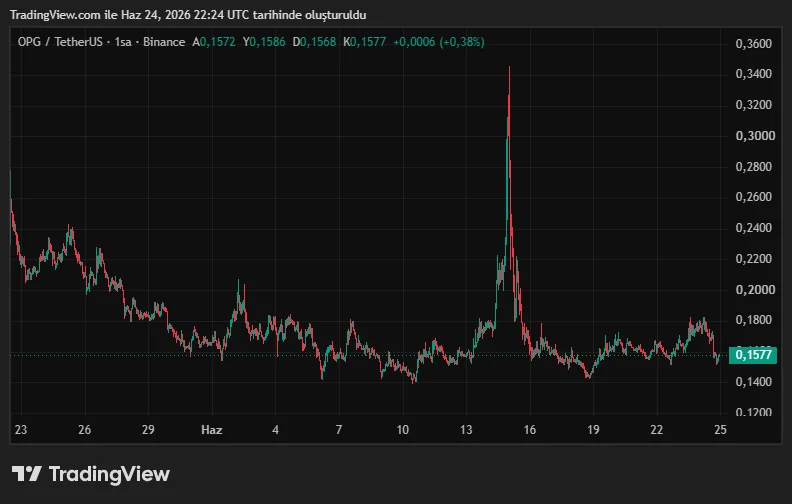
After entering the market, OPG traded with the high volatility often seen in new AI tokens. Data as of June 25, 2026 showed the OPG coin price at around $0.15 to $0.16, while its all-time high was recorded at around $0.47 in April 2026.
Why Is OpenGradient Important?
The main reason OpenGradient is important is that it focuses on the problem of verifiability in artificial intelligence. AI models are no longer used only in chatbots. They are becoming part of decision-making processes in many fields, including financial analysis, health assessment, content moderation, automation, cybersecurity, data processing and investment strategies.
In these areas, how a model output is produced matters greatly. If an AI system uses the wrong model version, alters the output or applies a filtering process that is not visible to the user, the consequences can be serious. In centralized AI services, most of these processes cannot be controlled by the user.
OpenGradient tries to bring blockchain-based auditability to the AI inference process. The goal is for the model output not to come merely from an application programming interface that is assumed to be reliable, but from a process that is technically verifiable.
The Need for Secure Infrastructure for AI Agents
AI agents are one of the most important use cases targeted by OpenGradient. An AI agent is a software system that can carry out certain tasks on behalf of a user. In the future, these agents may manage wallets, perform on-chain transactions, monitor DeFi positions or run automated strategies.
At this point, the trust problem becomes more visible. If an AI agent is acting on a user’s assets, it must be verifiable which model it is acting on and which data its decisions are based on. Otherwise, the user effectively entrusts their assets to an invisible decision-making mechanism.
OpenGradient’s architecture aims to make such agents more auditable. When the model output, data source and verification process are connected to each other, it may become possible to use AI agents more safely in on-chain applications.
An Alternative to Centralized AI Infrastructure
Another important aspect of OpenGradient is its claim to offer an alternative to centralized AI infrastructure. Today, most AI applications run through APIs provided by a few major technology companies. These services are powerful, but they are closed. Users and developers often cannot control changes in model behavior or data usage policies.
OpenGradient aims to move AI models to a more open and portable infrastructure. Model Hub, decentralized storage, node-based inference and verification mechanisms are parts of this goal. This structure can help developers build AI features without being fully dependent on a single centralized provider.
This does not mean that centralized services will disappear entirely. OpenGradient’s approach is more about building a secure and verifiable alternative layer for AI applications. This layer is especially important for Web3 applications, because users already come to this ecosystem with expectations of decentralized ownership, transparency and auditability.
Its Importance for DeFi and Financial Applications
The increasing use of AI in DeFi may increase the importance of projects such as OpenGradient. AI models can be used in areas such as risk analysis, credit scoring, liquidation forecasting, market data interpretation and portfolio automation. However, the outputs of these models have financial consequences.
If a DeFi protocol determines a risk parameter based on an AI model, it needs to be proven that the model is working correctly. If an AI agent manages a user’s position, the decisions it makes need to be traceable. OpenGradient’s verifiable inference approach can provide infrastructure for such use cases.
For this reason, OpenGradient’s potential does not depend solely on general interest in AI. The project seeks to provide a technical layer that allows AI to be used reliably in financial and on-chain applications.
An Open Economy for Model Developers
Another factor that increases OpenGradient’s importance is that it offers a new revenue model for model developers. In the traditional AI ecosystem, models are usually shared on centralized platforms or used within closed services. A model creator’s ability to generate revenue often depends on platform rules.
OpenGradient Model Hub gives model developers the ability to offer their models on a decentralized network. When a model is used, this usage can be reflected in the network economy. OPG token comes into play at this point as a payment and incentive tool.
In the long run, this structure can create a more open AI model marketplace. Users can discover different models, developers can open their models to a wider ecosystem and applications can access the AI capacity they need in a blockchain-compatible way.
OpenGradient’s Developers and Community
According to OpenGradient’s official team page, the project’s CEO and co-founder is Matthew Wang, while its CTO and co-founder is Adam Balogh. Matthew Wang’s background includes quantitative research at Two Sigma and software engineering experience at Google, Facebook and NASA. Adam Balogh has technical leadership experience on the Palantir Artificial Intelligence Platform, as well as experience at Google and Amazon.
The team includes people with experience in AI research, cryptography, blockchain engineering, large-scale software systems and product development. This is important for OpenGradient’s technical character. The project is not built solely on crypto marketing, but on complex technical fields such as AI infrastructure and verifiable computation.
It should also be noted that the team page highlights experience from companies such as Palantir, Google, Meta and Two Sigma.
Community and Developer Ecosystem
The OpenGradient community consists of developers, model creators, node operators, AI researchers, investors and Web3 users. The long-term success of the project depends on how active these groups are.
For an AI infrastructure project, community does not mean only social media followers. More important indicators include how many developers use the SDK, how many models are added to Model Hub, how many applications run inference on OpenGradient and how the network’s real usage volume grows.
For this reason, developer metrics should be examined alongside community metrics when tracking OpenGradient. GitHub activity, documentation updates, model count, inference count, node participation and ecosystem announcements can provide more meaningful signals about the health of the project.
Frequently Asked Questions (FAQ)
Below are some frequently asked questions and answers about OpenGradient:
- What is OpenGradient? OpenGradient’s early development and DevNet process came to the fore in 2024. The OPG token was launched in 2026 and began listing on major exchanges in the same year.
- When was OPG coin listed? OPG began listing on centralized exchanges in 2026. Binance announced that it would open OPG/USDT, OPG/USDC and OPG/TRY trading pairs on May 22, 2026.
- Who developed OpenGradient? According to OpenGradient’s official team information, the project’s CEO and co-founder is Matthew Wang, while its CTO and co-founder is Adam Balogh. The team includes people experienced in AI, blockchain, cryptography and large-scale software infrastructure.
- What is OPG token used for? OPG token is used as a payment, incentive and governance tool in the OpenGradient ecosystem. Users can pay with OPG to run AI models, model developers can earn revenue from the use of their models and node operators can be rewarded for their contributions to the network.
- What problem does OpenGradient aim to solve? OpenGradient aims to solve the trust and verifiability problems seen in centralized AI services. It aims to allow users to technically verify that an AI model has actually been run, that the output has not been altered and that the process is reliable.
- How does OpenGradient work? OpenGradient uses an architecture called Hybrid AI Compute Architecture, or HACA. This structure separates the inference process, where the AI model is run, from the verification process. In this way, AI operations can be executed faster while being made verifiable through proof and attestation mechanisms.
- What is the total supply of OPG token? The total supply of OPG token is 1 billion. This supply is divided into different categories such as ecosystem, foundation, core contributors, investors, staking rewards, liquidity and airdrop.
- Why is OpenGradient important? OpenGradient is important because it focuses on the problem of verifiability in artificial intelligence. As AI models are increasingly used in finance, data analysis, automation and Web3 applications, verifying how these models work and which outputs they produce becomes more critical.
Follow the JR Kripto Guide series for the latest information about OpenGradient, OPG and blockchain-based artificial intelligence infrastructures.