In the DeFi world, speed is not always just a matter of convenience. If an order is processed a few seconds late, the price can change, a liquidation opportunity can be missed, or the user can end up with a much worse transaction result than expected. That is why blockchain projects in recent years have been competing not only with the promise of “more transactions,” but also with lower latency and a smoother user experience.
Fogo stands out as one of the next-generation Layer-1 blockchains positioned right in the middle of this competition. The project uses Solana’s architecture and works in a way that is compatible with SVM, the Solana Virtual Machine. This allows developer tools, applications, and infrastructure from the Solana side to be moved to Fogo more easily.
The main idea behind Fogo is to make blockchain more useful for financial applications that require fast transactions. On-chain order books, real-time auctions, liquidation processes, and reducing the impact of MEV are among the key parts of this goal.
Fogo’s Definition and Origins
Fogo is a high-performance Layer-1 blockchain developed for DeFi-focused applications. While the network benefits from Solana’s architectural approach, it also makes some different choices in line with its own performance goals. Low latency, fast block production, and a simplified user experience sit at the center of Fogo.
SVM compatibility is one of Fogo’s core building blocks. SVM refers to the environment where smart contracts and transactions on Solana are executed. Fogo’s compatibility with this structure allows projects and developers in the Solana ecosystem to move faster on Fogo.
The need for speed in the DeFi market plays a decisive role in Fogo’s emergence. On centralized exchanges, users are used to their orders being processed within milliseconds. On the blockchain side, network congestion, transaction fees, and confirmation times can slow this experience down. Fogo offers an infrastructure that aims to reduce this gap.
Fogo’s History: Key Milestones
Late 2024: Seed Round
The project closed a $5.5 million seed round led by Distributed Global in December 2024. During this period, Fogo clearly positioned itself as an infrastructure project focused on solving the speed problem in DeFi. The main goal was to take Solana’s TPS capacity and push it even further toward lower latency.
January 2025: Echo Round and Community-Focused Growth
In the first month of 2025, the community round held through Cobie’s Echo platform brought not only funding to the project, but also more than 3,000 crypto-native angel investors. This broad investor base strengthened Fogo’s awareness and community ownership at an early stage.
October 2025: Validator Design
The validator design article published in October 2025 showed how Fogo tries to balance network security and speed. Topics such as high hardware standards, physical proximity, and performance-based validator selection were emphasized. While this model supports faster network performance, it also brings centralization debates with it.
July 2025: Testnet Launch
The testnet went live in July 2025 and quickly rose to the top of Chainspect’s performance leaderboard. According to Chainspect data, Fogo reached 136,866 transactions per second in the maximum TPS measurement over the last 30 days.
January 2026: Mainnet and Token Launch
On January 15, 2026, the Fogo mainnet went live. At the same time, a $7 million token sale took place through Binance Wallet. The FOGO token started trading on exchanges such as Binance, OKX, Bybit, Bitget, Gate.io, MEXC, and Backpack. “Fogo Flames” point holders were also able to convert their accumulated points into FOGO tokens. On launch day, around 10 applications went live on the mainnet, including the DEX Valiant, token launchpad Moonit, liquid staking protocol Brasa, and lending protocols Pyron and Fogolend.
FOGO Price History and Market Data
FOGO began trading on January 15, 2026, alongside the mainnet launch. The FOGO coin price made a strong start on launch day and reached its all-time high of around $0.063. This initial excitement did not last long; the token saw a sharp correction in the following weeks.
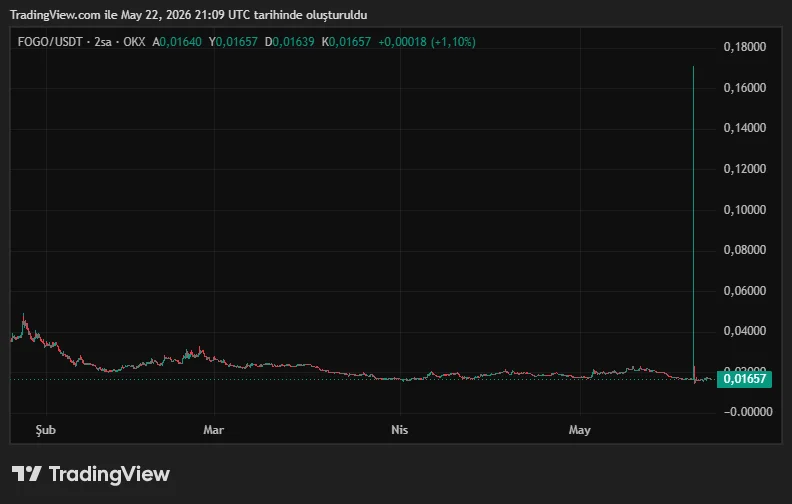
The Binance IEO price was set at $0.035. Its all-time low was around $0.0149 on May 20, 2026. As of May 2026, the price is moving in the $0.016–$0.021 range; its market capitalization is around $61–81 million, while its FDV is around $160 million. FOGO can be accessed through Binance, OKX, Bybit, Bitget, Gate.io, MEXC, and Backpack.
The price, down around 74% from its ATH, follows the post-launch selling cycle often seen in new projects. The large token unlock scheduled for September 2026 stands out as the closest major test ahead of the market.
Why Is Fogo Important?
To understand Fogo’s importance, it is necessary to look at what speed means in DeFi applications. In traditional financial markets, even milliseconds can matter. On the blockchain side, however, transaction confirmation, order sequencing, and the transmission of price data to the system often move much more slowly.
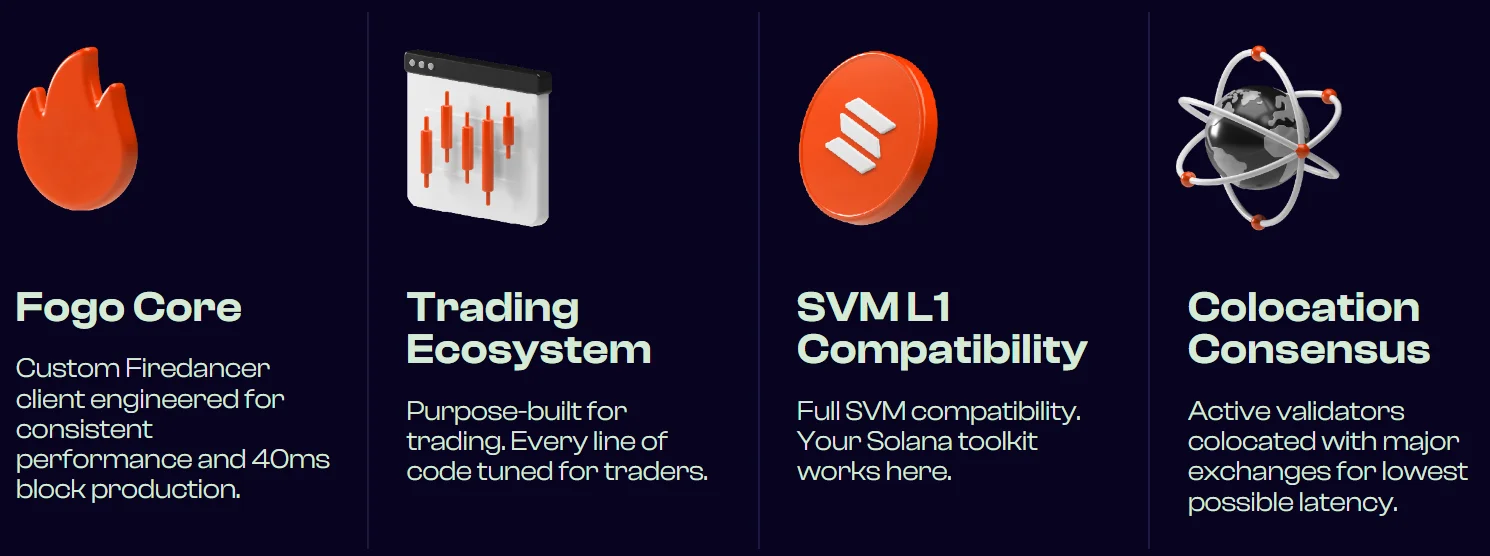
This is exactly where Fogo makes its claim. The network operates with a block time below 40 milliseconds, which means it can be up to 18 times faster than high-throughput chains such as Solana and Sui. This speed advantage creates a tangible difference in order book-based exchanges, liquidations, and high-frequency DeFi applications.
SVM compatibility is another advantage. Offering a familiar technical environment for Solana developers makes it easier for existing applications to move to Fogo. This initial momentum is important for a new network that wants to attract developers.
The fact that Fogo’s team comes from traditional finance and high-frequency trading backgrounds also stands out. A blockchain founded by people who directly understand TradFi’s speed standards approaches this problem from a practical perspective, not just a theoretical one.
How Does Fogo Work?
Fogo works by using many of the core components of Solana’s architecture. Structures such as Proof of History, Tower BFT, Turbine, leader rotation, and SVM form the technical foundation of the network. These components are used for sequencing transactions, spreading blocks across the network, and running smart contracts.
The Firedancer-based client approach plays a decisive role in its performance target. Firedancer is a high-performance Solana-compatible client developed by Jump Crypto. Fogo aims to achieve faster and more consistent network performance by building on this structure. The single canonical client approach creates some debates around security and diversity; however, Fogo makes this choice knowingly, with low latency as the priority.
Multi-Local Consensus Structure
One of Fogo’s most distinctive features is its multi-local consensus model. In this system, validators operate in physically close regions during certain periods. The aim is to reduce communication time between validators and speed up block production.
In blockchain networks, validators being distributed across different parts of the world is seen as valuable for decentralization. But this distribution also causes messages to move more slowly within the network. Fogo tries to establish a different balance here: validators can be positioned near the same data center region during certain periods. This physical proximity significantly reduces network latency.
To avoid permanent dependence on a single region, the network performs regional rotation at certain intervals. These transitions aim to prevent the network from being tied only to one country, data center, or infrastructure provider. Still, this model leaves an area that needs to be carefully monitored in terms of decentralization.
What Is Fogo Sessions?
Fogo Sessions is a structure that eliminates the need for users to sign every transaction separately or pay transaction fees directly when interacting with applications. It brings together account abstraction and the fee sponsor model.
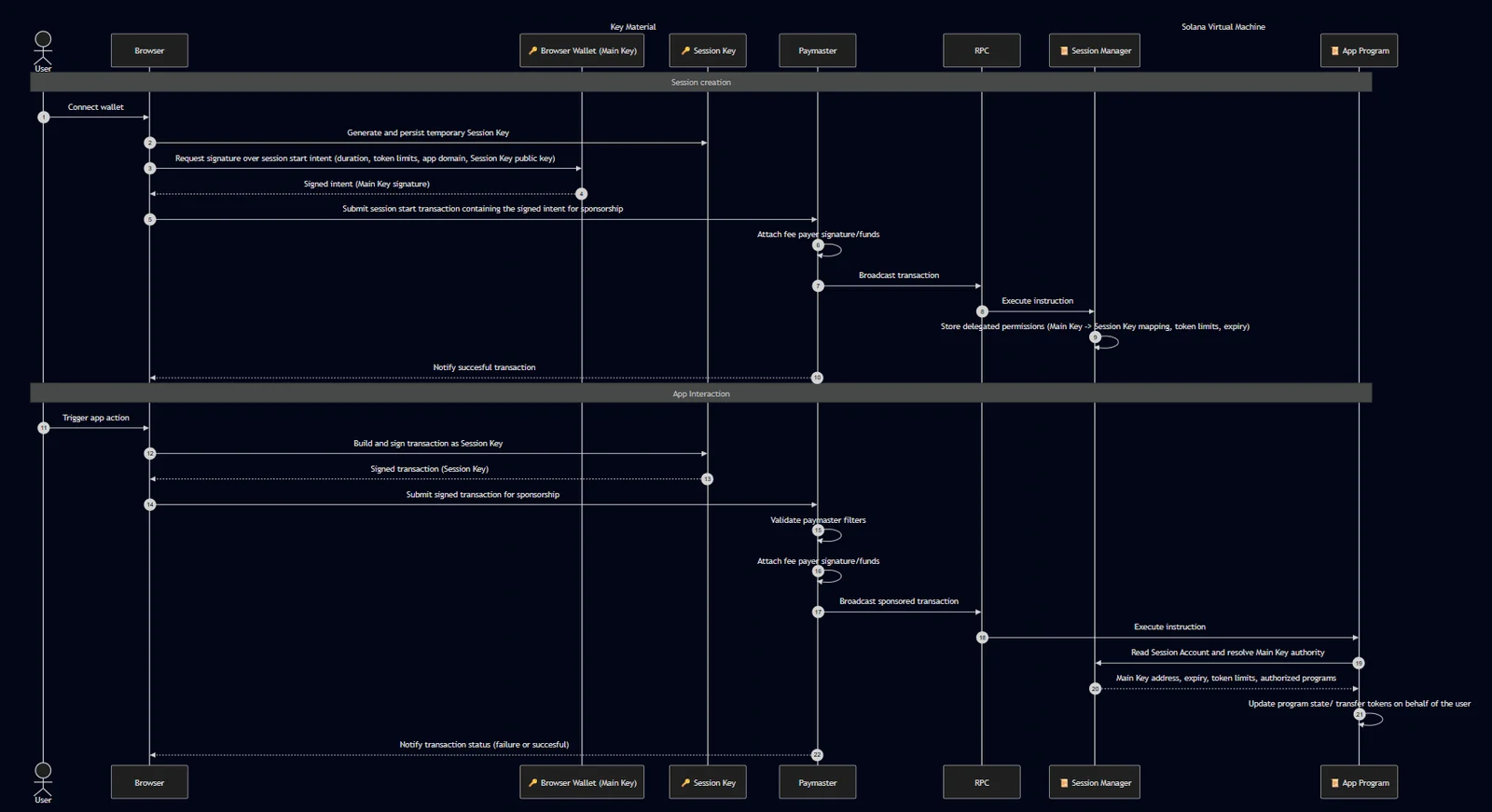
Account abstraction is an approach that makes the wallet experience more flexible for users. The fee sponsor model allows transaction fees to be paid by the application instead of the user. A DeFi application can cover the user’s gas fees itself; this way, the user can use the application without calculating gas at every step.
On the security side, sessions are kept limited. They can be restricted by certain time periods, specific tokens, or specific application areas. This allows users to grant narrower and more controlled usage permission instead of opening access to their entire wallet. These kinds of experiences are becoming increasingly critical for DeFi to reach wider audiences.
What Is the FOGO Token Used For?
FOGO is the native token of the Fogo network. Transaction fees, staking processes, and ecosystem value flow revolve around FOGO.
Transaction fees are the first use case. Transactions on Fogo are paid with FOGO. However, applications can cover these fees on behalf of the user; the end user can use the application without directly paying gas fees.
Staking and network security form the second use case. Token holders can contribute to the network through validators and earn rewards in return. This structure builds the network’s economic security through the FOGO token.
Ecosystem value flow forms the third dimension. Fogo Foundation aims to support projects built on the network through grants and investments. Some projects are expected to return value to the Fogo ecosystem through revenue sharing or similar models.
FOGO Tokenomics
FOGO’s initial supply was set at 10 billion tokens. There is no fixed total supply cap; the protocol creates new FOGO with 2% annual inflation, and these tokens are distributed as validator block rewards.
Category | Details |
Initial Supply | 10 billion FOGO |
Total Supply Cap | None, flexible supply |
Annual Inflation | 2%, validator block rewards |
Circulating Supply | ~3.82 billion FOGO, May 2026 |
Distribution Categories | Community, investors, core team, foundation, advisors, liquidity |
Airdrop | Conversion for “Fogo Flames” point holders |
Major Unlock | ~15.4% of total supply unlocks in September 2026 |
On the distribution side, there are categories such as community ownership, institutional investors, core contributors, foundation, advisors, and launch liquidity. At launch, a significant portion of the genesis supply was locked. The gradual unlocking of locked tokens aims to support the long-term contribution of the team, investors, and advisors.
For investors, the unlock schedule is an important point to watch. Around 1.54 billion FOGO will unlock in September 2026, equal to roughly 15.4% of the total supply. Depending on market conditions, large unlocks of this kind can create selling pressure.
Fogo Ecosystem and Use Cases
The Fogo ecosystem is mainly shaped around DeFi use cases. On-chain order books, fast swap applications, derivatives, lending protocols, liquidation systems, and auctions are among the leading scenarios for this network.
The common point across these use cases is the need for speed. Especially in order book-based applications, latency directly affects transaction quality. If a user’s order reaches the network late, a gap can form between the expected price and the executed price.
The applications that went live with the mainnet launch include DEX Valiant, token launchpad Moonit, liquid staking protocol Brasa, and lending protocols Pyron and Fogolend. Doug Colkitt’s Ambient Finance is also planned to be deployed on Fogo and is positioned as the network’s flagship DEX.
For the network to build a lasting ecosystem, infrastructure tools such as oracle solutions, bridges, explorers, and data services also need to mature alongside these applications. Douro Labs’ connection with Pyth Network provides a natural advantage on the oracle side.
Fogo’s Future
Fogo’s future depends on whether it can turn its technical performance into real user demand. The project makes a clear claim around low latency, fast transaction processing, and a simpler DeFi experience. But for this claim to be sustainable, strong applications and lasting liquidity need to form on the network.
SVM compatibility offers an important starting advantage. Providing a familiar technical environment for Solana developers can make application migration and new experiments easier. On the other hand, Fogo should not be perceived only as “a fast network similar to Solana”; developing its own unique use cases and applications is essential for long-term success.
Fogo Sessions is one of the structures that could play a decisive role in the project’s future. An experience where users deal less with gas fees, wallet approvals, and technical details can increase the usage rate of DeFi applications. This difference can become more visible, especially in applications where users transact frequently.
In the coming period, the large unlock in September 2026, ecosystem growth, and the maturation of liquid staking protocols are among the key topics to watch for Fogo. The technical infrastructure is ambitious; the ecosystem and market tests are still at an early stage.
Who Are the Founders of Fogo?
When looking at Fogo’s background, the first thing that stands out is that almost the entire team has experience in TradFi, meaning traditional finance, and high-frequency trading. This is a profile that is somewhat unusual for crypto projects.
Doug Colkitt: Co-Founder
Colkitt leads the technical side of the project. He worked at Citadel Securities for around 10 years as a high-frequency trader focused on Japanese equities. Later, he founded Crocodile Labs and developed the decentralized exchange protocol Ambient Finance, formerly known as CrocSwap. He has clearly stated that he wants to design Fogo as a chain close to the latency profile of modern electronic markets. He personally experienced infrastructure problems while trading on blockchain at Citadel and founded Fogo to solve them.
Robert Sagurton: Co-Founder / Director of Fogo Foundation
Sagurton manages the commercial and institutional side. He served as Global Head of Digital Asset Sales at Jump Crypto; before that, he worked in institutional sales and digital assets at JPMorgan, State Street, Deutsche Bank, Morgan Stanley, and the institutional blockchain company R3. He says Fogo was created to fill the gaps that make existing crypto infrastructure unusable for professional traders and institutional clients.
Michael Cahill: CEO and Co-Founder
Cahill worked at Morgan Stanley for more than seven years as Vice President of Foreign Exchange Trading, then spent four years at Jump Crypto. He is also the CEO of Douro Labs, the company behind Pyth Network. This connection also explains the technical relationship between Fogo and the Pyth ecosystem.
Advisors and Contributors
There is a strong group of advisors around the team. These include Robert Leshner, founder of Compound and Superstate; Tarun Chitra, founder of Gauntlet, who works on risk and mechanism design; and Dan Reecer from Wormhole Foundation. Ambient Finance is planned to be deployed as Fogo’s flagship DEX.
Funding Process
Fogo raised around $20.5 million in total funding. In December 2024, it completed a $5.5 million seed round led by Distributed Global. In January 2025, a community round was held through Cobie’s, or Jordan Fish’s, Echo platform; more than 3,000 angel investors contributed $8 million in under two hours. CMS Holdings, Big Brain Collective’s Larry Cermak, Kain Warwick, and other crypto-native names took part in this round. In January 2026, a $7 million token sale took place through Binance Wallet alongside the mainnet launch.
Frequently Asked Questions
- What is Fogo?: Fogo is an SVM-compatible Layer-1 blockchain developed for DeFi applications. It uses Solana’s architecture and aims to provide infrastructure for low-latency financial transactions.
- What is FOGO coin?: FOGO is the native token of the Fogo network. It is used for transaction fees, staking processes, and network security. It also sits at the center of the economic value flow in the Fogo ecosystem.
- Is Fogo the same as Solana?: No. Fogo is a separate Layer-1 blockchain that benefits from Solana’s architecture. Thanks to SVM compatibility, it can work closely with Solana tools and applications, but it continues as a separate network with its own validator structure and performance targets.
- What does Fogo Sessions do?: Fogo Sessions makes it easier for users to interact with applications. Users can use applications without signing every transaction separately and without directly dealing with gas fees.
- What is the FOGO token supply?: The initial supply is 10 billion tokens. There is no fixed total supply cap; new FOGO is created through 2% annual inflation in the protocol.
- What is Fogo’s biggest advantage?:Its focus on low-latency DeFi transactions. SVM compatibility, the Firedancer-based client approach, and the multi-local consensus model support this goal. In addition, the team’s high-frequency trading background allows it to approach the problem from a practical perspective.
- What is Fogo’s biggest risk?: The performance-focused design can create debate around decentralization. Having validators operate in certain regions and on high-performance infrastructure provides speed, but it needs to be monitored carefully in terms of distribution. The large unlock in September 2026 is also a short-term risk factor.To explore next-generation Layer-1 projects like Fogo, their tokenomics, and their use cases in the DeFi ecosystem more closely, you can check out the latest guides on JrKripto.