Artificial intelligence is no longer a field developing only inside the closed systems of major technology companies. The crypto world is trying to offer a more open and participatory alternative to this technology. Allora stands out at this point as a decentralized intelligence network. The project aims to coordinate many machine learning models within the same network instead of relying on a single AI model.
Allora’s native token, ALLO, plays a fundamental role in the network’s economic structure. ALLO is used for access to AI inferences, in-network payments, staking, reward distribution, governance and participant coordination. For this reason, seeing Allora only as an AI token would be incomplete.
The project’s main difference comes from its “collective intelligence” approach. In Allora, different models work on the same problem, the network evaluates the performance of these models and tries to produce a stronger collective inference. As a result, AI outputs come not from the closed infrastructure of a company, but from an open and incentive-driven network.
DeFi protocols, AI agents, prediction markets, liquidity management and on-chain data analysis are among Allora’s target use cases. In this guide, let’s take a closer look at what Allora is, how it emerged, what the ALLO token does and where the project stands in the Web3 ecosystem.
Allora’s Definition and Emergence
Allora is a self-improving decentralized AI network that uses community-built machine learning models. The project’s main goal is to combine inferences from different AI and ML models within the same network to produce more accurate, more context-aware and more useful results.
This structure tries to answer an important problem in the field of artificial intelligence. Today, most advanced AI systems are controlled by centralized companies. Models operate within closed infrastructures, users often cannot see how a model makes decisions and developers can usually join these systems only through limited access layers. Allora, on the other hand, wants to move AI production into a more open, more participatory and economically incentivized model.
The project was introduced more broadly by Allora Labs in 2024. The team behind Allora used the experience it gained from the structure previously known as Upshot and shifted its focus to decentralized artificial intelligence. This transition strengthened the project’s goal of building a more general intelligence infrastructure, rather than remaining limited to narrow fields such as data or NFT valuation.
Allora’s purpose is to make AI inferences accessible for on-chain applications. A DeFi protocol may want to obtain a better forecast for future price movements. An AI agent may need to evaluate market conditions before executing a transaction. A developer may want to add real-time and more accurate data inference to an application. Allora tries to respond to these needs through a decentralized network.
Allora’s role in the Web3 ecosystem becomes clearer at this point. The project does not use blockchain only for payments or token transfers. Blockchain is used to incentivize participants in the network, measure their performance, distribute rewards and connect inference demand to an economic system. In this way, AI outputs become a product that works together with the network’s internal value flow.
Allora’s History: Key Milestones
Allora’s history goes back to the Upshot era. Upshot was known as one of the early projects working at the intersection of AI and crypto. Later, the team focused on developing a broader decentralized AI network under Allora Labs. This transformation also changed the direction of the project. The goal was no longer to produce a solution for a specific data field, but to build a general-purpose intelligence network that coordinates different machine learning models.
One of Allora’s first important milestones was the announcement of the edgenet launch in March 2024. Edgenet was one of the first working environments prepared before the public testnet, allowing partner projects and early participants to test the network. This stage showed that Allora was not only a theoretical model, but had started building a working network architecture.
In May 2024, the first phase of the Allora Points Program began. This program was important for enabling the community to interact with the network and for including early contributors in the process. Then, in June 2024, the Allora Network whitepaper was published. The whitepaper made the project’s technical logic, incentive mechanism and model coordination system more detailed.
Throughout 2024, Allora announced many partnerships and integrations. AI-powered prediction markets with PancakeSwap, blockchain data and machine learning models with Chainbase, real-time data flow with Masa and dApp development areas with networks such as Eclipse and Mantle stood out. These partnerships showed that Allora was especially focused on DeFi and on-chain AI use cases.
2025 became a more application-focused period for Allora. The project announced new use cases in areas such as AI agents, automated trading strategies, liquidity management and prediction signals. Work with ElizaOS, Solana Agent Kit, Virtuals Protocol, Grix, Mantis, Cod3x, RoboNet and various DeFi-focused projects showed that Allora was trying to integrate decentralized AI into more applications.
In February 2025, Allora’s mainnet beta developer launch phase was announced. This was a critical development, as the network was opened to developers and selected participants in a mainnet environment for the first time. This process, which included workers, reputers, validators and strategic partners, allowed the network to be tested for security, scalability and performance before the full public mainnet.
On November 11, 2025, the Allora Foundation officially announced the launch of the Allora mainnet and the ALLO token. With this announcement, Allora activated its decentralized Model Coordination Network structure on mainnet. In the same period, the ALLO token was launched as the network’s native asset and became accessible on exchanges such as Binance, OKX, Bitget and Kraken.
The main framework of ALLO tokenomics was also announced before mainnet. The maximum supply was set at 1 billion ALLO. The initial circulating supply ratio started at 20.05 percent. The token’s use cases included inference payments, topic creation, staking, reward distribution and governance.
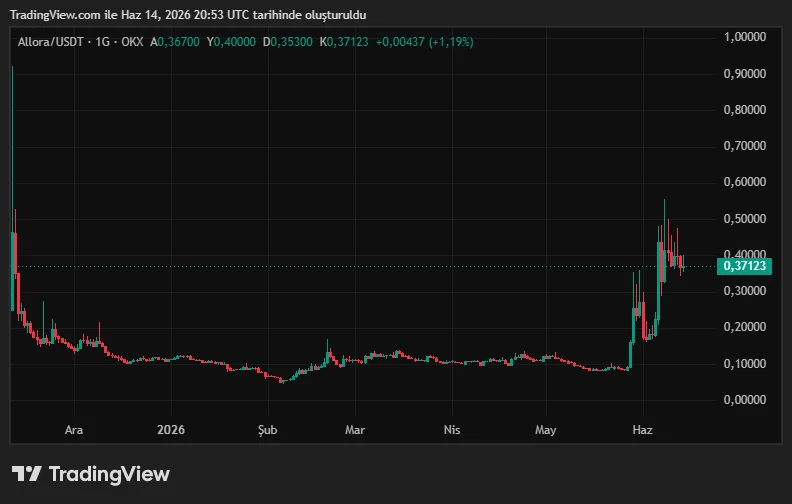
As of June 2026, the ALLO coin price is trading at around $0.37. The token remains below its all-time high of around $1.60, which it reached on November 11, 2025.
Why Is Allora Important?
Allora’s importance comes from the fact that it offers an alternative to the centralized structure in artificial intelligence. Today, most powerful AI models operate inside closed systems. Although these systems provide high performance, they can remain limited in terms of transparency, access and participation. Allora approaches this problem with an open and economically incentivized network model.
The project’s most striking aspect is its claim to reduce single-model risk. An AI model may perform well in a specific task, but it may not show the same performance under different conditions. Allora tries to run multiple models within the same network and produce a stronger collective result from their outputs. The network measures the performance of models and aims to reach better results over time.
This structure is especially important for DeFi. In crypto markets, price, volatility, liquidity and risk conditions change very quickly. A protocol or investment strategy needs not only historical data, but also context-aware predictions to make accurate decisions. Allora is trying to build an infrastructure that can provide these kinds of signals to DeFi applications.
Another important aspect of Allora is related to AI agents. AI agents are systems that can execute transactions, make decisions and carry out various tasks automatically. These agents need reliable data inference to make healthier decisions. Allora aims to provide a usable intelligence layer for agents in this field.
The project also creates a new economic field for model developers. In Allora, models that perform well can be rewarded. Reputers evaluate the quality of model outputs. Validators secure the network. Users pay for the inferences they need. As a result, the production, consumption and evaluation of artificial intelligence come together within the same economic cycle.
How Does Allora Work?
Allora’s operating structure is built on the “topic” system. A topic refers to a specific prediction or inference task on the network. For example, one topic may focus on predicting the price movement of a certain asset. Another topic may be dedicated to a different task such as volatility measurement or market sentiment.
Each topic works with its own rules and performance metrics. This allows the network to coordinate different groups of models for different tasks instead of producing a single type of AI output. Allora’s flexibility comes from this structure. The network can create intelligence markets optimized separately for many different use cases.
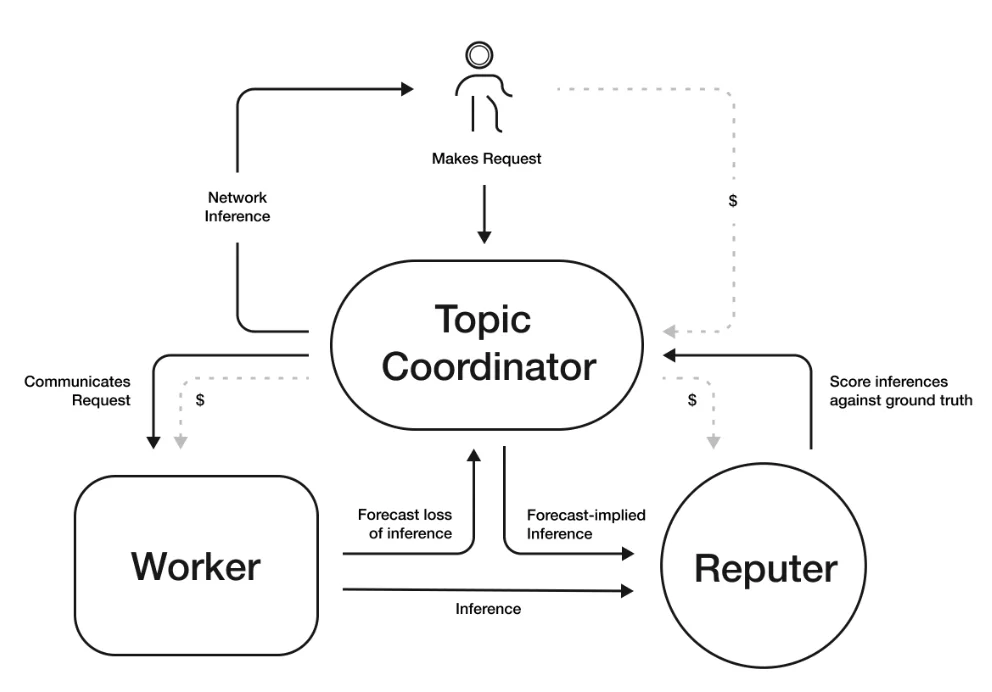
Workers are the participants that produce inferences in the Allora network. These participants run AI or ML models and submit predictions to the network. A worker may produce an inference directly related to the target topic or provide supporting signals about the performance of other models. Workers’ rewards are determined according to the quality of the inferences they provide.
Reputers are the participants that evaluate the quality of inferences in the network. This role is critical for Allora’s self-improving structure. Reputers compare the results produced by workers with real data whenever possible and measure which inferences contribute more to the network-wide result. This evaluation system helps rewards to be distributed more fairly and model quality to improve over time.
Validators are the participants that secure the Allora appchain. The network operates with a delegated proof-of-stake structure. Validators run the chain, contribute to consensus and protect the network’s core infrastructure. Users can also contribute to network security by delegating their ALLO tokens to validators or reputers.
Consumers are users, developers or applications that request inferences from the network. A DeFi protocol can use Allora to obtain price predictions. An AI agent can pull signals from the network before executing a transaction. A developer can add a context-aware prediction layer to an application. These inferences are paid for with ALLO.
Allora’s technical value proposition is that these different participant roles work within the same economic system. A worker produces inference, a reputer evaluates quality, a validator secures the network and a consumer uses this intelligence. The ALLO token is the payment and incentive tool of this flow.
What Is the ALLO Token?
ALLO is the native token of Allora Network. The token is designed to enable value exchange within the network. Users can buy inferences with ALLO, create topics, participate in network tasks, stake and earn rewards.
The first main function of ALLO is inference payments. Users who want to receive AI predictions or data inferences from Allora pay ALLO in return. This structure turns AI into a service that can be priced on the network.
The second function is topic creation and participation. Creating a topic for a specific task on the network or joining existing topics as a worker or reputer is an economic process. ALLO works as the shared value unit of these processes.
The third important function is staking. Users can delegate their ALLO tokens to validators or reputers. More technical users can also run their own validator or reputer structures. Staking supports the security and economic integrity of the network.
ALLO is also used in reward distribution. Workers, reputers and validators earn ALLO according to their contributions to the network. This model tries to encourage not only joining the network, but also providing high-quality contributions. Rewards are distributed according to the measurable impact of participants.
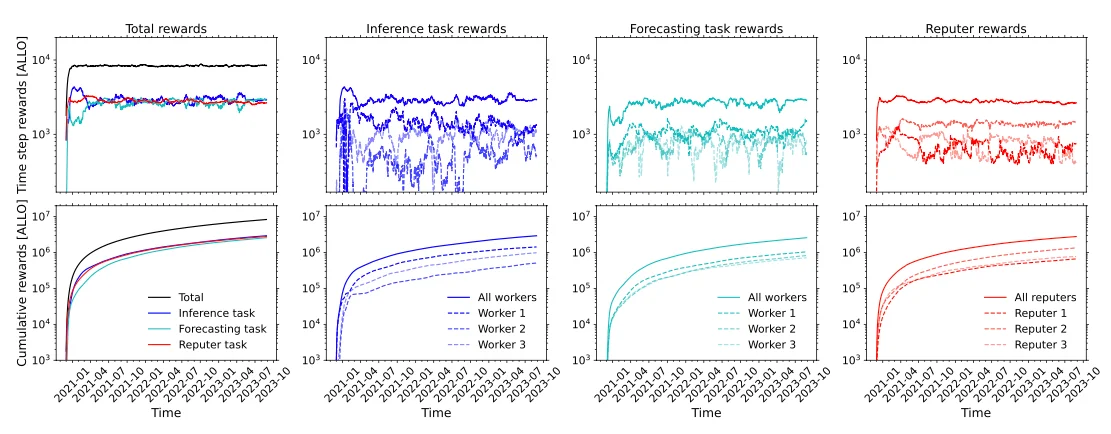
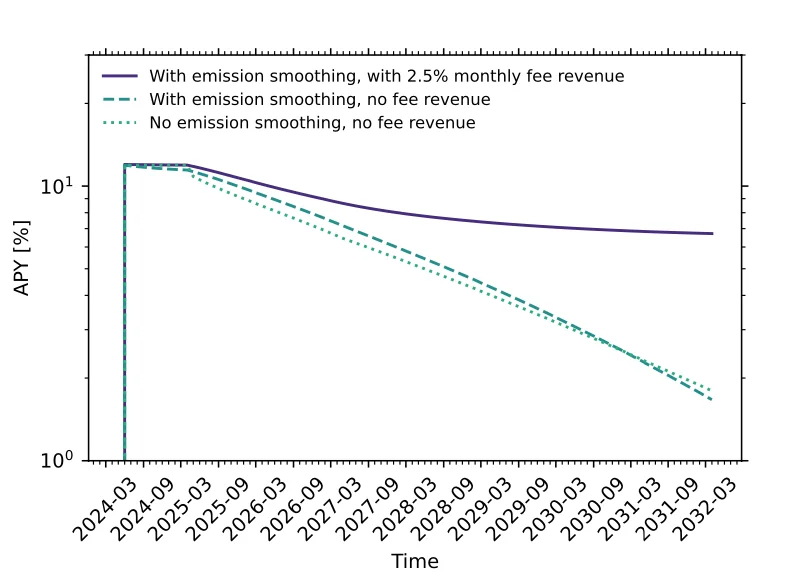
On the tokenomics side, the maximum supply is limited to 1 billion ALLO. The initial circulating supply was announced as 20.05 percent. The emission model aims to build a decreasing and more sustainable reward structure over time. As network usage increases, inference fees are expected to contribute more to the reward cycle. The emission model can also be seen in the chart below:
Allora’s Use Cases
One of Allora’s strongest use cases is DeFi. DeFi protocols need more accurate market signals. Price predictions, volatility forecasts, liquidity strategies and risk analysis are critical areas for decentralized finance. Allora aims to provide AI-powered prediction infrastructure for these areas.
Another important area is AI agents. AI agents are systems that perform certain tasks automatically. For these agents to work better, they need accurate data, up-to-date signals and context-aware inference. Allora is positioned as one of the infrastructures that can provide this decision support layer to agents.
Prediction markets are also a suitable use case for Allora. In prediction markets, users take positions on future events or price movements. For these markets to function properly, strong data and prediction systems are needed. Allora’s model coordination structure can be used to produce more dynamic signals in such markets.
On-chain data analysis is also among the areas targeted by the project. Blockchain data is large, fragmented and fast-changing. Allora can allow models that process this data to contribute within the network and enable applications to use these inferences.
There are also potential scenarios on the institutional use side. Financial institutions, data providers, risk management systems and automated decision mechanisms can benefit from inference networks like Allora. However, the growth of this field depends on the project’s real usage volume and developer adoption.
Allora’s Developers and Community
Allora Labs and Allora Foundation stand out in the development of Allora. Allora Labs is one of the core contributors to the network. Allora Foundation plays a role in the ecosystem, tokenomics, community programs and the broader development of the network.
One of the most visible names behind the project is Nick Emmons. Emmons appears in different official announcements as the founder and co-founder/CEO of Allora Labs. Allora’s early introductory articles and the vision of a model coordination network were also shaped through Emmons’ narrative.
Allora Labs’ total funding reached $35 million in 2024. The project’s investors included well-known names in the crypto sector such as Polychain, Framework Ventures, CoinFund, Blockchain Capital, Archetype, Slow Ventures, Mechanism Capital and Delphi Digital. This investor interest showed that Allora was one of the projects taken seriously in the decentralized AI field.
On the community side, testnet, the points program, airdrop, staking and developer tools played important roles. Allora is trying to attract not only end users, but also data scientists, machine learning developers, node operators, DeFi teams and AI agent developers to its network.
Frequently Asked Questions (FAQ)
Below, you can find some frequently asked questions and answers about Allora (ALLO):
- What is Allora, and when was it launched?: Allora is a decentralized AI network that aims to coordinate many machine learning models within the same network to produce stronger AI inferences. The project was introduced more broadly in 2024, while the mainnet and ALLO token launch took place on November 11, 2025.
- Who developed Allora?: Allora Labs and Allora Foundation stand out in the development of Allora. The most visible name on the founding side of the project is Nick Emmons.
- What does the ALLO token do?: ALLO is used for inference payments, topic creation, in-network participation, staking, reward distribution and governance. The token is at the center of Allora Network’s economic structure.
- What problems does Allora aim to solve?: Allora aims to reduce the access, transparency and single-model dependency problems in centralized AI systems. The project tries to coordinate different models to produce stronger and more context-aware inferences.
- Why is Allora important in the decentralized AI field?: Allora aims to coordinate AI models inside an open network with economic incentives. This approach can help move AI out of closed services and turn it into a usable infrastructure layer for Web3 applications.
- Which network does Allora run on?: Allora has its own appchain structure. In addition, the ALLO token has also been made accessible on networks such as Ethereum, Base and BNB Chain. The project has built a structure that supports multichain access.
- Can ALLO be used for staking?: Yes. ALLO holders can run a validator or reputer, or they can delegate their tokens to active validators and reputers. Staking has an important function in terms of network security and the reward mechanism.
- Is Allora suitable for investment?: There is no definitive answer to this question. Allora has a strong narrative in the decentralized AI field and notable partnerships. However, the ALLO price is affected by many factors such as market conditions, token supply, unlocks and real network usage. For this reason, current data and risks should be evaluated together before making an investment decision.
Follow the JR Kripto Guide series for the latest insights on Allora and decentralized AI projects.