
The U.S. nonfarm payrolls report came in well below market expectations in July, paving the way for a short-term relief bounce in Bitcoin. According to the data, released one day earlier due to the July 4 holiday, the U.S. economy added only 57,000 jobs in June. Markets had expected an increase of 114,000, while the previous month’s figure stood at 172,000. The unemployment rate was also recorded at 4.2%, instead of the expected 4.3%.
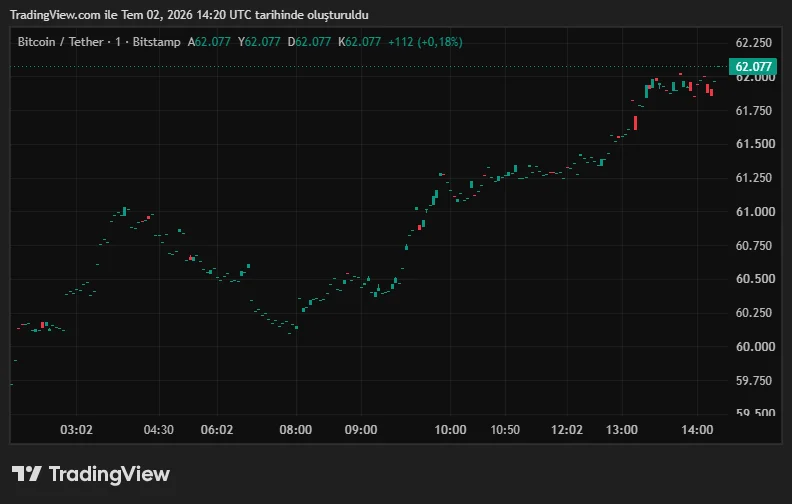
Bitcoin was trading around $61,700 when the data was released. According to TradingView data, the cryptocurrency briefly moved higher after the announcement and approached the $62,000 mark, before fluctuating within that range for the rest of the day. The limited price reaction suggests that the market interpreted the weak employment data as a development that could increase the likelihood of a Fed rate cut, but did not price it in with aggressive buying.
Kyle Rodda of Capital.com described the nonfarm payrolls report as the most critical data release of the week. According to Rodda, markets had lowered the probability of a rate hike this month from 33% at the beginning of the week to 28%; weak employment figures could reinforce this expectation. It is also worth noting that the Fed kept interest rates unchanged in June for the fourth consecutive time, while rate cut expectations were pushed back to 2027 due to the hawkish stance of new Chair Kevin Warsh.
Bitcoin spent most of the week under pressure
Before the employment data, Bitcoin had already been through a difficult week. The cryptocurrency fell to a 21-month low during the week, dropping to $57,800. According to Bitfinex analysts, this marked the fourth time in the cycle that a decline in bond yields and a drop in Bitcoin’s price occurred at the same time; Bitcoin continued to pull back even as the S&P 500 closed the quarter at a record high.
Two main groups are behind the selling pressure. Spot Bitcoin exchange-traded funds recorded $4.5 billion in net outflows in June, marking their worst month since their launch in January 2024. BlackRock’s IBIT alone accounted for $3.55 billion in outflows. In addition, Strategy’s board approved the sale of up to $1.25 billion worth of Bitcoin on June 29 to build dollar reserves and meet liabilities. The company’s stock is now trading roughly 30% below the value of the Bitcoin it holds.
Despite this, Glassnode analyst Chris Beamish noted that long-term investors have started accumulating again. According to Beamish, buying appetite is spreading across a wide range of participants, from small wallets to entities holding between 100 and 1,000 BTC. However, for the first time during this downturn, the amount of Bitcoin held at a loss has exceeded the amount held in profit; approximately 10.83 million BTC is currently being held below its cost basis.
A similar picture is emerging on the Ethereum side
Ethereum, meanwhile, recovered from its low near $1,500 and climbed into the $1,600-$1,620 range. Simon-Peter Massabni of XS.com described this move not as a confirmed reversal, but as buying from a technical bottom. Spot ETH funds have seen net outflows for seven consecutive weeks, with total outflows reaching $1.18 billion during this period.
In the coming days, the market’s main focus will be how much the weak employment data influences the Fed’s rate decision. For now, whether Bitcoin can break above the $62,000 resistance level on a sustained basis appears to depend on both macro data and the direction of ETF flows.