
Bitcoin’s decline in the second quarter weighed heavily on two of the crypto industry’s biggest names. Strategy (MSTR), the world’s largest corporate Bitcoin holder, reported a net loss of $8.2 billion on Thursday, while crypto exchange giant Coinbase (COIN) missed revenue expectations across almost every major business segment.
Strategy’s loss came from Bitcoin’s carrying value
According to Strategy’s filing with the U.S. Securities and Exchange Commission, most of the loss did not involve a cash outflow. The company recorded an $8.32 billion fair-value loss on its Bitcoin holdings.
As of July 26, Strategy held 843,775 Bitcoin, up 25% since the beginning of the year. At current prices, the holdings are worth around $54.8 billion, compared with the company’s total acquisition cost of $63.7 billion. That leaves Strategy with a substantial unrealized loss.
The company raised $17.06 billion through share sales this year. It also repurchased $1.5 billion of its convertible debt at an 8% discount and increased its U.S. dollar reserve to $3.75 billion.

Chief Financial Officer Andrew Kang said the reserve could cover preferred-stock dividends and interest obligations for more than 2.1 years.
More notably, Strategy sold approximately $218.4 million worth of Bitcoin under its new BTC Monetization Program. The company has long been known for its “buy, hold and never sell” approach, making the transaction a small but meaningful departure from that strategy.
Executive Chairman Michael Saylor said the company remained focused on its new “Digital Credit” business despite Bitcoin’s price weakness. Strategy has also announced a $1 billion share repurchase program for MSTR stock, although it has yet to use it.
The company purchased approximately $25 million worth of STRC preferred shares below their nominal value. Management said it would continue buying the shares as long as they remained below that level.
Coinbase delivers a more straightforward miss
Coinbase shares fell approximately 5% in after-hours trading. Revenue came in at $1.22 billion, below analysts’ expectations of $1.29 billion.
Transaction revenue declined to $599 million, while subscription and services revenue fell to $555 million. Both figures missed market estimates.
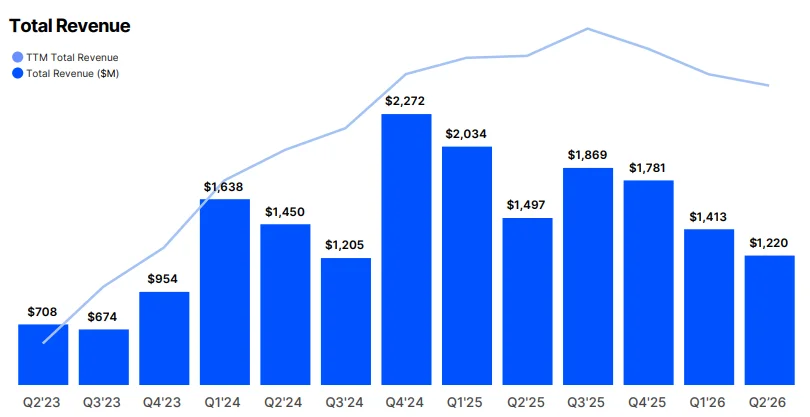
The reason was relatively simple. Bitcoin lost 14% during the quarter, while Ethereum declined 25%, dragging trading volumes lower.
Coinbase was not the only platform affected by weaker market activity. Robinhood, which reported its results on Wednesday, said crypto revenue fell 38% year over year, dropping from $160 million to $100 million.
In a post on X, CEO Brian Armstrong highlighted the company’s businesses beyond transaction fees, including stablecoins, Base and prediction markets. He also said Coinbase captured a record 10.3% share of global crypto trading volume.
Chief Financial Officer Alesia Haas offered a more measured assessment. Industry-wide spot trading volumes fell by more than 20%, while the total cryptocurrency market capitalization declined by a double-digit percentage. These conditions pushed Coinbase’s total revenue down 14% from the previous quarter.
Coinbase added 819 Bitcoin to its balance sheet during the quarter, increasing its total holdings by 5% to 17,211 BTC. However, the company’s main challenge remains reducing its dependence on transaction fees.
Subscription and services revenue includes interest income from USDC, staking, custody services, Coinbase One memberships and institutional products. Its performance provides one of the clearest indications of how successfully Coinbase can insulate itself from market volatility.
Analysts will continue watching developments in derivatives, prediction markets and Base, Coinbase’s Ethereum layer-2 network. The company is scheduled to meet with investors later in the day.