
Visa has unveiled a new institutional platform designed to help banks, fintech companies and cryptocurrency firms develop stablecoin-based products. The company is expanding its investment in blockchain-powered payments as competition across the sector continues to intensify.
Visa introduces VSP
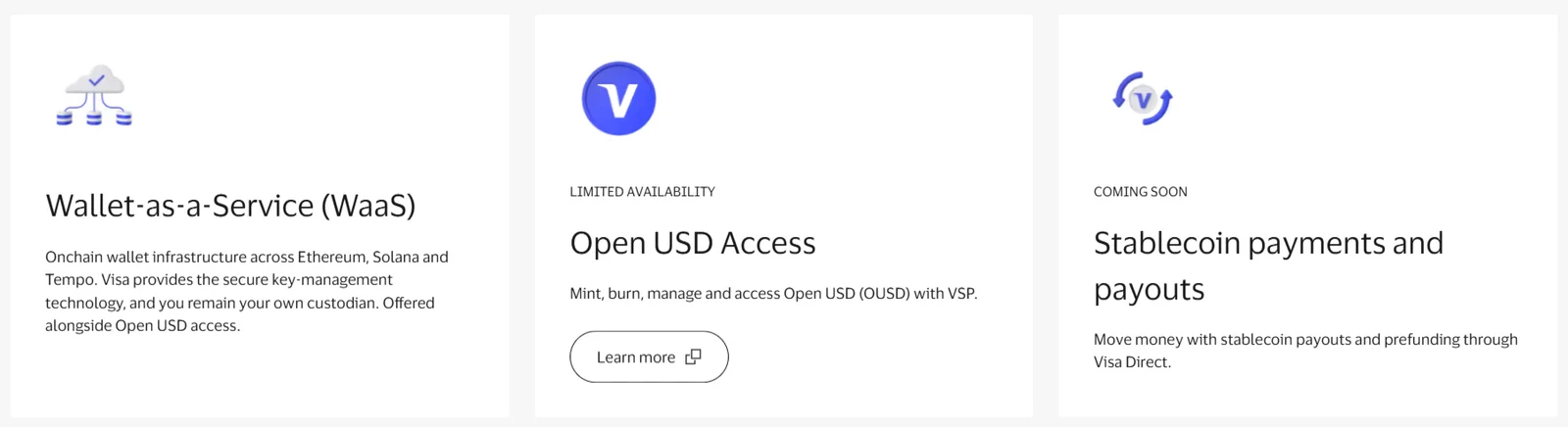
Visa announced the Visa Stablecoin Platform, or VSP, on Thursday. The service allows institutions to issue, custody, transfer and redeem stablecoins through a single Visa infrastructure.
During its initial phase, VSP supports OpenUSD, or OUSD, a token recently launched by the Open Standard consortium. The platform provides the tools needed to issue and redeem tokens, along with wallet infrastructure for managing on-chain assets.
Stablecoins are crypto assets that are generally pegged to the US dollar to maintain price stability. Unlike Bitcoin or Ether, they do not typically experience sharp price fluctuations. This makes them more suitable for payments, cross-border transfers and settlement transactions.
Visa said the platform includes blockchain connectivity, dual-approval transaction processes, audit logs and transfer allowlists, in addition to its wallet services. VSP also integrates with Visa’s existing payment network.
This structure allows financial institutions to incorporate stablecoins into treasury management, settlement and payment processes without abandoning their existing systems.
Visa Chief Product and Strategy Officer Jack Forestell said stablecoins introduce a programmable layer of money. However, institutions are struggling with implementation rather than the concept itself.
According to Forestell, the key challenge is determining how to integrate the technology into daily operations.
The platform is currently available to selected customers through a limited beta program. Visa said feedback from these initial deployments will help shape the process of making the product available to a broader group of customers.
Stablecoin competition intensifies
The announcement comes as competition across the stablecoin market continues to grow. Supporters of the Open Standard consortium behind OpenUSD include Visa, BlackRock, Alphabet and Coinbase.
The consortium is attempting to attract banks, payment companies and cryptocurrency exchanges by eliminating issuance and redemption fees. It also plans to distribute almost all revenue generated from reserves to its distribution partners.
Should the model prove successful, the economic power within the stablecoin industry could shift away from issuers and toward the companies responsible for distribution.
The pressure from this competition is already becoming visible. Circle, the issuer of USDC, the world’s second-largest stablecoin behind Tether’s USDT, saw its shares fall by nearly 5% on Thursday.
Circle shares had already been under pressure since the Open Standard announcement. Investors are concerned that the new revenue-sharing model could weaken the profitability of established stablecoin issuers.