The U.S. Senate approved the 21st Century ROAD to Housing Act, a sweeping housing bill, on Monday by a vote of 85-5. The bill aims to increase housing supply across the country and limit the dominance of institutional investors in the market. However, the part that drew the most attention from the crypto community was another provision embedded in the legislation: a ban on central bank digital currencies, or CBDCs.
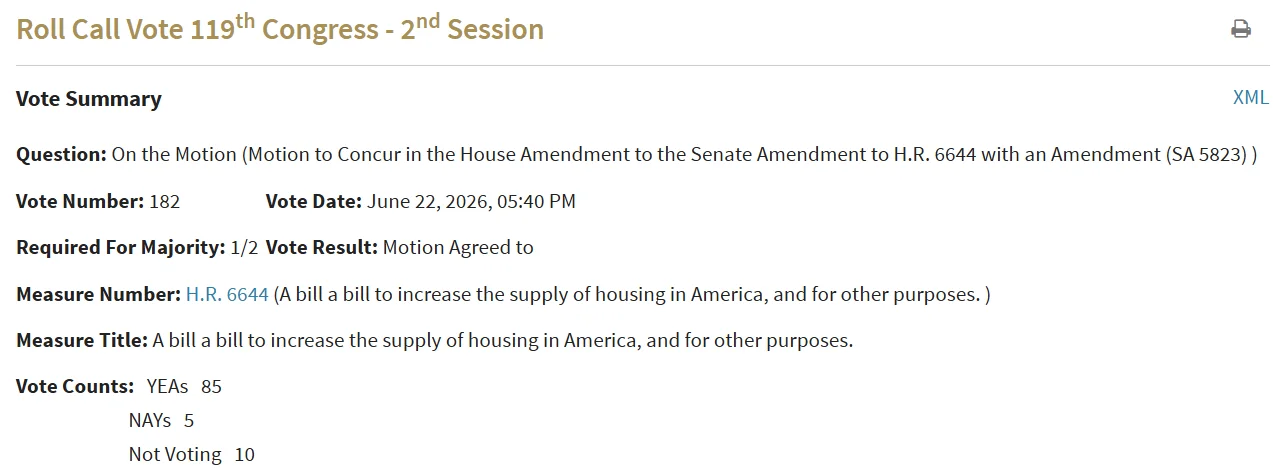
According to voting records on the Senate’s official website, bill H.R. 6644 passed with 85 votes in favor and only 5 against. This shows how broad the support for the legislation was. Given that housing costs have remained near the top of the political agenda in the U.S. for years, that is not particularly surprising.
Background of the bill
Last week, key senators and representatives jointly released an updated version of the bill, signaling that the two chambers had reached an agreed text. House Financial Services Committee Chair French Hill said after Monday’s vote that housing supply lies at the heart of the problem and that the bill delivers real progress on that front.
The bill is now waiting for a vote in the House of Representatives. If it passes the House, it will be sent to the president for approval. Politico reported last week that Republican House leadership planned to bring the bill to an expedited vote on June 23, when the House returned from recess.
Details of the CBDC ban
The 21st Century ROAD to Housing Act includes a provision that would ban the Federal Reserve from issuing a CBDC, or any digital asset “substantially similar” to a CBDC, until December 31, 2030. Adding an anti-CBDC provision to a housing bill is not a typical move, but it highlights a common tactic in Washington: attaching a controversial or standalone policy to a larger piece of legislation that is highly likely to pass. According to earlier reporting by journalist Eleanor Terrett, Republican representatives were the ones pushing for the provision to be included in the bill.
The Trump administration has taken a clear stance on CBDCs from the beginning. Treasury Secretary Scott Bessent reiterated last month that CBDCs were definitely “not on the table,” emphasizing that the administration’s main priority was finalizing the Clarity Act, which focuses on digital assets.
What does it mean for the crypto market?
The fact that the ban excludes stablecoins is a critical detail for the industry. The text of the provision defines “open, permissionless and private” dollar-denominated assets as exceptions to the ban. This means that instead of a government-backed digital dollar, the path would remain open for stablecoins issued by the private sector. The ban is set to expire in 2030, and after that point, the Fed would still need congressional approval to move forward with a CBDC.
If the bill becomes law, the U.S. will join the small group of countries that legally restrict their central bank from issuing a digital currency. This would place the U.S. in a distinct position in the global CBDC debate, separating it from other major economies at a time when many countries around the world are still researching, piloting or developing CBDC projects.