
Bitcoin is heading into Friday’s $10.5 billion quarterly options expiry under pressure, with market attention now focused on Deribit’s positioning data.
Deribit, the world’s largest crypto options exchange, shows its Bitcoin volatility index, DVOL, at 41.5%. The index measures Bitcoin’s 30-day annualized implied volatility. That is far below the 90% peak recorded in February, but slightly above the lows seen in May.
Jean-David Péquignot, Deribit’s head of commercial operations, said volatility is cheap compared with its own history, though it can no longer be described as “low-priced.”
Cheap volatility means investors expect more limited Bitcoin price movements compared with the past year. It also makes options contracts used for hedging against price swings less expensive. Since volatility tends to revert to its mean, investors often turn to options when they believe volatility has become cheap relative to historical levels.
According to Péquignot, implied volatility on call options is noticeably cheaper than on put options, making bullish call spread strategies more attractive. He said call spreads still look favorable for those positioning for a recovery after the quarterly reset, and they now look better from a volatility perspective as well. That is because call spread buyers are purchasing the cheaper side of the volatility curve, which is currently skewed in the opposite direction.
Several factors could push volatility higher in the near term. The most important one is Friday’s options expiry, which Péquignot described as “one of the most important liquidity events in the annual calendar.”
Put option buyers from recent months are currently in profit, while call buyers are seeing their positions move toward expiration without value. Péquignot said that with Bitcoin’s spot price around $64,000, the June 26 expiry book is clearly leaning toward profitable put positions and worthless call positions. Call buyers who chased strikes above $80,000 are now sitting on embedded losses.
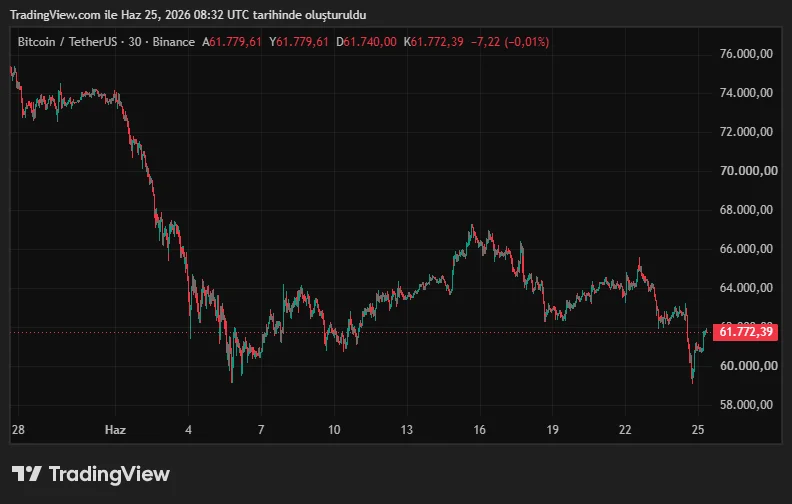
Another topic of debate ahead of the expiry is the “maximum pain” theory. According to this theory, options sellers tend to push the spot price toward the level where options buyers suffer the largest losses, causing as many contracts as possible to expire worthless. For this expiry, that level is calculated at $72,000, well above Bitcoin’s current price. The theory gained popularity during several expiries in 2020 and 2021, when the price appeared to move closer to those levels, but a similar “pinning” effect has not been clearly observed recently.
Focus Turns to PCE
Signals from outside the Bitcoin market are also being watched closely. Sharp declines in Alphabet (GOOG) and SpaceX (SPCX) shares, combined with weakness in Asian equity markets, could add further pressure on Bitcoin. The cryptocurrency’s tendency to move in line with technology stocks is already a familiar market pattern.
The core PCE index, the Federal Reserve’s preferred inflation gauge, is also on the agenda for Thursday. The data is expected to show the strongest price pressure since May 2024. Such a result could trigger volatility across a wide range of assets, from Treasury bonds to cryptocurrencies.