
Crypto exchanges entered the SpaceX IPO prepared, but by the end of the day, they had no shares left to offer. Hyperliquid, meanwhile, recorded $1.4 billion in trading volume without holding any shares at all.
Three Major Exchanges Went Down at the Same Time
Bybit, Binance and Bitget had prepared for one of the highest-valued IPOs in history through tokenized stock products ahead of SpaceX’s public listing. All three used the xStocks system built on Kraken’s infrastructure, a model where real shares are converted into blockchain-based tokens.
On IPO day, xStocks failed to receive any share allocation, causing all three platforms to break down at the same time. Customer subscriptions were canceled and refunds began. The structural weakness of the tokenized stock model appeared right at peak demand: any product backed by real shares becomes unusable the moment those shares cannot be sourced.
preStocks users had a different, but similarly jarring, experience. The platform had sold pre-IPO access to SpaceX shares, but buyers only realized after trading began that a 180-day lock-up period applied. The stock gained 19% that day.
Hyperliquid’s SPCX perpetual futures contract is based on a different model. As a synthetic instrument, it does not hold real shares; instead, it is linked to the market price through funding rates. It does not require share allocation, and no lock-up period can be applied.
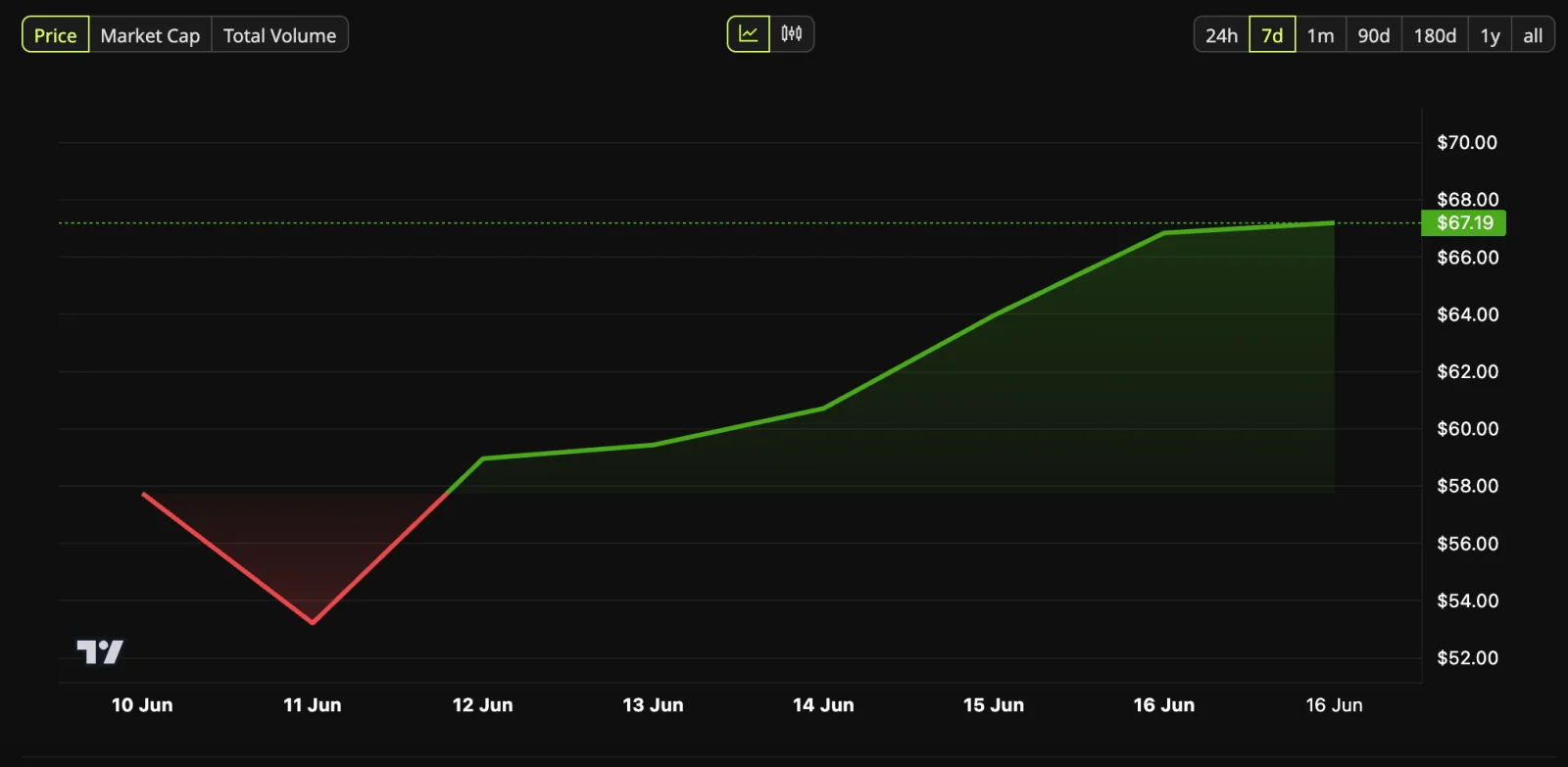
On IPO day, SPCX perpetual futures generated $1.4 billion in trading volume on Hyperliquid. That figure accounted for 30% of all HIP-3 ecosystem trading that day. The platform’s native token, HYPE, also gained around 10% on the day.
In the first half of June, HIP-3 markets linked to equities recorded a total trading volume of $18.8 billion. Over the same period, WTI and Brent crude oil perpetual futures remained at $7.66 billion combined. The product mix, previously more commodity-heavy, shifted toward equities during this period; behind that move were the late-May and early-June correction in U.S. stocks and rising volatility.
$1.4 Billion in Trading Volume
On SpaceX’s first trading day on Nasdaq, around 500 million shares changed hands. At an average price of $161, this corresponds to roughly $80 billion in equity trading volume. Hyperliquid’s $1.4 billion represented 1.7% of that total.
For a single decentralized product, that is not a negligible figure; but it also does not support a claim of direct competition with traditional stock markets. ICE CEO Jeffrey Sprecher’s description of Hyperliquid this year as “bigger than Nasdaq” greatly exaggerates the reality.
The main signal here is structural resilience rather than performance. While tokenized stock products became unusable on IPO day, synthetic perpetual futures that did not need to hold any shares continued operating without interruption.