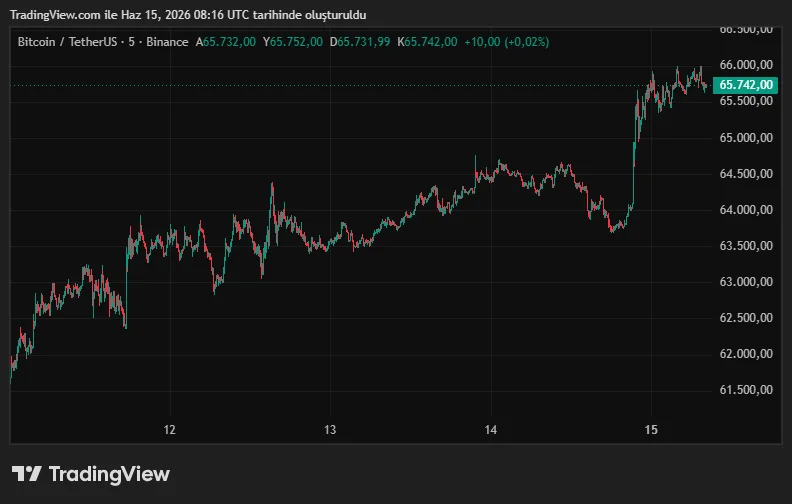
Bitcoin climbed above $65,000 late Sunday. As the geopolitical risk premium that markets had been pricing in for months suddenly unwound, a broad wave of buying also spread across crypto assets.
At the time of writing, Bitcoin was trading at $65,605, up 1.90% over the past 24 hours. Its intraday low was $63,663, while its high stood at $65,935. Ethereum rose 2.8% to $1,720, XRP gained 3.5% to $1.19, and Solana advanced 4.2% to $71.11. The surprise performer of the day was Hyperliquid’s HYPE token, which climbed 7.5% to around $65.
Peace deal and the Strait of Hormuz
CNN reported Sunday that the United States and Iran had reached a ceasefire agreement set to take effect on Friday. President Donald Trump said the U.S. would lift its naval blockade and reopen the Strait of Hormuz as soon as the agreement was signed. The first announcement came from Pakistani Prime Minister Shehbaz Sharif, and Trump and Iranian state media confirmed it shortly afterward.
The Strait of Hormuz is a narrow waterway through which roughly one-fifth of global oil trade passes. The possibility of its closure had been one of the main factors keeping oil prices elevated in recent months. As that risk faded, crude oil prices saw one of their sharpest daily declines in three months. WTI futures fell 4.84% to $80.77 per barrel, while Brent crude dropped 4.33% to trade at $83.53.
Analysts: Crypto move was macro-driven
Zeus Research analyst Dominick John said markets were repricing risk after the U.S.-Iran agreement and the reopening of the Strait of Hormuz, triggering a broad risk appetite move. John described the rally as a positioning and risk rotation move rather than a change in underlying fundamentals.
Min Jung of Presto Research painted a similar picture. She said Bitcoin and Ether benefited from improving risk appetite as the peace deal reduced concerns over further geopolitical escalation.
Rick Maeda, markets director at crypto derivatives analytics platform Laevitas, described the move as “not a crypto-specific story, but macro relief beta amplified by thin weekend liquidity.” According to Maeda, the selling pressure began to ease after Trump’s remarks on the U.S.-Iran framework, which removed the risk premium from crude oil and lifted pressure from crypto.
CoinEx chief analyst Jeff Ko offered the same framework: “The recovery in crypto was largely driven by a compression in the macro risk premium triggered by Trump’s latest signal that a deal was close. It pulled oil lower while lifting Asian markets at the same time.”
Asian markets turned green
With geopolitical risk receding, equities also started the day on strong footing. The Nikkei 225 was up about 4.89% around midday, nearing a record close. The Kospi jumped 5.63%. The Hang Seng rose 0.45%, while the Shenzhen Composite Index was up 2.53%. S&P 500 futures gained 1.2%, while the dollar weakened against major currencies.
Fed week and institutional flows
Another source of uncertainty is on the agenda this week: the Federal Reserve will hold its first meeting under new Chair Kevin Warsh. BTSE COO Jeff Mei said Warsh’s remarks would offer “the first clues about how interest rate policy will take shape for the rest of the year.” Maeda listed the key factors to watch as confirmation of the deal and the terms around Hormuz, the risk of renewed escalation, and the direction of oil prices. He added that all of this coincides with a busy central bank week.
The peace deal removed an important source of pressure, but it did not answer every question. Strategy’s disclosure earlier this month that it sold 32 Bitcoin to make a preferred stock dividend payment exposed the presence of demand built around the assumption that Saylor would never sell. ETF outflows are also keeping pressure on the market; neither the Strategy issue nor the institutional demand dynamic is the kind of problem that can be solved by a peace agreement. Whether institutional flows return alongside this wave of risk appetite will become clearer in the coming days.