
A significant shift in Japan's regulatory approach to cryptocurrency markets is underway. The country's financial regulator, the Japan Financial Services Agency (FSA), is considering adding cryptocurrencies to the list of eligible assets for spot exchange-traded funds (ETFs). According to Nikkei Asia, Japan could approve its first spot crypto ETFs by 2028. Such a move would effectively end the FSA's current ban on spot crypto ETFs. This timeline is seen as a further postponement of expectations for the launch of crypto ETFs in Japan. Indeed, a KPMG Japan executive argued in August 2025 that approval of Bitcoin ETFs would be difficult before 2027. Recent developments indicate that the regulatory process is proceeding cautiously but steadily. On the other hand, the picture regarding investor demand is quite clear. Nomura Holdings executive Hajime Ikeda, referring to a previously shared survey, stated that more than 60% of Japanese investors want to invest in crypto assets “in some way.” This data shows that the regulator's ETF move is not only aimed at aligning with global trends but also responds to domestic market demand.
Nomura and SBI are ready for Japan's first crypto ETFs
According to Nikkei, Nomura Holdings and financial giant SBI Holdings have developed Japan's first crypto ETF products and are awaiting approval. These ETFs are planned to be listed on the Tokyo Stock Exchange. If approved, investors will be able to access crypto assets through a structure similar to stock or gold ETFs. SBI Holdings confirmed last year that it planned to launch XRP-based ETFs if it received regulatory approval. In a presentation published in August, the company announced that it was working on two separate products. The first of these is the "Gold and Crypto Assets ETF," which allocates 49% of its assets to Bitcoin, while the second is designed as an ETF offering exposure to both Bitcoin and XRP. This structure suggests that crypto products in Japan may not be limited to Bitcoin alone.
Examples from the US and Asia are leading the way for Japan
Globally, while Japan's step is delayed, it is not alone. The US and Hong Kong approved their first spot crypto ETFs in 2024. In the US, spot Bitcoin ETFs quickly gained significant interest, reaching approximately $115.8 billion in net assets and a size equivalent to 6.5% of Bitcoin's total market capitalization. Thanks to these products, institutional investors such as pension funds, family offices, and university foundations have been able to enter the crypto markets more easily. The largest ETFs in operation are as follows:
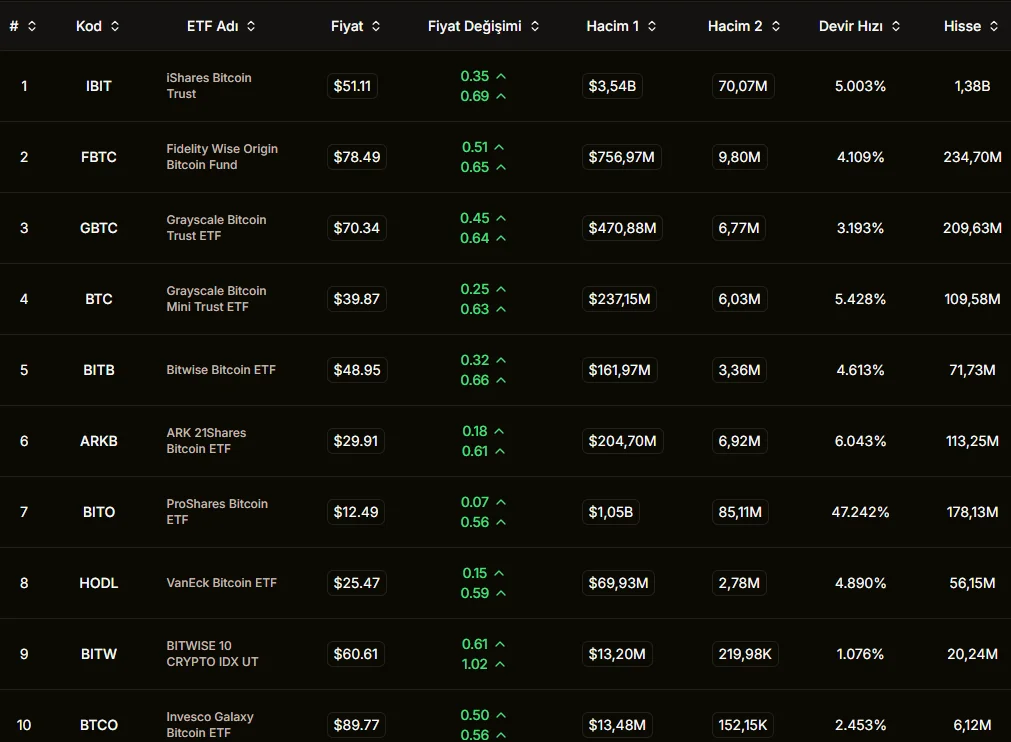
The ETFs in Hong Kong, however, differ from the US by offering in-kind creation and redemption options. Funds in the region have direct access to assets such as Bitcoin, Ether, and Solana. In South Korea, work is underway on a Digital Asset Basic Law, and this framework is expected to pave the way for spot crypto ETFs. Recently, Japanese Finance Minister Satsuki Katayama declared 2026 as the "digital year," expressing support for crypto transactions being conducted through exchanges. Katayama stated that in the West, crypto investment products are being adopted as a hedge against inflation through ETF structures, and similar approaches could be seen in Japan.